Tuesday, January 25, 2011
We’re growing up.

Thursday, January 6, 2011
With the simple act of using twigs to poke a rubber spider, New Caledonian crows may have become the first birds to join an exclusive cognitive class.
Friday, December 31, 2010
Asus Eee PC 1015. Notepad++, Dropbox, and iDrive.
- It survived. In very hard conditions. Jumping up and down in 4x4s. Dust; so much dust! And I used it very intensively: over the last seven months I maybe turned it off ten times maximum.
- It is powerful. Without problems it ran all my computer programs and simulations.
- It's cheap. I just bought this new one for less than 300 euro (the 2gb RAM is an extra 50).
- Its battery. One battery last for around ten hours. I also have a second battery. So longer periods without electricity are no problem.
- It's small and light. 10 inch and around 1kg. Great for when one travels a lot. And belief me, you get used to the small keyboard.
- Stata SE: An expensive, but an easy to use and powerful computer program for statistical analysis. Very necessary to analyse data, but also to build, clean and edit databases. Luckily I can get it via Columbia for free.
- MS Office: A necessary evil. Luckily, again for free via Columbia.
- Skype: I have to stay in contact with mom and dad, friends, and very important for work.
- R and packages: A completely free program that can do almost anything you want it to do: statistical analysis, building maps, solving equations, etc. All done in the R language - a language that I am still not very comfortable with after using the program for a year. However, a crucial, fantastic, and very powerful program. Download the program and packages here.
- ArcGIS: Way too expensive program for making maps. But used by everybody in the GIS world. Luckily, again for free via Columbia.
- TeXnicCenter, MikTex and packages: This is my default program for word processing. It's fantastic. You have to learn the language LaTeX but it's not difficult, and the software is for free, it is much faster than Word if many equations are used, the output documents look so much better, and you can do much more with this program than, for example, with MS Word. See here for a video on how to install.
- Pendragon: A computer program we use to create surveys so that they can be put on PDAs and used in the field.
- CutePDF: A free PDF converter. See here.
- Notepad++: For Stata and R I often write so-called do-files. These are documents with code that tell the program exactly what to do. I use Notepad++ to write these do-files. It's great. First, others have written free so-called 'language-packs' (here) so that different commands get different coloring. Secondly, from within the program it is possible to immediately run script (how to get this working look here). Also, this program is completely free and since yesterday I know they have an awesome shop.
- Dropbox: This is likely the most amazing program ever. If you don't have it get it (here)! In brief, Dropbox is a folder on your laptop and on the internet. It is great for two reasons. First, if you work together with others it is possible to share (part) of your Dropbox-folder. For example, in my Dropbox-folder I have a folder called "Congo" that I share with Macartan and Raul. If I change something in this folder it is automatically changed in the same folder on Macartan and Raul's computer. Fantastic! Secondly, Dropbox is great when you use different laptops or when you often have a new laptop. All my documents are in Dropbox (around 40gb). Just before leaving the Congo and giving my counterpart my old laptop I "unlinked" the Dropbox-folder and I deleted it. Yesterday I installed Dropbox on my new laptop and I linked it to my Dropbox-folder. It immediately started downloading my 40gb+ of files. It's great! You get 2gb for free and for a 100$ per year you get 50gb.
- iDrive: My program that back-ups files. Every 3am - automatically - iDrive makes a complete scan of my computer and back-ups all the documents that changed during the day before and saves this new version online. Thus, if I have a document X that I worked on for over 10 days I thus have 10 different versions of that document online. "I should never have deleted that chapter. Where is it?" will thus never happen. See here to download it (5gb for free and 100gb [500gb] for 5$ [15$] per month.)
Thursday, December 30, 2010
Back in the Netherlands.
- It is not necessary to copy&paste an email before sending it (being afraid that the internet breaks down while sending). Fantastic!
- While on the road: "Where are all the 4x4s?" , "There are no holes in the road?", "Where is the CODAN?", and "What!? People stay on their side of the road?".
- KLM does not mean "Kilo, Lima, Mike" and stop thinking like that.
- A working shower! Even better: with warm water! And I can keep my mouth open. Ha!
- When leaving the house I feel empty without a backup phone, GPS device, satellite phone, pocket knife, etc.
- Here when things are written on walls it is graffiti, not information about vaccinations that took place.
- More serious. There is so much abundance. I know that it is now the year's worst moment (Christmas and New Year), but still. Breakfast, then coffee with a slice of apple pie, then it's time for lunch, after that it tea with chocolate, etc.
- So many serious things are going on in the world. What are the Dutch people busy with? The yearly top-2000 best songs, what to wear during New Year, etc. The scariest thing, though, is that in a matter of days I'll be used to all of the above again.

Sunday, November 28, 2010
Training in Bukavu.
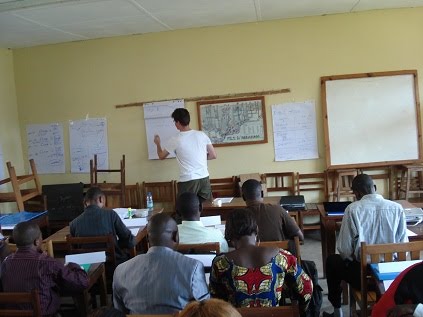
For two weeks Raul and me trained 30 people of which in the end 24 were selected. How to conduct focus groups and general assemblies. How to audit a development project. How to conduct a myriad of different surveys. How to take GPS locations and use a PDA. Etc. It was much fun. The students are intelligent and very participatory; by default 1/3rd of the room had their hands raised.
Monday, November 15, 2010
The Congo River.
I flew with a MONUSCO plane from Bukavu to Kindu: only about a two
hour flight. After about an hour the rainforest started. I thought I knew what
to expect. When I finally saw a big river running like a snake through
the forest, I felt... nothing. Dissappointing! Was this what I read about.
Was this the magical Congo River?! But we kept on flying. After thirty more
minutes a new river could be seen snaking through the rainforest far
away. As we neared the River I got a chill on my back: This was the Congo River!
So beautiful and so big. On the picture: A first glimpse of "La Fleuve".
There is a reason why the people call the River "La Fleuve". First, Kindu
is completely isolated; a city hidden in the rainforest. Everything is either
flown in from Bukavu, or (mainly) brought from Kinsangani via the River: a
5-day trip in a piroque to get from Kindu to Kisangani (back to Kindu
takes longer as it is against the River's current). Second, people wash their
food, themselves, their clothes, etc. in the River. People use it as a big toilet
and use it as drinking water. On the picture: Close to Kindu there are not
too many crocodilles and hippos so children play in the River.
On the picture: As soon as the River stops. The rainforest starts.
piroque. These are boats cut out from a tree (yes in
one piece) and can be as long as fifteen meter. They are
really impressive. On this picture: We often had to cross the
River with our motorbikes to reach a new village. Thus:
motorbikes in the piroque.
excess of 230 meter and the second largest river in the world by
volume of water discharged (yes, Wikipedia). It is a river you do
For one hour: strong winds, heavy rain and waves that made me think
I was in the Netherlands looking at the North Sea. One hour later
the sun was shining again as if nothing happened. So impressive!
Sunday, November 14, 2010
Back. 1/4
On the picture: walking for two hours to reach the
village. The views are gorgeous though.
large meeting with the villagers to inform them about Project RAPID. We
require that at least 25% of the villagers are present. On the picture:
One of the team members conducting a general assembly.
at arrival we ask whether there is a place where we
could sleep in the village. This is never a problem. On
this picture: In this village in Sud Kivu's territoire
Kalehe we were especially lucky. Not only was there
a hospital with beds (and no patients) where we could
sleep. In the evening the village offered us rice and a
living chicken. The chicken tasted great.
Back. 2/4
provincial supervisor for Sud Kivu on the motorbike.
The road you see is a really really good road. Most
roads - if existant at all - are not doable by 4x4s and
often also not by motorbikes. The teams often walk
hours to reach a village.
islands. On the picture: our transport to the village.
These boats are piroques: boats often cut out of a tree.
piroque.
- even after a long day of work in the field - more work. On the
picture: debriefing of a trip to a village in Sud Kivu's terroire Kalehe.
Back. 3/4
in a paroish with nuns (who make amazing liquor from fruit). Important
when using motorbikes is maintenance. On the picture: At 6am in the
morning, before leaving to the next village, the team cleaning and
verifying the motorbikes.
the picture: interview with randomly selected villager.
The teams, including me, sleep most of the time in the villages where we
work: most of the time in the house of the chief or in another house or
building in the village. On the picture: Beds are a rarity and most of the
times we sleep on the ground.
Congo is a beautiful country. Plagued by povery and conflict, but
gorgeous. On the picture: The view when waking up early in the
morning. Try to beat that!
Back. 4/4
evaluation there. In Sud Kivu, Haut Katanga and Tanganyika we work with
the IRC. In Maniema we work with CARE International. On the picture:
briefing the CARE staff about the evaluation and introducing the
evaluation team (not on the picture).
RAPID: conduct interviews, do general assemblies, focus groups, etc.
In the evening they verify the collected data and enter it into PDAs.
On the picture: In one of the village chef's house (where we all slept in
the evening on the ground) the team is filling out the PDAs.
strict. It is, for example, allowed for me to drive a
motorbike and thus I made many many kilometers. Such
a sense of freedom. On the picture: My Yamaha bike,
sun going down and the Congo river. Truly amazing!
Belgian period. The building ares thus decades old but have not been
maintained. People do live there. On the picture: "La Roche" a former
Belgian dancing club.
boat to Bukavu the next day) I also landed in Punia and Kasongo. On
the picture: the awesome aiport of Punia. In the middle of the rainforest.
Sunday, October 17, 2010
The evaluation has started.
The last two weeks were nuts regarding work. Therefore the absence of posts. Given the absence of internet and for large part phonecoverage in the days and weeks to come, don't expect many posts. If you want to get in contact:
- Phone with Zain-coverage: +243998399330
- Phone with Vodacom-coverage: +243810930927
- Satelite phone (always on from 8-820am and 6-620pm): +8821643340723
Saturday, October 2, 2010
All alone in Bukavu.
by working together and helping each other.
Tuesday, September 28, 2010
Motorbike training.
Tuesday, September 21, 2010
Wednesday, September 15, 2010
Training in Eastern Congo.
- We discussed the idea behind the evaluation, including the importance of randomization; both for selecting the 1,120 villages and for selecting the treatment and control villages of the program we're evaluating;
- How to conduct and take measures during general assemblies;
- How to conduct and take measures during focus groups;
- During step A and B a lot measures are taken along the way, so we had to go over all these different forms, which includes several different types of surveys (the chief, households, different types of general assembly participants, committee members, etc.);
- There were also practical things that had to be discussed: 1. When and how to go to which village (there is a schedule to follow); 2. language to be used in the field (we worked on the protocol and scripts for over a year); 3. how to take GPS coordinates (in each villages more than 10 coordinates will be taken); 4. How to randomly select households, people within household, and people from general assemblies; 5. how to use PDAs (all forms will have to be filled out on PDAs); 6. how to charge PDAs with solar panels; 7. how to upload data from PDAs to laptops; 8. how to drive a motorbike, etc.;
- All these things had to be practiced, so we created games, exercises and played a lot (a lot!) of simulations;
- And because only a sample would be selected from all the people present, we also created exams - as an extra measure - to get at people's quality level.
More on training
Training is so important. We have been working on this final part of the evaluation (step A-D) for over a year (the evaluation itself started in 2007); creating surveys, protocols, scripts, etc. When all combined this document is over 200 pages big. Needless to say, while we can discuss language for days, think carefully about which questions to ask, etc. if the people in the field do not understand things, we could just as well throw away those 200+ pages. This is quite a scary thought;
In total, professor Chimanuka - the implementing partner for Sud Kivu and Maniema - had brought 25 people to the training; this so that we could select the best 14. This was not an easy thing to do at all. Most of them were older than Raul and me, some were doctors, lawyers, etc. and above all many were unemployed but with a family and there were some that had left their job for this; all to get this job with one-year job security;
Raul had been sick-ish in the two weeks running up to the training. On Monday he got really sick and Professor Chimanuka - a specialist on malaria - tested him for malaria: he tested positive. Despite the fact that he looked and felt horrible last week, he kept on teaching - and very impressively;
We noticed that Congo seems to have a very different teaching-style than Raul and me are used to. Here students seem to listen and frantically try to copy whatever the professor says into their notebooks. We quickly got rid of that and moved to simulations, exercises and them teaching each other. People really seemd to enjoy this and, we hope, learned much more as a result.
- When do you know that people start applying what you taught them? Well, during lunch we walked around the room with a bunch of bananas for the people to take. One student replied: "I will choose my banana randomly." HA!
Then on Saturday evening it was over. After a very intense week it was finally time to relax and get to know each other socially. We first went to a local restaurant where we ate and drank until late in the evening. After that we visited "Parc au Prince" and danced until early in the morning. We not only have 14 very smart people, they are also a great group socially - something that is going to be important when in the field together for a year.