Friday, September 21, 2012

Thursday, September 20, 2012
Pro-social Behavior in the NYC Metro.
Yesterday,
around midnight. Raul, Neelan and me in the metro: back from University to our apartment in Brooklyn. While waiting for the train Neelan gets a smile on his face and says "I am very pro-social now". Raul and I look behind us, see what's in the picture below, and crack up.

Why? Neelan and I are writing a paper together that deals, among others, with the behavior of people when they are under scrutiny. On this topic there is a well-known paper by Kevin Haley and Daniel Fessler (published in 2005 in "Evolution and Human Behavior") that shows that even small hints of monitoring can make people more pro-social. They do so by placing a set of eyes on computer screens while people play lab experiments. The abstract:
Maybe a bit nerdy? :)

Why? Neelan and I are writing a paper together that deals, among others, with the behavior of people when they are under scrutiny. On this topic there is a well-known paper by Kevin Haley and Daniel Fessler (published in 2005 in "Evolution and Human Behavior") that shows that even small hints of monitoring can make people more pro-social. They do so by placing a set of eyes on computer screens while people play lab experiments. The abstract:
Models indicate that opportunities for reputation formation can play an important role in sustaining cooperation and prosocial behavior. Results from experimental economic games support this conclusion, as manipulating reputational opportunities affects prosocial behavior. Noting that some prosocial behavior remains even in anonymous noniterated games, some investigators argue that humans possess a propensity for prosociality independent of reputation management. However, decision-making processes often employ both explicit propositional knowledge and intuitive or affective judgments elicited by tacit cues. Manipulating game parameters alters explicit information employed in overt strategizing but leaves intact cues that may affect intuitive judgments relevant to reputation formation. To explore how subtle cues of observability impact prosocial behavior, we conducted five dictator games, manipulating both auditory cues of the presence of others (via the use of sound-deadening earmuffs) and visual cues (via the presentation of stylized eyespots). Although earmuffs appeared to reduce generosity, this effect was not significant. However, as predicted, eyespots substantially increased generosity, despite no differences in actual anonymity; when using a computer displaying eyespots, almost twice as many participants gave money to their partners compared with the controls. Investigations of prosocial behavior must consider both overt information about game parameters and subtle cues influencing intuitive judgments.Link to the complete paper here.
Maybe a bit nerdy? :)
Monday, September 17, 2012
Apple in Africa.
I saw this passing by on Facebook. Not sure whom to give credit (I saw something saying "I Love Ghana), but it's good fun:

Sunday, September 16, 2012
Manuscript Submission to a Journal? Some Useful LaTeX Code.
I'm about to submit a manuscript to an academic journal. People that write their papers in LaTeX often do so in a format of which they like the .pdf output: e.g. single-spaced, footnotes at the bottom of the page, et cetera. Now unfortunately journals often want to receive their manuscripts in a very different format. The one I am about to send a manuscript to wants:
%%%%%%%%%%%%%%%%%%%%%%%%%%%%%%%%%%%%%%%
% Create your condition:
\newif\ifissubmission
% The below is the only thing to be changed. Indicate whether you want the normal work version (deselect "\issubmissiontrue"), or whether it's for submission (deselect "\issubmissionfalse"):
\issubmissiontrue
\issubmissionfalse
% The next bit of code makes the document doublespaced, makes the footnotes endnotes, and places the tables and figures at the end of the document on separate pages, but only if the document is for submission:
\ifissubmission
\doublespacing
\usepackage{endnotes}
\let\footnote=\endnote
\usepackage[nolists,tablesfirst,heads]{endfloat}
\else
\fi
% The next bit of code makes the document anonymous (i.e. takes out the authors' name and acknowledgements), but only if the document is for submission:
\ifissubmission
\else
\author{AUTHOR1\footnote{ACKNOWLEDGEMENT TEXT.} \and AUTHOR2} \fi
% Any other text or code in the document can be made conditional, and be kept out or changed depending whether it is for normal use, or for submission. Here, for example, a website link in a footnote is given "normally" if we want the normal working document, but it will become anonymized as "{link}" when the document is for submission:
NORMAL TEXT.\footnote{All documents can be found on the project's website: \ifissubmission \{link\}. \else {REAL WEBSITE LINK} \fi NORMAL TEXT
% Finally, the code below, which should be placed at the end of the document, gives the references in Chicago style, and indicates where the endnotes should appear, but again only if the manuscript is to be for submission:
\ifissubmission
\newpage
\theendnotes
\newpage
\bibliographystyle{chicago}
\bibliography{PATH TO .BIB FILE}
\else
\newpage
\bibliographystyle{YOUR NORMAL STYLE}
\bibliography{PATH TO .BIB FILE}
\fi
%%%%%%%%%%%%%%%%%%%%%%%%%%%%%%%%%%%%%%%
- The manuscript double-spaced throughout;
- Footnotes, references, tables, and graphs on separate pages at the end of the document;
- To follow The Chicago Manual of Style;
- And because the journal sends out the manuscript anonymously for review, the author names and affiliations should be taken out, and anything else that makes the manuscript not-anonymous.
%%%%%%%%%%%%%%%%%%%%%%%%%%%%%%%%%%%%%%%
% Create your condition:
\newif\ifissubmission
% The below is the only thing to be changed. Indicate whether you want the normal work version (deselect "\issubmissiontrue"), or whether it's for submission (deselect "\issubmissionfalse"):
\issubmissiontrue
\issubmissionfalse
% The next bit of code makes the document doublespaced, makes the footnotes endnotes, and places the tables and figures at the end of the document on separate pages, but only if the document is for submission:
\ifissubmission
\doublespacing
\usepackage{endnotes}
\let\footnote=\endnote
\usepackage[nolists,tablesfirst,heads]{endfloat}
\else
\fi
% The next bit of code makes the document anonymous (i.e. takes out the authors' name and acknowledgements), but only if the document is for submission:
\ifissubmission
\else
\author{AUTHOR1\footnote{ACKNOWLEDGEMENT TEXT.} \and AUTHOR2} \fi
% Any other text or code in the document can be made conditional, and be kept out or changed depending whether it is for normal use, or for submission. Here, for example, a website link in a footnote is given "normally" if we want the normal working document, but it will become anonymized as "{link}" when the document is for submission:
NORMAL TEXT.\footnote{All documents can be found on the project's website: \ifissubmission \{link\}. \else {REAL WEBSITE LINK} \fi NORMAL TEXT
% Finally, the code below, which should be placed at the end of the document, gives the references in Chicago style, and indicates where the endnotes should appear, but again only if the manuscript is to be for submission:
\ifissubmission
\newpage
\theendnotes
\newpage
\bibliographystyle{chicago}
\bibliography{PATH TO .BIB FILE}
\else
\newpage
\bibliographystyle{YOUR NORMAL STYLE}
\bibliography{PATH TO .BIB FILE}
\fi
%%%%%%%%%%%%%%%%%%%%%%%%%%%%%%%%%%%%%%%
Monday, September 10, 2012
Moving.
Blogging has been slow. The reason: I'm back in NYC and spent a good bit of time searching for a new apartment, and moving in. The latter happened this weekend. To give an idea of the overlap of work and social life for a PhD student: I'll be living with three close friends, all are PhD colleagues, and two are co-authors. And to give an idea how nerdy we are: we have a large empty wall in the living room so somebody came up with the idea of buying a projector to watch movies. After less than 1 minute we were talking about how cool it would be to show newly-created R figures, or do coding on such a large screen. Two pictures (because the apartment is still a mess with boxes):

After five years on the island (2 in Harlem, 3 in Upper-West Side) we said goodbye to Manhattan. On the picture: financial district from the Manhattan Bridge (World Trade Center just to the right outside of the picture).

We moved to Brooklyn where the coffeeshops are larger and there are more outdoor spaces. Specifically, we moved to Crown Heights (Franklin Avenue 581): a very dynamic upcoming neighborhood: new bars, coffeeshops, etc. Also, compared to our previous apartments we get twice as much space at 60% of the price we paid in Manhattan. And instead of looking at the wall of the neighboring building we have an extraordinary view over Franklin Avenue and from our window we can see the financial district again -- including the World Trade Center being build (see picture above). And this is not even from our roof.
Great months ahead!

After five years on the island (2 in Harlem, 3 in Upper-West Side) we said goodbye to Manhattan. On the picture: financial district from the Manhattan Bridge (World Trade Center just to the right outside of the picture).

We moved to Brooklyn where the coffeeshops are larger and there are more outdoor spaces. Specifically, we moved to Crown Heights (Franklin Avenue 581): a very dynamic upcoming neighborhood: new bars, coffeeshops, etc. Also, compared to our previous apartments we get twice as much space at 60% of the price we paid in Manhattan. And instead of looking at the wall of the neighboring building we have an extraordinary view over Franklin Avenue and from our window we can see the financial district again -- including the World Trade Center being build (see picture above). And this is not even from our roof.
Great months ahead!
Friday, August 31, 2012
Causality, RCTs and Impact Evaluations
Early August 2012 I was briefly in Congo (slightly more here). One reason for this was to give a presentation to the development community in Bukavu about conducting evaluations. The presentation deals with, among others:
- Why RCT's are so important to get at causality;
- The limitations of RCTs;
- Alternatives to RCTs;
- Techniques to get at sensitive questions.
Also, if you have any questions, feel free to send me an email.
Tuesday, August 28, 2012
Random
I'm about to take a plane to Berlin, and then tomorrow back to NYC! Hereby a quick post with some links:

- Notes from NASA's Curiosity on Mars. "I've got a nuclear-powered laser and control of an entire planet… so I'm essentially a Bond villain. #suckit007. Smart little fellow. More here (h/t Ali);
- "DRC: Bushmeat blamed for Ebola outbreak". Mmm. Maybe I should cut down on eating monkey. Old blogpost here, and an old picture of my bike while doing fieldwork in Maniema, Congo (FYI: I only ate it once):

- Yesterday I watched "Inside Job" by Charles Ferguson. A 2011 documentary about the current financial crisis. It's a must-watch. Trailer:
- Last week, OCHA released 500 free humanitarian symbols on both ReliefWeb and the Noun Project websites. More here. This is "carjacking":

Saturday, August 25, 2012
Wonderful Days (also in IKEA) by Charly Lownoise and Mental Theo
That little bit of credibility that I have build with the last 300+ posts will be gone after this one -- but I just have to. The song of my youth ("Wonderful Days" by Charly Lownoise and Mental Theo) on xylofoon (h/t Lucas):
For those that did not had such a sophisticated youth as I had, hereby the 'real' version.
And why does the following never happen when I'm at the IKEA?
For those that did not had such a sophisticated youth as I had, hereby the 'real' version.
And why does the following never happen when I'm at the IKEA?
Thursday, August 23, 2012
Migration (and cellphones).
Partly for work but mostly as a treat I often read articles in Science, Nature, PNAS, etc. As you know I'm interested in "migration", and also have been working on a phone-based project in Congo (more here). How cool is it to combine both? Well, this cool:
Reading on Migration:
Btw, there is quite a bit of reading out there on migration (and with a wide variance in quality). Some journals below (with their impact factor if I could find it):
Most severe disasters cause large population movements. These movements make it difficult for relief organizations to efficiently reach people in need. Understanding and predicting the locations of affected people during disasters is key to effective humanitarian relief operations and to long-term societal reconstruction. We col- laborated with the largest mobile phone operator in Haiti (Digicel) and analyzed the movements of 1.9 million mobile phone users during the period from 42 d before, to 341 d after the devastating Haiti earthquake of January 12, 2010. Nineteen days after the earthquake, population movements had caused the population of the capital Port-au-Prince to decrease by an estimated 23%. Both the travel distances and size of people’s movement trajectories grew after the earthquake. These findings, in combination with the disorder that was present after the disaster, suggest that people’s movements would have become less predictable. Instead, the predictability of people’s trajectories remained high and even in- creased slightly during the three-month period after the earth- quake. Moreover, the destinations of people who left the capital during the first three weeks after the earthquake was highly cor- related with their mobility patterns during normal times, and spe- cifically with the locations in which people had significant social bonds. For the people who left Port-au-Prince, the duration of their stay outside the city, as well as the time for their return, all followed a skewed, fat-tailed distribution. The findings suggest that population movements during disasters may be significantly more predictable than previously thought.From Lu, X., Bengtsson, L., & Holme, P. (2012). Predictability of Population Displacement After the 2010 Haiti Earthquake. In Proceedings of the National Academy of Sciences.
Reading on Migration:
Btw, there is quite a bit of reading out there on migration (and with a wide variance in quality). Some journals below (with their impact factor if I could find it):
- International Migration Review (1.149). By the Center for Migration Studies
- Journal of Refugee Studies (1.191). By the Refugee Studies Centre, University of Oxford
- International Migration (0.773) By the IOM (International Organization for Migration)
- Journal of International Migration and Integration
- Migration Letters
- Journal of Immigrant & Refugee Studies
Wednesday, August 22, 2012
A Few Hours of Solid Entertainment.
While entering data from the Congo I like to have a tv-series on in the background. I've already watched "Peepshow", "The Young Ones", and "Bottom" too many times, and "Mr. Bean" doesn't say very much, so the last few weeks it has been "I'm Alain Partridge", "Sax" or " "Men Behaving Badly". It seems I have a preference for type of humor on the other side of the North Sea:
Sax:
I'm Alain Partridge:
Sax:
Men Behaving Badly:
Friday, August 17, 2012
Random Things.
Four very random things:
1. Some solid Irish commentary at the London Olympics. Despite the bad video quality, it's definitely worth watching. (h/t Pierce)
2. This is lovely. CNN's Soledad O'Brien taking on somebody from the Romney campaign.
3. Beautiful photos at WIRED: Mars-Inspired Art as commissioned by NASA:

4. We've got -- yet again -- elections coming up in the Netherlands: September 12. There is a website that helps Dutch people: Kieswijzer. Based on your reply to 30 statements it will tell you what party to vote for. Last elections over 4 million people made use of this website -- almost 1/3rd of the Dutch electorate! Instead of this being great, isn't it really very scary. Our decisions depending on a reply to only 30 statements and an algorithm that we don't know. It reminded me of a thought-provocing article in NewScientist how algorithms are -- without us noticing it -- taking over more and more of our lives.
1. Some solid Irish commentary at the London Olympics. Despite the bad video quality, it's definitely worth watching. (h/t Pierce)
2. This is lovely. CNN's Soledad O'Brien taking on somebody from the Romney campaign.
3. Beautiful photos at WIRED: Mars-Inspired Art as commissioned by NASA:

4. We've got -- yet again -- elections coming up in the Netherlands: September 12. There is a website that helps Dutch people: Kieswijzer. Based on your reply to 30 statements it will tell you what party to vote for. Last elections over 4 million people made use of this website -- almost 1/3rd of the Dutch electorate! Instead of this being great, isn't it really very scary. Our decisions depending on a reply to only 30 statements and an algorithm that we don't know. It reminded me of a thought-provocing article in NewScientist how algorithms are -- without us noticing it -- taking over more and more of our lives.
Wednesday, August 15, 2012
The Power of Introverts.
Whenever I'm alone reading a book or staring in front of me... Please do not disturb! It better for all of us. :)
An interesting presentation by Susan Cain about the power introverts:
Monday, August 13, 2012
ThreeHundredFifty Faces From Congo.
How to thank the many Congolese for the information they have given me over the last four years so I could learn about their lives, and write a dissertation? How to thank these people with whom I have lived with — sometimes for months — while conducting fieldwork in Eastern Congo? I hereby present 350 out of 420 pictures we recently took for a lab-in-the-field experiment (more here).

Via these pictures I hope to say thanks. When going through the slideshow please do two things. First, look at the backgrounds to get a glimpse into their extraordinary lives. Texts that are written on the wall and doors, the public goods in front of which the pictures are made, the election posters to decorate the livingrooms, the children that peer in via the window while the picture is taken, etc. Secondly, look into their eyes. Some show the worry and hardship the Congolese face in their daily lives. But for others the eyes also speak of the extraordinary warmth, the strength among the women and the joy I found among many of them.
I had the honor and pleasure to live closely with these people for an extended period of time, and I hope this is a good way to share these experiences. Click the following link to start the slideshow:
If you want an image in full-size, feel free to send me an email.
Saturday, August 11, 2012
An Idiot Abroad.
No, not a post about myself. A series by Ricky Gervais. Karl is visiting the seven world wonders. Good fun! (h/t Roy).
Friday, August 10, 2012
A HUNDRED FACES FROM CONGO - Preview
How to thank the many Congolese for the information they have given me over the last four years so I could learn about their lives, and write a dissertation? How to thank these people with whom I have lived with -- sometimes for months -- while conducting fieldwork in Eastern Congo?
For a lab-in-the-field experiment in which we hope to learn about migrant-native networks (more here) pictures were taken of 420 villagers -- sixteen in six villages and eighteen in eighteen other villagers. These people were randomly selected in (on their turn) randomly selected villages, and are thus the literally representative of the area we work in Eastern Congo. In upcoming days I plan to upload a selection of one hundred of these pictures on my website.
Thus, in upcoming days I plan to show a selection of one hundred of the 420 pictures on my website under the title:
Not only are the people in these pictures beautiful, their eyes speak. Some show the worry and hardship the Congolese go through in their daily lives. But for others the eyes also speak of the extraordinary warmth and joy I found among many of them. Hereby a small preview:


For a lab-in-the-field experiment in which we hope to learn about migrant-native networks (more here) pictures were taken of 420 villagers -- sixteen in six villages and eighteen in eighteen other villagers. These people were randomly selected in (on their turn) randomly selected villages, and are thus the literally representative of the area we work in Eastern Congo. In upcoming days I plan to upload a selection of one hundred of these pictures on my website.
I was inspired to do this by an exhibition Raul -- close friend and way too smart co-author and colleague -- has at the M55 Art Gallery in New York from July 25th to August 11th 2012. During his trips to Congo he makes beautiful pictures, which include the ones he will show at the exhibition (see here). For some other beautiful pictures please have a look here. I am unfortunately in the Netherlands and can't make it to the exhibition, but I strongly recommend going -- tomorrow is the last day.
Before posting the four pictures below (and the other 96 still to come) I thought carefully whether this could be done at all -- the villagers did not give me permission to present them publicly. But... First, I do not connect (sensative) information to these pictures. There is also no way somebody can find these people back in Congo -- I will not tell you their names, or in which villages I collected my data. Secondly, the reason to do this is to say thanks to these villagers, and by doing so provide a glance into their extraordinary lives; something I think is very important people should learn about. I had the honor and pleasure to live closely with these people for an extended period of time, and I hope this is a good way to share these experiences. Finally, although I didn't ask them for permission I have spent much time with many of them and know they would welcome this. If you disagree though and have good reasons, let me know.
Thus, in upcoming days I plan to show a selection of one hundred of the 420 pictures on my website under the title:
"A HUNDRED FACES FROM CONGO"
Not only are the people in these pictures beautiful, their eyes speak. Some show the worry and hardship the Congolese go through in their daily lives. But for others the eyes also speak of the extraordinary warmth and joy I found among many of them. Hereby a small preview:


Wednesday, August 8, 2012
Congo Trip #7: The Voyage.
So I just came back from a 5.5 day trip to Congo -- of which I travelled more than halve. Rather nuts, but the trip was good fun though.
Getting to Bukavu
I had already visited Brussels to get a Congo-visa. And via internet I obtained a Rwandan entry-visa. Monday afternoon around 4pm my little brother dropped me off at Woerden trainstation from where I took a train to Schiphol. And from there by plane: Amsterdam to Frankfurt, to Addis Ababa, to Kigali. The plan was to prepare for my time in the Congo (so much to do), and to sleep as much as possible because I knew the following few days would be tough. I failed miserably. In the plane to Addis I sat next to a very nice girl from Vienna. We talked for the whole flight (more than 6 hours), and had a coffee in Addis while we waited for our next flights (me to Kigali, she to Lusaka). Once in Kigali I got myself a taxi. Normally I take a bus (5,200 Rwandan francs, around $10), but given I had so little time in Bukavu the risk of arriving late at the border could not be taken so the mode of transport was taxi ($180!). Once across the border, I got myself a motorbike and arrived around 8pm at the hotel. 28 hours in total: I think a record.
And back to the Netherlands
The trip back went smoothly as well. I left Bukavu around noon. Given that my plane would leave from Kigali only at 3am I had enough time to buss myself to Kigali. Unfortunately, upon arrival at the Congo-DRC border all busses were full. Shit! Luckily I had met a friendly aid-worker a few minutes before who gave me a lift to the main bus-station of Kamembe, Rwanda, from where I was able to get a bus to Kigali. It was a lovely ride and, because this trip was booked rather abruptly, instead of my field phone I had my smart-phone with me: full with music. Then after waiting for a few hours at Kigali Airport (and working with Macartan and Raul during these hours), it was: Kigali to Addis, to Frankfurt, to Amsterdam. After another train and car-ride, I arrived home around 8pm: 32 hours in total. Again not that bad.


Getting to Bukavu
I had already visited Brussels to get a Congo-visa. And via internet I obtained a Rwandan entry-visa. Monday afternoon around 4pm my little brother dropped me off at Woerden trainstation from where I took a train to Schiphol. And from there by plane: Amsterdam to Frankfurt, to Addis Ababa, to Kigali. The plan was to prepare for my time in the Congo (so much to do), and to sleep as much as possible because I knew the following few days would be tough. I failed miserably. In the plane to Addis I sat next to a very nice girl from Vienna. We talked for the whole flight (more than 6 hours), and had a coffee in Addis while we waited for our next flights (me to Kigali, she to Lusaka). Once in Kigali I got myself a taxi. Normally I take a bus (5,200 Rwandan francs, around $10), but given I had so little time in Bukavu the risk of arriving late at the border could not be taken so the mode of transport was taxi ($180!). Once across the border, I got myself a motorbike and arrived around 8pm at the hotel. 28 hours in total: I think a record.
And back to the Netherlands
The trip back went smoothly as well. I left Bukavu around noon. Given that my plane would leave from Kigali only at 3am I had enough time to buss myself to Kigali. Unfortunately, upon arrival at the Congo-DRC border all busses were full. Shit! Luckily I had met a friendly aid-worker a few minutes before who gave me a lift to the main bus-station of Kamembe, Rwanda, from where I was able to get a bus to Kigali. It was a lovely ride and, because this trip was booked rather abruptly, instead of my field phone I had my smart-phone with me: full with music. Then after waiting for a few hours at Kigali Airport (and working with Macartan and Raul during these hours), it was: Kigali to Addis, to Frankfurt, to Amsterdam. After another train and car-ride, I arrived home around 8pm: 32 hours in total. Again not that bad.

When travelling by road between Kigali and Bukavu you
go through Nyungwe Forest National Park -- East
Africa's largest protected high-altitude rainforest, and
at times breath-taking.
go through Nyungwe Forest National Park -- East
Africa's largest protected high-altitude rainforest, and
at times breath-taking.

Haji Nyanza: the ultimate place to eat goat brochette!
I'm not joking. When in the plane I already
look forward stopping here (and all busses always do).
I'm not joking. When in the plane I already
look forward stopping here (and all busses always do).

Not only the park, but also the seas upon seas of tea before
and after the park are gorgeous.

And don't to forget the African sunsets. How I love this continent!

I've been using Rwanda as transit country for more than three years
now. Say what you want about Rwanda: the lack of freedom of
(political) expression, their involvement in Eastern Congo, etc. I agree.
BUT each time I'm there the country developed yet another
bit further. This is visible even at that short track
between Kigali and Bukavu. The busses are getting better and better
each year. Work is done on the road throughout, km-signs are
constructed, etc. A new bus-station is build at Kamembe. Haji Nyanza
(that place with great goat brochettes) created proper toilets. And...
in Kigali there are now small lights build into the roads. Each
time I'm there the country has taken a step forward. How in contrast
to Congo.
now. Say what you want about Rwanda: the lack of freedom of
(political) expression, their involvement in Eastern Congo, etc. I agree.
BUT each time I'm there the country developed yet another
bit further. This is visible even at that short track
between Kigali and Bukavu. The busses are getting better and better
each year. Work is done on the road throughout, km-signs are
constructed, etc. A new bus-station is build at Kamembe. Haji Nyanza
(that place with great goat brochettes) created proper toilets. And...
in Kigali there are now small lights build into the roads. Each
time I'm there the country has taken a step forward. How in contrast
to Congo.

Once in Kigali I had to get to the Airport. Best mode of
transport: Motorbike!
transport: Motorbike!
Tuesday, August 7, 2012
Congo Trip #7: Search for Common Ground
No posts for more than a week. Did nothing interesting happen? On the contrary! Last Saturday evening I came back from a whole 2.5 days in Congo: 1.5 days travel to get there, 2.5 days in-country, and 1.5 days again to get back home. Why?
The reason to be in Bukavu was to work with Search For Common Ground (SFCG). As the readers of this blog know the Congo suffers from high levels of sexual violence and other abuses against civilian populations. The instigators of this violence are rebel armed groups, like the FDLR or local militia, but a major perpetrator is also the national army, the Forces Armées de la République Démocratique du Congo (FARDC). Search is the organization in Congo that works directly with the Congolese military to decrease these abuses. They do this by a set of social norms-changing interventions: cinema, distribution of comic books, sensabilisation sessions that include role-playing games, participatory theater, joint military-civilian activities, etc.
To date, none of the interventions that are intended to directly address abuses against civilian populations has been seriously evaluated (read: RCT). Important questions remain: Is this violence due to lack of community ties? Lack of monitoring? Because soldiers are underpaid? Because of social norms explanations? Lack of access to justice? And the body of evidence accumulated about what works is very weak. However, there exists evidence that social norms-changing interventions can be effective in other contexts, addressing related problems of prejudice (see for example, work by Betsy Paluck). Combined with the importance of the topic SFCG and us (Macartan, Raul and I) thought this to be a potential program for an solid evaluation.
Last Monday (yesterday) there was a deadline for a 3ie grant application -- 3ie is an organization that funds impact evaluations (they for example funded our TUUNGANE study with the International Rescue Committee). To learn about the causal impact of the SFCG program we want to conduct an RCT evaluation (randomly assigning treatment to units) and thus a lot had to be learned on both sides before we could send a successful application to 3ie:

The reason to be in Bukavu was to work with Search For Common Ground (SFCG). As the readers of this blog know the Congo suffers from high levels of sexual violence and other abuses against civilian populations. The instigators of this violence are rebel armed groups, like the FDLR or local militia, but a major perpetrator is also the national army, the Forces Armées de la République Démocratique du Congo (FARDC). Search is the organization in Congo that works directly with the Congolese military to decrease these abuses. They do this by a set of social norms-changing interventions: cinema, distribution of comic books, sensabilisation sessions that include role-playing games, participatory theater, joint military-civilian activities, etc.
To date, none of the interventions that are intended to directly address abuses against civilian populations has been seriously evaluated (read: RCT). Important questions remain: Is this violence due to lack of community ties? Lack of monitoring? Because soldiers are underpaid? Because of social norms explanations? Lack of access to justice? And the body of evidence accumulated about what works is very weak. However, there exists evidence that social norms-changing interventions can be effective in other contexts, addressing related problems of prejudice (see for example, work by Betsy Paluck). Combined with the importance of the topic SFCG and us (Macartan, Raul and I) thought this to be a potential program for an solid evaluation.
Last Monday (yesterday) there was a deadline for a 3ie grant application -- 3ie is an organization that funds impact evaluations (they for example funded our TUUNGANE study with the International Rescue Committee). To learn about the causal impact of the SFCG program we want to conduct an RCT evaluation (randomly assigning treatment to units) and thus a lot had to be learned on both sides before we could send a successful application to 3ie:
- What is the treatment? What is the theory of change? Do we and the organization actually belief the program makes a measurable impact, and how is this impact achieved? What are the mechanisms? And can we measure these mechanisms? Do we think some parts of the program to be particularly strong? Does a variation in treatment make sense?
- What is the unit of analysis? Search works with the military units, but the outcome is at the population level. Is there geographical overlap between the two?
- Is there enough statistical power? And at what military unit level should Search work? To have the largest impact possible, but also keeping into account that more treatment units increases statistical power. The more power the more likely false negatives (there is actually an effect but we didn't find it) are avoided.
- What about spillovers? Many parts of Congo are "military active", and thus military units are moved around a lot. Does this lead to spill-overs? The treatment is information, and that might spread quickly between treatment and control units.
- How to measure abuses by the military? Asking a soldier "Did you rape last week?" and then comparing treatment with control communities, is not very likely to work. So how to measure civilian abuses. Might we implement an SMS-based monitoring system (a la Voix des Kivus) in hundreds of treatment and control villages to learn about levels of abuse?
- Are we ethically ok to conduct an RCT? We should not keep control units away from treatment if over the course of the program we find out that some control military units are abusing to an extend larger than some treatment units. Maybe methods different than RCT are better suited (regression discontinuity, process tracing, etc.)?
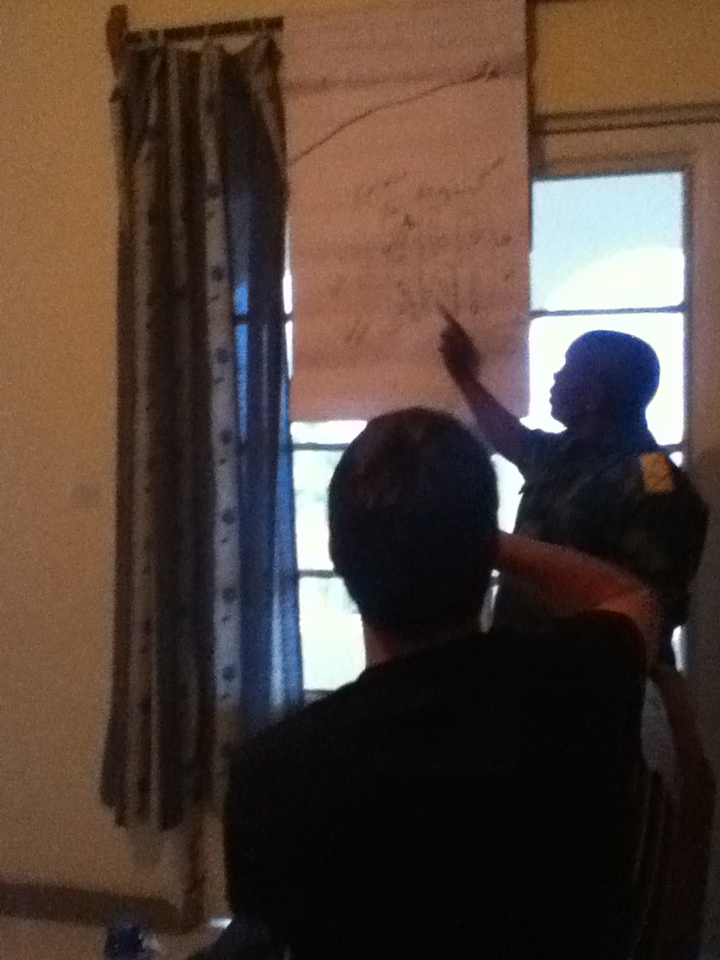
Me learning from an army major about the FARDC's hierarchical structure.


Lots to be learned.


Regions, regiments, battalions, companies, pelotons.
And then differences across provinces.
And then differences across provinces.
Movements of companies within regiments: Does
the FARDC keep track of these? How far are
peletons geo-graphically separated from each
other? Etc.
Saturday, July 28, 2012
Heading to DRC this Monday and US F1-VISA.
A few hours ago I got myself a plane to Kigali: flying out from Amsterdam this Monday (yes, the day after tomorrow), and arriving Tuesday afternoon. Upon arrival I hope to get myself a bus and head to the Rwanda-Congo border that same day. I'll only be in the Congo for 3 days, I leave again on Friday afternoon (plane leaves early Saturday morning from Kigali). It's a short trip to work together with Search for Common Ground (95% of the time), to give a presentation on how to conduct evaluations, and to meet my team that has been in the field over the last months. Because it's so short I will only stay in Bukavu. No field for me this time. It's a pity, otherwise I could have used the following sleeping back (h/t Simon):

One reason to leave quickly again is because on August 6 I have an appointment at the US Embassy in Amsterdam for my F1-visa -- after 5 years my current visa expired. I already filled out the online application, which included the following questions:
- Are you coming to the United States to engage in prostitution or unlawful commercialized vice or have you been engaged in prostitution or procuring prostitutes within the past 10 years?
- Have you ever been involved in, or do you seek to engage in, money laundering?
- Have you ever committed or conspired to commit a human trafficking offense in the United States or outside the United States?
- Are you the spouse, son, or daughter of an individual who has committed or conspired to commit a human trafficking offense in the United States or outside the United States and have you within the last five years, knowingly benefited from the trafficking activities?
- Do you seek to engage in terrorist activities while in the United States or have you ever engaged in terrorist activities?
- Have you ever been directly involved in the establishment or enforcement of population controls forcing a woman to undergo an abortion against her free choice or a man or a woman to undergo sterilization against his or her free will?
Friday, July 27, 2012
From Brussels to... Congo?
Yesterday morning 5am. Alarm went off. 530am: on my way to Rotterdam Centraal, and from there to Brussels to get a single-entry, one-month visa for the Congo (I know. Again!? More on this later). Depositing the necessary material is between 9-12pm, and the pick-up is at 430pm. Thus a lot of time in Brussels. Of course I had my laptop with me and the grandiose plan to work. Well that didn't work out at all with me being in a city that I haven't explored a lot yet and the sun shining. So I hired a bike for a day [Genious system btw. They have bikes positioned throughout the city. It costed me $1.60 for a day], and spent a day playing the tourist.
Brussels is a great city.


Brussels is a great city.


Brussels' Grote Markt
Thursday, July 26, 2012
The Worst Mistake in the History of the Human Race.
Agriculture.
...
From an 1987 article by Jarod Diamond. Not sure how it fits in with his "Guns, Germs and Steel".
...
To science we owe dramatic changes in our smug self-image. Astronomy taught us that our earth isn't the center of the universe but merely one of billions of heavenly bodies. From biology we learned that we weren't specially created by God but evolved along with millions of other species. Now archaeology is demolishing another sacred belief: that human history over the past million years has been a long tale of progress. In particular, recent discoveries suggest that the adoption of agriculture, supposedly our most decisive step toward a better life, was in many ways a catastrophe from which we have never recovered. With agriculture came the gross social and sexual inequality, the disease and despotism, that curse our existence....
One straight forward example of what paleopathologists have learned from skeletons concerns historical changes in height. Skeletons from Greece and Turkey show that the average height of hunger-gatherers toward the end of the ice ages was a generous 5' 9'' for men, 5' 5'' for women. With the adoption of agriculture, height crashed, and by 3000 B. C. had reached a low of only 5' 3'' for men, 5' for women. By classical times heights were very slowly on the rise again, but modern Greeks and Turks have still not regained the average height of their distant ancestors.....
There are at least three sets of reasons to explain the findings that agriculture was bad for health. First, hunter-gatherers enjoyed a varied diet, while early fanners obtained most of their food from one or a few starchy crops. The farmers gained cheap calories at the cost of poor nutrition, (today just three high-carbohydrate plants -- wheat, rice, and corn -- provide the bulk of the calories consumed by the human species, yet each one is deficient in certain vitamins or amino acids essential to life.) Second, because of dependence on a limited number of crops, farmers ran the risk of starvation if one crop failed. Finally, the mere fact that agriculture encouraged people to clump together in crowded societies, many of which then carried on trade with other crowded societies, led to the spread of parasites and infectious disease. (Some archaeologists think it was the crowding, rather than agriculture, that promoted disease, but this is a chicken-and-egg argument, because crowding encourages agriculture and vice versa.) Epidemics couldn't take hold when populations were scattered in small bands that constantly shifted camp. Tuberculosis and diarrheal disease had to await the rise of farming, measles and bubonic plague the appearnce of large cities.....
Besides malnutrition, starvation, and epidemic diseases, farming helped bring another curse upon humanity: deep class divisions. Hunter-gatherers have little or no stored food, and no concentrated food sources, like an orchard or a herd of cows: they live off the wild plants and animals they obtain each day. Therefore, there can be no kings, no class of social parasites who grow fat on food seized from others. Only in a farming population could a healthy, non-producing elite set itself above the disease-ridden masses. Skeletons from Greek tombs at Mycenae c. 1500 B. C. suggest that royals enjoyed a better diet than commoners, since the royal skeletons were two or three inches taller and had better teeth (on the average, one instead of six cavities or missing teeth). Among Chilean mummies from c. A. D. 1000, the elite were distinguished not only by ornaments and gold hair clips but also by a fourfold lower rate of bone lesions caused by disease....
From an 1987 article by Jarod Diamond. Not sure how it fits in with his "Guns, Germs and Steel".
Subscribe to:
Posts (Atom)