Thursday, May 31, 2012
Saturday, May 19, 2012
How (not) to use the toilet.
Wednesday, May 16, 2012
Kinshasa, Congo
- I don’t expect to upload many pictures. Not only did I forget my camera, I expect to spend most my time in hotels and offices – i.e. substantially less exciting then the field.
- Kinshasa is warm and humid. That is, around 2pm one really wants to take a shower.
- Talking about showers. The hotel we stay in has a hot shower! So, last Monday, I had a hot shower (i.e. actually hot water coming out of a wall) for the first time ever in Congo! Brilliant.
[1] I know I still do not say anything about the results of the evaluation. I'll wait until the evaluation report has been made public.
Tuesday, May 8, 2012
I’m Heading Back to the Congo
Our evaluation of the Tuungane 1 program – one of the world’s largest community-driven development (CDD) programs – is done. It's a very serious evaluation. It started in 2006 with a baseline survey (I only joined in 2008). The final survey employed almost 100 enumerators, worked in over 1,120 villages for around 1.5 years (Oct’10 to Feb’12), has a very solid (behavioral) measure to measure the impact of the development program, etc. Up to now the results have only been shared with a small group of people: DFID (the donor), the IRC and CARE (the implementers) and a set of academics working in this field of research (EGAP). As soon as we go public I’ll write more on this blog.
I travel with Macartan and Raul. The reason for the trip is to present the results to, first, DFID’s country team in Kinshasa. Then a few days later (in Lubumbashi) we present to the national and provincial teams of the implementing partners (IRC and CARE). After that Raul stays in the Congo to do fieldwork for his dissertation and Macartan continues to Nairobi to present again. I fly out on the 21st back to NYC.
I would have loved to stay longer. My team is working in South Kivu at this very moment (collecting data for my dissertation) and I really would like to meet them, check their work, etc. Moreover there is lots to do for Tuungane 2 – the second stage of Tuungane 1 and about three times as big. Unfortunately I can’t; on the 24-25th there is WGAPE at Berkeley. This is a twice-a-year-get-together of economists and political scientists from Berkeley, UCLA, etc. that work on the political economy of development of Africa. Via Macartan I was able to go there. I’m exited because there are some really amazing scholars there doing very interesting work. Luckily Raul will meet up with my team though in Bukavu.
Two more things:
- Did you know that if you book your flight at Orbitz.com you'll be flying to the “Democratic People’s Republic Congo”
- Food for thought: I often write too fast when using my phone and select “y” instead of the “t” so often my “you”s becomes “tou”s. Now the big question is: Where is the “h” coming from in Shakespeare’s “thou”? The “h” is not that closely located to the “y” on a phone's keyboard. Why would Shakespeare make those mistakes?
Friday, April 13, 2012
70th Annual MPSA Conference
I present two papers: "Migrant Cooperation as a Signal": a paper based on a set of field-experiments done in the Congo last time I was there. "Crowdseeding in the Congo: Using New Technology to Understand Conflict": a paper with Macartan based on Voix des Kivus. More later!
First thoughts about Chicago (compared to NYC):
- the city is clean
- people are friendly
Tuesday, March 20, 2012
Back in New York City.
- Together with Massimo I'll be going to the gym at least three times a week for rowing. I lost almost 10 kilograms in the Congo last time, so the idea is to try to avoid adding too much in the months to come. And with several colleagues I'll squash as well once or twice a week;
- I received a small office at Columbia, but probably will still be working a lot in coffeeshops;
- April 12-15 the MPSA conference takes place in Chicago where I present two papers: 1. One on migration, and 2. one (together with Macartan) about our Voix des Kivus project. Both, unfortunately, still have to be written;
- By the end of this week Macartan, Raul and me have a deadline to hand in a revision of a paper we submitted to a prestigious journal. I'm currently running some extra simulations on Columbia University's supercomputer, we are replicating all our results (both the formal and statistical ones) one more time to be sure that everything is correct, etc.
- By the beginning of April our final report for the Tuungane evaluation has to be in. Yes, the evaluation of the 5 year Tuungane project - the project that is the reason for the existence of this blog. More (among others the results!) to come;
- Then in May I'm likely to be back in the Congo again - with Macartan and Raul. There are two reasons: 1. To present the findings of the evaluation to shareholders, and 2. To meet up with my research team that is currently still in the field to collect data for the dissertation.
Last Tuesday together with colleagues Ali and Pierce we visited Neelan in Brooklyn to work in the coffeeshops there. It was fantastic. The sun shined. We visited the Brooklyn Botanical Gardens. And at 11pm we ended our day of work with a whisky in a spacious bar sitting on a leather sofa next to a fireplace. It's good to be back.
Tuesday, March 13, 2012
Back from Congo: Congo Recap.
I'm back in New York City since last Thursday. A quick recap of my two months in the Congo:
Security
This time in Congo’s South Kivu province I was not under IRC's security umbrella. Given that I've already had my fair share of sleepless nights due to gunfire, have been chased by a mob with sticks and stones, and several other things happened that I don't write about because my mom reads these posts, this was the major concern. In the end it was unnecessary. We had no security incidents whatsoever. What came closest was the use of force from my side on two occasions:
When in Goma, Freddy and I took motorbikes to get to the harbor from where we would leave by boat to Bukavu. The motorbike had to stop for a truck that blocked the road. While waiting a local youth bumped into me rather unnecessarily because it was not crowded. I immediately checked my pockets and noticed that my moleskin notebook was missing. When he noticed I knew, he started running and after a short chase I had my notebook back. Ha! He better had stolen my wallet: the notebook had information from many interviews and was thus many times more valuable to me than my wallet.
When leaving Congo Neelan - as a proper academic - took the hotel room key with him. About two months later I had the same room as Neelan in the hotel. Due to a hole in the backpack I lost the key one day and had the following conversation with the hotel employee:
- Peter: “I lost my key. I'm sorry. Can I have the spare key.”
- Employee: “Because the other white guy took the key with him we don’t have a second key.”
- [Now several minutes of silence and me waiting for more from his side]
- Peter: “So what are you going to do?”
- Employee: “Well we don’t have a key”
- Peter: “I know. But all my stuff is inside and thus we have to solve this”
- [Several minutes of silence and me getting more and more annoyed.]
- Peter: “Ok. I’ll go to the bar next door to read a book and you solve the problem. You have two hours.”
- [On my way out also informed the boss of the hotel of the issue. Then after 2 hours:]
- Peter: “My door is still locked”
- Employee: “Yes. We don’t have the key”
- Peter: “I know. But how are you going to solve that”
- [Several minutes of a blank stare and me getting really annoyed.]
- Peter: “If you don’t open it, I will kick in the door myself.”
- Employee: “Haha. That’s not possible.”
- [A minute later the (oh-so-high quality) door was kicked open and I was in the room.]
Health
Also health-wise things went unexpectedly smooth. Overall I haven't been sick, with the exception of some diarrhea and throwing up the first two weeks when Neelan was still in Congo. Needless to say, I now blame Neelan for me being sick during that period. There is only one type of animal that bothered me twice: those insects that start digging in your foot and leave their eggs. I have had this before (here), and with a little bit of pocket-knive-surgery and disinfecting-with-whisky this was solved quickly (see the picture below).Research
Needless to say this was the reason why I went through all the trouble of going to Congo again. And it was worth it! A lot of amazing data has been and is being collected: from lab-in-the-field experiments, village mapping, etc. Data that is central to my dissertation. There is another reason, however, why especially these last two months in the Congo were so important. Let me give an anecdote. Last semester I presented a draft paper at Columbia's comparative politics workshop. In brief, based on data collected for our Tuungane evaluation, the draft has a lot of regressions and empirical results regarding migration. People then correctly asked: “So what do the migrants say?” At that point I had spend over 1.5 years in the Congo, but I could not tell them that. I spent time in the field but never specifically focussed on my dissertation because the time spent in villages was to manage evaluation teams. Another problem was IRC's security rules that make it obligatory to be out of the villages in the early afternoon. Now after two months of sleeping in the villages and talking over and over again with migrants, I now do feel more comfortable answering this question.
Do note that I still have the feeling that there are a million things that I don't understand in the Congo - and this only seems to get worse the more I visit the country.
Friday, March 2, 2012
David Mitchell.
Please also watch his series "Peepshow" that he does together with Robert Webb. It is really good fun (link here).
And back in the Netherlands: a Happyplace.


Btw, I'm quite sure that children with such responses will go far in life. On a similar note, Ken Robinson is going as far as saying that our current education system is destroying creativity (please watch here).
Wednesday, February 29, 2012
Greetings from Entebbe Airport, Uganda.
My last evening was very nice: I went for dinner with three people that are dear to me. Vera just posted two pictures on Facebook and I hereby re-post them:

With Vivi (left) I am working closely regarding Tuungane 2. With Julie (right) and Vera (below) I've lived together in IRC's "House 8" for around eight months in 2010; I still have font memories of those months (Julie wrote this brilliant note afterwards).

Let me briefly re-cap the story about that bottle of gin in the picture (the bottle is all for Vera):
> Vera: "Do you have gin & tonic?".
> Waiter: "No. We don't have gin."
> Vera: "Are you sure you don't have gin."
> Waiter: "Yes."
> Vera: "Are you a 100% sure."
> Waiter: "Let me check."
10 minutes later and the waiter is back:
> Waiter: "No we don't have any gin."
> Vera: "Ok. Could you buy it downstairs in the shop."
> Waiter: "I can check but you have to buy the whole bottle then."
> Vera" "Ok."
10 minutes later:
> Waiter: "Yes. There is gin in the shop."
> Vera: "Ok. Here is money please buy it."
10 minutes later and waiter is back with the bottle of gin:
> Vera: "Thanks. A gin & tonic please."
> Waiter: "Sorry. We don't have tonic."
:). You see where I am going. In the end it was gin and maracuja juice for Vera. This experience though is very normal when going out for dinner in Bukavu. For example, it is not uncommon that you order and 15 or 20 minutes later the waiter would come back asking "What did you order again?". This is one of the reasons why the Congo can get under your nails once in a while, but it is also one of the reasons why you love the country.
2 months != no beard.

A low quality photo btw. Although I'm leaving, my team continues and had need of my camera (I'm back again in April or May). So this picture - and the previous re the shower - were made with my phone.
Btw, I found a 1.5 years old, quite telling picture in my phone. When launching the Tuungane evaluation Raul and me worked: day & night. Here I had an appointment with the rector of the Universite Officiel du Bukavu and of course I had to wait, which meant: laptop out and work.
Tuesday, February 28, 2012
In Rwanda where water comes from the wall.
Now I am in Kigali, which means: warm shower, shower, shower! Upon arrival in my room it took only a matter of seconds before I was in the bathroom. But the showerhead-holder had broken! Thus I had to be creative. Thank you coat-hanger. Nothing will keep me away from my warm shower!
Saturday, February 25, 2012
Sophisticated thoughts in the Congo.
Wednesday, February 22, 2012
Back in Bukavu 1/7. Mweha.
1. In Mweha Desire and Eustache slept in the house of a local notable, and Freddy and me in the house of the chief. After a few days the notable asked for our dirty clothes so they could be washed. Awesome. But to the horror of my team (all graduate students and quite world-wise), not his wife or daughter but he himself started cleaning the clothes. The reaction of my team after me asking why it was so bad: "What kind of example will he be setting for other men!?" :)
2. I'm still not used to people throwing their litter on the ground but I now have at least my team so far not to do this. Nice: During our lab-in-the-field we give, in addition to foufou and sambaza (small fish), a package of biscuits to the players. In Mweha, without me mentioning it, the team told all the people when distributing the biscuits: "Please don't throw the plastic on the floor, but place it in this bag." Ha! Now of course there are no litterbins or anybody to empty those litterbins so now probably the bag (with all the plastic in side) will end up on the ground.
3. The belief in witchcraft is very much present in Eastern Congo. Let me give three examples. 1. Many chiefs when asking about the impact of in-migration on their village say: "Increase in witchcraft". Following them, for example, the Butembo ethnic group - one of the major displaced groups here - has a lot of sorcerers. 2. At a certain point there was thunder & lightning. The chief of Mweha turned pale and told me that he was afraid because sorcerers can keep and save the lightning in their hands when it strikes and then use it the next day to kill somebody. 3. In Kanenge there were an unusual large number of widows. So I asked the chief why this could be the case. He told me it was sorcery - most women in the village were dangerous. Now I've always been saying that women are dangerous, but the chief told me it was because most women in the village poison their husbands. FYI: Ted Miquel has a very interesting paper about how the murder of witches increases when economic shocks hit: here.
4. As you probably know this is not my first time in the DRC. However, this is my first time without being with the International Rescue Committee. The latter has been very helpful over the last three years: providing transport, security, etc. However, for a researcher there are also minuses of being with a big NGO: the security rules are constraining, villagers think you have come to distribute, etc. For example, if I would be with the IRC staying over in villages is out of the question. So, this time, I am “on my own”. As a result, over the last two months I have learned as much as the previous three years together. And it’s also a lot of fun staying in villages.
5. This is something I want to write more about one day: I am of the strong opinion that the international community (read: NGOs and MONUSCO) is helping sustain a culture of dependency and maybe even of learned-helplessnes here in the Congo. Let me give an example. If I go anywhere outside of Bukavu all children shoot “biscuit”. Now this looks rather innocent: MONUSCO cars often pass by and they distribute biscuits. However, I think it’s not innocent at all. It’s the start of dependency, which continues until you’re adult when you don’t have to (or don’t think you can) build schools, water-sources, etc. in your own village but that you’ll have to wait for the NGOs to come and build it for you. After so much time in the field I feel very strongly about this. There is a culture of “donnez-moi” - each and every person asks me to give something. Given Congo's history I'm careful to say that the NGOs and MONUSCO has created this culture, but I’m quite convinced that their not helping much decreasing it.Probably a lot of people will disagree, and I know this warrants a much longer post.
6. To show that although I have been in the field for two weeks without internet I have learned about the most important thing that happened to the human race: we have met another race on another planet: here.
The house on the top-right with the brightly colored windows (3 windows and one door) was where Freddy and I stayed in Mweha. Actually the family stayed in the house but they had a small maissonete with one bed (proper mattress!) and we could use that for a few nights. Ha!
I love being in the field, but it is also very tiring. Often you don’t sleep really well: rats, Freddy keeps hitting me in his sleep (I still think he does it on purpose), etc. In the field you stay with a household so you have to adapt to them: if you sleep in the living room on the floor you wait for the chief of the household to go to bed first. Villagers eat late. Dinner is often not ready before 8 or 9pm so the hours before we are waiting (we talk, I read my Kindle and the guys listen to the radio). Also, I am always together with my team: wake up at 6am together, work together, eat together, socialize together, etc. It’s difficult to get some time on your own. For example if I go for a walk on my own in a matter of minutes there are 20 children walking with me. The picture above, for example, is in Mweha. I try to work but the children keep on looking at me and people keep on walking in to salute the muzungu. Macartan: if I haven’t done too much work done… :)
The guys at work in Mweha – after all the surveys were done in Mweha.
View from our house in Mweha.
A big tree had fallen down (a long time ago) and the top part now hung above a cliff. Result: cool pictures. Btw, for all the pretty women that read this blog: In the field we normally do not have breakfast or lunch so most of my belly is gone.
Back in Bukavu 2/7. Mweha.
As you might know for our lab-in-the-field (our "games") we need three isolated area to play our games. Normally we confiscate a school or a church and use plastic sheetings to create these. In Mweha this was not possible so we confiscated three shops! Desire played in the public phone booth on the left, Freddy in the pharmacy and Eustache in yet another shop (not on the picture). It worked great.
For the games we need to print pictures: we need three pictures per player and we have 18 of them so this is a total of 54 pictures per village. Back home I bought a Polaroid Pogo printer to you just that: it prints pictures directly from a photo-camera. Because it's the Congo and I knew electricity would be a problem (and also that likely one printer would not survive), I bought a second printer as well and a spare battery. Unfortunately even all this is not sufficient to print the 54 pictures - already after 15 pictures the Pogo printer's battery is flat. Thank you Polaroid. So inbetween printing we need to find an electricity source to charge the batteries. So upon entry in a village one of our first questions is "Is there is a generator in the village?" - don't expect there to be electricity proper. We then buy two liters of petrol and half a liter of oil (around $5 all together) which is then - depending on the type of generator - enough for 5 hours of electricity. This picture is us in Mweha: 2 printers (in the plastic bag), three phones, and my laptop. Normally connected to my laptop are also my Kindle, phone and camera.
Nice story. In Kanenge (after a long search) we found one generator, but it clearly had not been used in months (if not years) - petrol is very expensive. Once we put the oil and petrol in and connected the printers, the family that owned the generators took of the protection of the television and about ten people were present in the expectation to watch TV. When we came back two hours later to change one of the batteries, almost the whole village was present and watching television! Fantastic. So if my research has no impact whatsoever, at least it had one positive external effect. :)
As I wrote before, there is nowhere to get a proper cup of coffee (if you are lucky you find Nescafe). This despite the fact that you break your neck over the coffee beans! Here people are taking off the skin of the coffee beans. After first taking them from the tree - you do that once they are red.
Once the skin is off you dry them for 2 to 3 days in the sun. Unfortunately Eastern Congo is not able to process the coffee beans further (goodbye my nice cup of coffee), so it is sold like this for about $1.7 per kilo and exported (often to Rwanda).
The team with the chiefs of Mweha (fltr): Desire, nyuba kumi, the priest of the village, two more nyumba kumis (below), me, chief of the village and Eustache. Freddy is taking the picture.
Back in Bukavu 3/7. Mweha.
Let's talk about very important signs in the Congo. If you see leafs hanging next to a house like this: STOP. They sell Kasigsi (the local banana liquor). Put some extra whisky and sugar in it "et a votre soif!". Depending on the quality, a litre bottle is around 500 Congolese francs (around $0.50).
This is actually a picture made about a month ago. Now, in contrast to the first few villages, I spent little time with the guys when they are working - and especially when they interact with respondents or game players. That is, I either try not to be present or will sit quietly in a corner at a distance observing my team. There are two reasons for this: 1. The best way to learn is to make mistakes (so I let them make them and discuss the mistakes made with the team in the evening), and 2. Having a Muzungu present might influence the behavior of the respondent. Not only is this common sense, last week Jacobus Cilliers, Oeindrila Dube and Bilal Siddiqi presented an interesting paper at Stanford University providing evidence for this in Sierra Leone.
People use this in their stoves to prepare dinner. Men in the forest set fire to trees, the lady goes there and buys them in (really big) bags full and then sell it at the market. I forgot the prices but one pile is a few hundred Congolese francs (900 Congolese francs is $1). To prepare foufou one pile is sufficient, but for beans you are more likely to need three. The stoves people use are completely inefficient (a lot of heat escapes) and thus unnecessary expensive in use and it's bad for the environment. Maybe somebody should do an evaluation to investigate how more efficient stoves can be diffused in society (here). :)
This is such a common sight in the Congo. Women with (very) heavy packs on their bag: filled with bananas, manioc, etc. I'm at least 1.5 heads taller than the average Congolese women, and (I expect) much stronger, but I'm sure I won't be able to carry this.
And another common sight in the Congo. On the left you see manioc lying outside to dry. Once it is dry, people grind it (the famous picture of Africa of women using those wooden sticks hitting it down into a wooden bowl), then boil it, and you have foufou. The staple food in Congo.
Back in Bukavu 4/7. Mweha -> Kanenge.
The chief of Mweha sent two of his villagers with us to carry luggage and equipment. In first instance I wanted to say "thanks chief, but that is not necessary". But after an hour or two I was very grateful.
Descending the mountain with breath-taking views of Lake Kivu. Last week I finished reading Stanley's "How I Found Livingstone". Needless to say there is no way our four hours on easy terrain relate to his months and months in the jungle, but I felt myself a bit of a mini-adventurer. :)
Just a beautiful picture.
And another one.
And what do you write on your door today? FYI: this is the door of a house, not a school.
Back in Bukavu 5/7. Kanenge.
The nyumba kumi - a person responsible in the village for around 10 households ("nyumba kumi" in Swahili literally means "house ten") - had a lovely buganvilia tree under which we often worked. From left to right: four nyumba kumis, Desire, Freddy and Eustache. The nyumba kumi with whom we stayed (the guy in the blue t-shirt) had two wifes, each living in a different house. So, Desire and Eustache stayed over in one house and Freddy and me slept in the other.
Game day in Kanenge (the players are outside of the church). As said before we bought plastic covers so that we only have to confiscate a church and we have our location set up for the games: three areas where games can be played in private, and one area where a game can be played in public - i.e. with the chief and several notables present when the player is playing (currently taking place on the right). Also notice the lovely Columbia sign. My dear University. :)
You wake up at 6am. You feel annoyed because it is cold and have not slept very well because of the rats. But then... Any day is fantastic if it starts with a view like this while brushing your teeth.
So I try to be all cool here eating sugercane. For 200 Congolese francs (a little more than $0.20) you buy a two-meter cane, cut it in pieces with a machette, take of the skin with your teeth and suck on what is inside. Well that is how the locals do it - I am just posing here. In contrast, I take of the skin with a machette and then use my pocketknive to make small pieces on which I then suck. The guys make fun of me.
Hello!
Two more notes on Kanenge:
1. Kanenge was really not that far away from the big road close to Nyabibwe (a 3 hour walk). Despite this there was no market. Also, the last time a white person had visited the village was in 1989 - a priest came to check on a school that his paroish was building (and he didn't stay over in the village at night). Now imagine the faces of these villagers (especially children) when after 23 years a white guys arrives in the village and actually stays over for several nights. But incredible no? This village is only a few hours away from a big road. If you look at the map of the Congo 99% of all Congolese villages are located in much more isolated areas.
2. Kanenge doesn't have a nearby river and none of its robinets worked so we had to wash in Lake Kivu. That's not bad at all - the sun often shines. One day I went for a swim and also planned to do some bathing afterwards. Because I wasn't in the mood for wet clothes I went to an isolated area, took of all my clothes and while naked did some lovely swimming. Until a villager passed by and saw the muzungu swimming... Within 10 minutes there were at least 30 more villagers bluntly staring at me. Now try to get out of the water. :)
Back in Bukavu 6/7. Kanenge -> Nyabibwe.
Nyabibwe in the background. The city is the capital of the groupement Mbinga Nord. It is now known for the large number of displaced people that fled from the Haut Plateau and - because of many casserite mines nearby - for the miners, prostitutes and soldiers. It's a bit the Sodom and Gomorrah of the territory Kalehe.
We stayed over with a friend of a friend who is a miner for casserite in a mine nearby Nyabibwe (his house in the picture above). We already visited him and Nyabibwe a few days earlier and after a lot of paperwork and the necessary approvals by the SEASCAM (Congo's ministry of mining. We promised we were no journalists and we would make no pictures), the local authorities (we knew them well after working in the area for two weeks so no problems here) and the owners of the mine (it is a cooperative, and the friend of a friend helped here), I visited a casserite mine. Ha! Unfortunately no pictures.
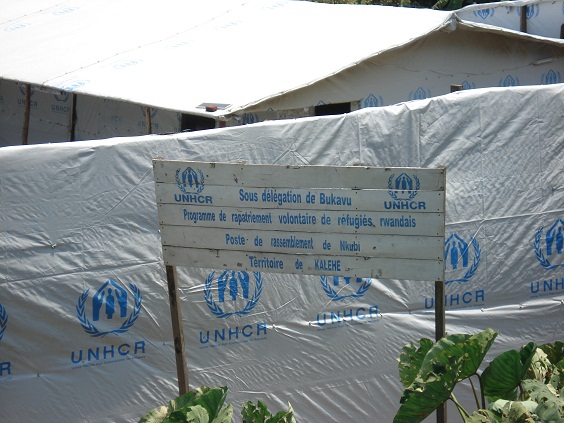
Because of the large number of displaced people the UNHCR is very much present in Nyabibwe. The photo shows a repatriation camp. Refugees from Rwanda (especially Hutu) who decide that they want to return home go here. They then stay several nights in this camp until the UNHCR picks them up by truck and brings them to Rwanda.
It is always nice to see how the presence of UN organizations spills over in other domains. Here a primary school in Nyabibwe is using a UNHCR plastic cover as ceiling cover.
I know childish but fun. Of these three shops in Nyabibwe only one is called "The Light" (the shop in the middle). It was also only this shop where the light did not work. :)
Back in Bukavu 7/7. Kanenge -> Bukavu.
Luckily we left Kanenge the day before our Goma trip. Kanenge is surrounded on three sides by mountains, and on the fourth side by Lake Kivu. So to get to Nyabibwe we had to climb 3 hours up the mountain.
We did have amazing views!
After a good, several-hour meeting regarding Voix des Kivus, it was time to go back to Bukavu. I had tried small speedboats from Goma, and also bigger boats during the day, but I had never tried the big boats that cross Lake Kivu at night. Curiousity of course forced me to try. In brief: fantastic! The person I met in Goma paid for the boattrip and we had comfortable seats (see picture), and even a bed. For the first time in 2 weeks I had a bed for myself (although not the room) and there were no rats running around. Ha! How I slept! The boat left at 17h00 and arrived the next day at 7h00 in Bukavu.
At 7h00 boats come in from the Idjwi (an enormous island in Lake Kivu) with sand to be used for construction in Bukavu.
Our boat - the "Akonkwa 2" - leaves again for Goma.