Sunday, October 17, 2010

The evaluation has started.

After months of preparation here in the Congo, and over one and a half year in New York City with some several-month long trips to the Congo, the evaluation started! Raul had the honor to start with his Haut Katanga team yesterday. I leave tomorrow morning for the field with my Sud Kivu team. It is a very special feeling. After so much work, ups and downs, it is really going to start!

The last two weeks were nuts regarding work. Therefore the absence of posts. Given the absence of internet and for large part phonecoverage in the days and weeks to come, don't expect many posts. If you want to get in contact:
  • Phone with Zain-coverage: +243998399330
  • Phone with Vodacom-coverage: +243810930927
  • Satelite phone (always on from 8-820am and 6-620pm): +8821643340723

Saturday, October 2, 2010

All alone in Bukavu.

After living together, working together, and sharing lots of ups and downs together for almost three months, Raul left me last week. I am all alone in Bukavu. In the months to come Raul will be responsible for the evaluation in the provinces Haut Katanga and Tanganyika; me for the provinces Maniema and Sud Kivu.
Before leaving however, the Sud Kivu and Maniema team that we trained the week before invited us for a goodbye-Raul drink. We had (yet again) a great evening together, which ended with them giving us two wooden carvings. The first is a hunter that carries a prey; the second a hunter that carries a wounded collegue. The first symbolizes how we have a job to do, the second how we will have to work together in the months to come.

Getting the work done, ...


by working together and helping each other.

Tuesday, September 28, 2010

Motorbike training.

For the evaluation we were planning to buy 16 motorbikes - those nice big 125CC Yamaha DTs. First, this would make logistics easier in the field; 4x4s can't get to most of our villages, and try to find a mode of transport different than walking when you are in the middle of nowhere. Second, after some engineering on the motorbike it would be possible to charge the GPS devices, PDA, laptops, etc. Anyhow, this sounded great in New York.
Once here our implementing partners told us it would be difficult to find more than eight people that would be both good for the evaluation and can drive a motorbike. So, we bought only eight motorbikes and during the training we assigned people to position taking into account whether they could or could not drive a motorbike. Knowing this is the Congo we were very explicit during the training. In one-to-one conversation we asked them "Can you drive a motobike?" and asked them explicitely about their level of experience, whether they had a driver's permit, etc. After the training we had our eight drivers. At least, that's what we thought.
Yesterday, just to be sure, I asked the IRC whether we could borrow a motorbike for several hours to check the guys for their driving abilities... You're ready? Of course within five minutes the first person was lying in a ditch next to the road with the motor on top of him. With the exception of two of them, none of the eight could decently drive a motorbike. So yesterday we arranged two motorbikes and two instructors for several days and thus today and the days to come it is... motorbike training.


This time the Sud Kivu supervisor not falling.


Two motorbikes, and


a lot of tests.

Tuesday, September 21, 2010

Wednesday, September 15, 2010

Training in Eastern Congo.

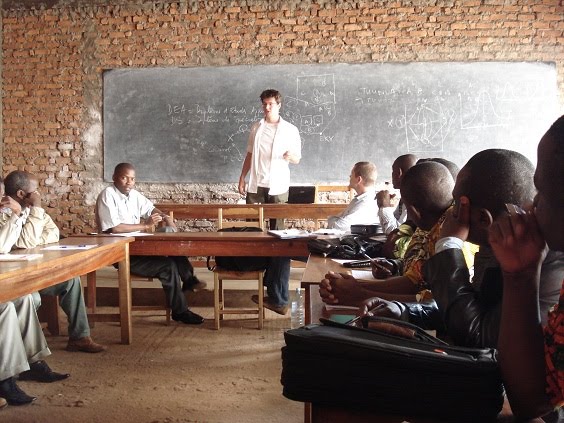
For the evaluation 560 randomly selected villages in Eastern Congo will be visited 3 times (step A-C) to implement a development project. After that 1,120 villages (including the 560) will be visited for a survey (step D). In total around 90 people will work on this for a year; we have to train all of them in the months to come. Raul and I trained the first 14 - the teams for step A and B for the provinces Maniema and Sud Kivu - last week; 7 will go to Maniema with me next Monday, the other 7 will start in three weeks in Sud Kivu. Raul heads to Haut Katanga next Monday to train the next 14.

During the training we covered a lot of material. You're ready?
  • We discussed the idea behind the evaluation, including the importance of randomization; both for selecting the 1,120 villages and for selecting the treatment and control villages of the program we're evaluating;
  • How to conduct and take measures during general assemblies;
  • How to conduct and take measures during focus groups;

Raul...

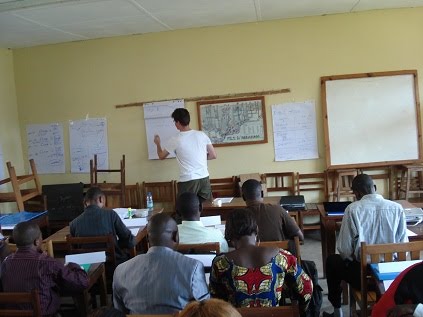
and Peter teaching.

  • During step A and B a lot measures are taken along the way, so we had to go over all these different forms, which includes several different types of surveys (the chief, households, different types of general assembly participants, committee members, etc.);
  • There were also practical things that had to be discussed: 1. When and how to go to which village (there is a schedule to follow); 2. language to be used in the field (we worked on the protocol and scripts for over a year); 3. how to take GPS coordinates (in each villages more than 10 coordinates will be taken); 4. How to randomly select households, people within household, and people from general assemblies; 5. how to use PDAs (all forms will have to be filled out on PDAs); 6. how to charge PDAs with solar panels; 7. how to upload data from PDAs to laptops; 8. how to drive a motorbike, etc.;
  • All these things had to be practiced, so we created games, exercises and played a lot (a lot!) of simulations;
  • And because only a sample would be selected from all the people present, we also created exams - as an extra measure - to get at people's quality level.

More on training

  • Training is so important. We have been working on this final part of the evaluation (step A-D) for over a year (the evaluation itself started in 2007); creating surveys, protocols, scripts, etc. When all combined this document is over 200 pages big. Needless to say, while we can discuss language for days, think carefully about which questions to ask, etc. if the people in the field do not understand things, we could just as well throw away those 200+ pages. This is quite a scary thought;

  • In total, professor Chimanuka - the implementing partner for Sud Kivu and Maniema - had brought 25 people to the training; this so that we could select the best 14. This was not an easy thing to do at all. Most of them were older than Raul and me, some were doctors, lawyers, etc. and above all many were unemployed but with a family and there were some that had left their job for this; all to get this job with one-year job security;
  • Raul had been sick-ish in the two weeks running up to the training. On Monday he got really sick and Professor Chimanuka - a specialist on malaria - tested him for malaria: he tested positive. Despite the fact that he looked and felt horrible last week, he kept on teaching - and very impressively;

  • We noticed that Congo seems to have a very different teaching-style than Raul and me are used to. Here students seem to listen and frantically try to copy whatever the professor says into their notebooks. We quickly got rid of that and moved to simulations, exercises and them teaching each other. People really seemd to enjoy this and, we hope, learned much more as a result.

Professor Chimanuka playing the chief of a village.

And another simulation: Tshimanuka doing step B.

Luc (the provincial supervisor for Maniema) teaching.

  • When do you know that people start applying what you taught them? Well, during lunch we walked around the room with a bunch of bananas for the people to take. One student replied: "I will choose my banana randomly." HA!
  • Then on Saturday evening it was over. After a very intense week it was finally time to relax and get to know each other socially. We first went to a local restaurant where we ate and drank until late in the evening. After that we visited "Parc au Prince" and danced until early in the morning. We not only have 14 very smart people, they are also a great group socially - something that is going to be important when in the field together for a year.

Marline, Pascal, Raul and Chris. Check out the latter two: that's team building.

FLTR: Peter, Sylvie, Alain, Marline, Pascal.

The teacher is going strong.

Tuesday, September 14, 2010

Eggs. Anybody?

Next to DRC - Rwanda border (Congo side).

Monday, September 13, 2010

Object #4.

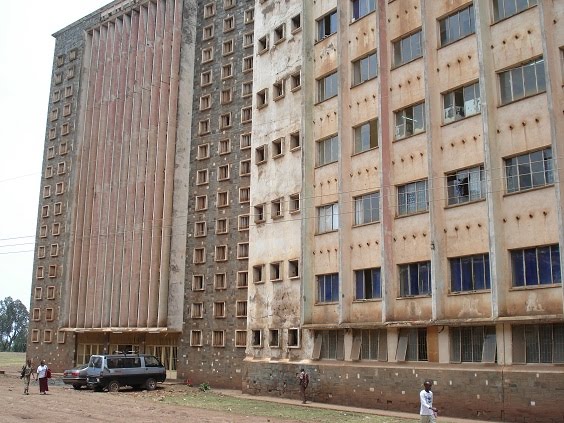
Warning: object 4 is big. Raul and I had a seminar at the Official University of Bukavu (OUB) last Saturday (see previous post). OUB is since recently at the campus of the Institut Supérieur des Techniques Médicales (ISTM), which is located just a few minutes out of Bukavu, on top of a mountain and with an incredible view over Bukavu and Lake Kivu. ISTM is basically one big building; and a building Congo-style. It was constructed by the Belgians, but has not been maintained or renovated since. Actually, when the Belgians were thrown out of the country in 1960, ISTM was still in the process of constructing the back part of the building. The latter has never been finished.

The front.

The back (the guy standing there is not photoshopped in).

The back part of the university is now university housing. Tilburg and Columbia University, I promise, I will never again complain about your university's housing.

Oeps! Did I leave my pants?

Sunday, September 12, 2010

Seminar at the Official University of Bukavu.

Yesterday Raul and I had organized a several-hour seminar with Congolese professors and Doctoral students at the Official University of Bukavu (OUB) at the ISTM campus in Bukavu. The seminar was organized for two reasons:

  1. Raul and I will split up in a week; I will be responsible for and living in the provinces Maniema and Sud Kivu; Raul has the provinces Tanganyika and Haut Katanga. The idea is that each of us will have a 'counterpart' with whom we will work closely together and train along the way for two reasons. 1. While we will leave the Congo in January, the evaluation continues for another half a year; the counterparts can take over from us. 2. It's a perfect knowledge-sharing opportunity. Raul and I will learn a lot about the Congo, and we can learn them about statistics, computer programs, etc. We want this counterpart to be a Doctoral student. So, Raul and I first presented the development project (Tuungane), which was then followed by a discussion about how the best evaluation would look like - in the meantime Raul and I checked carefully what they were saying and whether there was somebody that could be a counterpart.

  2. Raul...

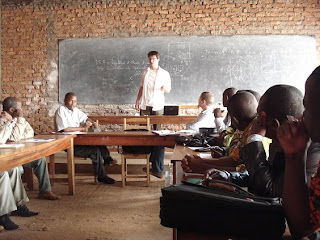
    and Peter presenting the evaluation.

  3. Needless to say, Raul and I also wanted to get to know Congolese academics - for us to see what they are working on and vice versa. So we had brief presentations of our research topics and after each we had several minutes of discussion. Raul and I presented our dissertation topics; Raul discussed the institution of the dowry, and I talked about migration and public good provision.
Peter's migration puzzle.

Sunday, September 5, 2010

It's great to be a ... PhD Candidate.

Sure, one works a lot. But you can choose your own topic and thus make sure it is all good stuff. In addition, you can work wherever you want - and so we do. We don't work in the IRC office: it's too noisy and there are too many people that want to shake your hand and be social. So, over the last three weeks, we've been working at home from early morning till lunch, and then after lunch we would work in l'Orchid (one of Bukavu's fancy restaurants) until we get kicked out (most of the times around 11pm).

Because we had been working in the Orchid for many days in a row we needed a change of environment. I think they were also happy not to have Raul and me there for a change; two people in student outfits with laptop and paper spread all over the table - probably not the best for a fancy restaurant. So, we went to Centre Amani; a monastry in Bukavu with only Catholic nuns whom we were able to convince that we should spend a day there for thinking. It is beautiful: it's at the tip of one of Bukavu's peninsulas, it has beautiful views, big gardens, and it is quiet with church music quietly in the background. I'm sure we'll be going there more often. It's really great to be a PhD Candidate!

I couldn't decide which picture was better...

... so hereby both.

Saturday, September 4, 2010

Nerdy thoughts from the Congo.


Taxis in Bukavu

There are a lot of taxicabs on Bukavu's main road ("Avenue President Mobutu" on Google Maps for the interested people); that is, normal-looking cars (see picture) that stop if you raise your hand. They also use their horns excessively and often stop if you don't one, so it's easy to get a taxi. Cost is 400 Congolese francs (around 0.45$) and because they only drive the main road (because that road is paved) the only thing you have to do is to choose the correct side of the road, sit down and wait until you want to get out again.

An average taxi.

Once in these taxi cabs you will observe clearly different behavior among it's drivers. In brief, the drivers can be divided into two groups: 1. One group of taxi-drivers that drive fast, 2. One group of taxi-drivers that drive slow. Why? Why are there seemingly two different strategies to obtain the same goal: earn the most amount of money. When driving fast one covers more meters per fixed amount of time and thus opens up seats faster. But when driving slower it is less likely that you miss potential customers. What makes a taxi-driver choose for either of these strategies? Some possible determinants:
  • The other taxi drivers. Let's say that the taxi-driver knows from experience that there are more fast drivers than slow ones. As a result, the best strategy could be to become a slow driver because many potential customers are not picked up by the fast ones. So it could be that the distribution of fast and slow drivers is important.
  • The mood of the driver that day. Maybe there is nothing rational to all this. Maybe after a fight with his wife in the morning, the taxi-driver is angry and thus puts the metal to the gas a bit more than otherwise. Thus, maybe a taxi-driver doesn't choose either one strategy for the rest of his/her taxi-driving career. One step further, maybe what is actually happening is that a driver has some mixed strategy where he drives fast some days (or hours) and slow the other.
  • Reaction speed of the driver. If a taxi-driver is quick to react, he is less likely to miss potential customers. Consequently, these guys are maybe more willing to become fast drivers.
  • Volume of the horn. Maybe what is important is the volume of the horn. If it is possible from a long distance away to notify potential customers that you are coming they have more time to walk to the road, and it is thus less likely you will miss them; i.e. you are more likely to be a fast driver.
  • Any more?
Anyhow, I would love to know more about this, talk with the taxi-drivers while being with them in the car, etc. Unfortunately, these months Raul and I fall under IRC's security umbrella and there is a clear and strict rule that says "You are not allowed to use taxis in Bukavu". Aargh!


Phone credit in the Congo

As you know phones are important and very popular in Africa - also among the poor. If you do not have at least two phones you are not a real man.
There are several cellphone providers in Congo and Zain, Vodacom and CCT are the biggest. I have both Zain and Vodacom because they have the best coverage. I
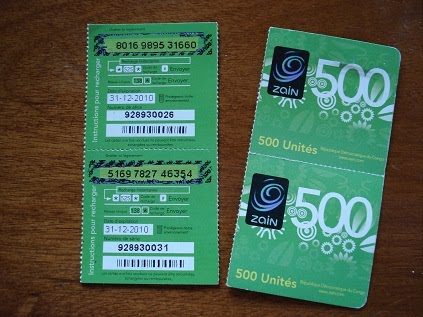
n order to charge one's cellphone you buy phone credit. For example with Zain you buy "unites" (see picture below) of 500 (5$) or 100 (1$), type in *525* plus the 13 digit number and end with a "#".

500 Unites from Zain.

Now please follow me through the following steps:
  1. These cards seem to be valid for a year.
  2. Let's say there are a total of 1 million Zain users in Congo.
    [the DRC has a population of around 60 million people. Most of the country doesn't have coverage, but the big cities do. While Bukavu has only about 300,000 inhabitants, other cities are substantially bigger. The capital Kinshasa, for example, has 10 million inhabitants. So, let's run with 1 million Zain users for now.]
  3. Every week I use about 6 of these 500 unites pieces of paper; or 30 of them if would buy the 100 unites. While I don't call much, I am a Mzungu and very rich so let's say on average people use 10 of these pieces of paper per week. That is, per year at least 520,000,000 times (1,000,000 * 10 * 52) those 13 digits numbers are used.
  4. It's possible that Zain doesn't introduce these unites on the market at the beginning of the year, but gradually throughout the year. Also, we have to take into account that once a person uses one of these 13 digit numbers it can't be used anymore. However, we also have to take into account that there should be many more than the 0.52 billion pieces of paper around because sellers needs reserves.
  5. So, let's say that around half a billion of these 13 digit numbers work and we know that there are 10 trillion (10^13 possibilities).
  6. You see where I am going?
  7. 1 out of every 2,000 tries should give you a hit. That is, on average every 2,000 times you enter a 13 digit number you earn yourself a dollar.
  8. Many people in the Congo have cellphones. Many people are also unemployed. Filling in a 13 digit number takes less than 10 seconds, so every hour you can try around 400 times. In other words, when working an 10 hour day you earn yourself 2 dollars.
  9. IDEA: What about hiring 100s of people, giving them a list with 1000s of unique 13 digit numbers on it and they can keep 100% of the profit.
  10. BUT: I'm sure Zain must have thought and calculated this through; it would have been relatively easy for them to put 14 numbers on the cards instead of 13. I am still curious though.

Object #3.

Warm showers are dear to me and it is definitely one of the things I miss a lot when here (next to family, friends and great Dutch food); for proof of me missing showers see some previous posts here and
here. Earlier this week after coming back from Buja, Raul walked through the garden and saw the big watertank given in the picture below. After some more investigation he also saw a boiler stuck to the house. After having a mechanic passing by to get things working we had a working shower!

Watertank - placed higher than the house.

Boiler?

Now there are two problems (I am Dutch so I have to complain - our national hobby by lack of major other problems): First, my shower is too low: if I stand up my shoulder hits the shower-head. Secondly, and more profound, how are we going to do this? I live with three more people: Vera, Jenny and Raul. We all like showers (the longer the better). However, the watertank has a limited amount of water in it and is filled only every so many weeks. We can't monitor each other's shower consumption (I think Vera and Jenny wouldn't allow us to monitor them while they take a shower) and thus even if we make a schedule saying, for example, that each day each person is allowed a 4 minute shower, I'll be afraid they'll cheat; that they will shower for longer and thus use more water. Knowing that this is my future water, I thus prefer to use my future water now, so I'll be standing under the shower for longer as well. Vera, Jenny and Raul will do the same.

Let's see how quick we'll be without water. Btw, I'm heading upstairs now to take a shower.

Wednesday, September 1, 2010

Blogs and websites I like.

Today I added several links to this blog (added to the bar on the right). These are links to blogs and websites that I like. There is a strong Africa - and especially Congo - bias. However, in the future this is likely to change ones I start working in other parts of the developing world; I'm still young. ;)
  • Africa is a Country: Blog on Africa.
  • African Arguments: Blog by the RAS and SSRC on Africa.
  • Alex Engwete: Very informative blog on the Congo.
  • Chris Blattman: Great blog on international development.
  • Congo Blog: Blog on... Congo.
  • Congo Siasa: Incredible blog on Congo by Jason Stearns.
  • IRIN News: UN news on development issues.
  • Project Syndicate: Ideas by some of the brightest minds in the world on development.
  • Radio Okapi: News on events in the Congo by MONUSCO.
  • Rootless Minds: Blog by friend and colleague Raul (until January with me in the Congo).
  • Relief Web: Informative website on development issues.
  • Solo Kinshasa: Blog about Kinshasa - capital of the DR Congo.
  • Texas in Africa: Great blog by Laura Seay on development issues with a focus on the Great Lakes.
  • Wronging Rights: Brilliantly sarcastic blog on development issues by (a.o.) colleague Kate.
  • Wired Science: Great blog on sciency things.

Monday, August 30, 2010

Back from Buja. Back in the velvet prison.

Last Sunday around 430pm Raul and I came back from a weekend in Bujumbura; the capital of Burundi.

Burundi

Burundi is a small country lying to Congo's east and Rwanda's south. Before gaining independence in 1962 it was - together with Rwanda - the German and (after WWII) the Belgian colony called Ruanda-Urundi with current-day Bujumbura as capital. Burundi is Rwanda's less-famous brother; just like Rwanda the Twa, Tutsi and Hutu are the country's ethnic groups, and - just like Rwanda - the latter two have been going at each other for decades. However, while Rwanda's 800,000 death in the 1994 genocide brought the country to fame, Burundi's 100,000s of deaths took place over a more extended period of time - and thus we don't have Hollywood movies about it. For example, a genocide took place in 1972 when Hutus attacked Tutsis and the Tutsi-dominated military regime responded with large-scale reprisals. In 1993, the Hutu Melchior Ndadaye, who had won the first democratic election, was assassinated by Tutsi soldiers, which starting more violence that killed an estimated 300,000 since. Currently, things are relatively ok. While the last major rebel group (the FNL - Forces for National Liberation) bombarded Bujumbura as recently as April 2008, they signed a peace agreement shortly after that. And while rumors of new rebel groups being created are surfacing since recently, Burundi has been relatively quiet and stable.

Bujumbura

Why did we go to Buja for a weekend? One of the reasons was that we still needed some equipment for the evaluation that is difficult to buy in Bukavu (four digital cameras and some cables to be able to charge satellite phones, GPS devices and PDAs from Yamaha 125CC motorbikes). However, the most important reason was for Raul and me to take a break. We have been in Congo for two months without a holiday and both of these months were very intense. Moreover, Raul and I wanted to leave Bukavu's security bubble. In the last two weeks we started to feel we were living in a prison: we are not allowed to walk in the evening, one's movements are always tracked, if you want to go out of the small, predefined area of Bukavu you need to obtain a security clearance, etc. So, up to Bujambura where we have several friends: JB who works for UNDP, Sebastian who works for Burundi's ministry of finance, and Guillaume who works for Burundi's ministry of Social Affairs.

In three words: It was fantastic! Although we had preferred to take public transport (to get to know local people, learn more about the country, etc.) we were obliged (again for security reasons) to take an IRC car to Bujumbura. But once we were on the road Raul and I couldn't keep the smile from our face. The road from Bukavu through Uvira (via Kamanyola and Sange) towards Buja is about 4.5 hours and beautiful: hills, desert, towns. Once in Bujumbura we had the feeling we were in a different world. Bujumbura is located right next to Lake Tanganyika - which is the second-largest sweet-water lake by volume, the second-deepest lake, and the longest lake in the world. The city has incredible beaches (just be careful for the crocodiles and hippos after sunset), and is much more developed than Bukavu: there are bars, sophisticated hotels (see for an example here), and since 2 years (with the help of the Chinese an the European Commission) good roads. Over the weekend, we had breakfast with eggs, bacon and smoothies, went to the beach and swam in Lake Tanganyika, visited Bujumbura's central market, hang-out with friends, slept more than the normal 6 hours, and... (you're ready)... after two months in Eastern Congo I had a shower... with warm water! After all the luxury and several days away from Bukavu's security bubble, we're back in Bukavu with our batteries charged and we're ready for the very heavy weeks to come.

Photos

Banana anybody?

Buja's central market.

I'm from a family of construction builders and thus love this picture.

Random
  • Man, I'm getting older. When 'young' you see those 'older people' that have cars, houses, proper salaries, etc. The guys in Buja had this - and I am of that age now. I never really notice it; I'm a PhD student and thus still study and don't really have a salary. I also live in New York where most people rent and live in small apartments. But people of my age are getting married, start making babies, getting mortgages, etc. I never really thought of that until Buja. Scary.
  • On the way to Bujumbura we drove through Uvira, a territoire of Sud Kivu in DR Congo. The car drove over 100km per hour on roads where one really should not do that. The reason was for security. I don't know how much of it is true but the driver told us that different groups (Mai-Mai, Banyamulenge from Uvira's Haut plateau, etc.) have a tendency to high-jack cars on that road. I am not sure what was more frightening the idea of being ambushed or the car being high-jacked, or the driver driving 100+ km an hour. :)
  • On the way to Bujumbura we also drove through the town of Sange, where about two months ago a truck caught fire and killed over 230 people (here). Congolese friends sent horrible pictures in the days after that. The burned-out truck was still there; as a horrible monument to the disaster.

Wednesday, August 25, 2010

Crows in the Congo.

Raul just ran out of the house screaming "whaaaaaaaaaaaaaa".


No, we're not going nuts. Raul and I work a lot at home. It's a bit unsocial but we are much more productive when we do not work at the office; at home there are no people around to shake your hand, there are no people that start talking to you, etc. However, in Bukavu there are a lot of crows; and they are noisy. They scream a lot. Moreover, we hear them walking/jumping on the roof; indeed, the tin roof-plates do not help with that. On average there are two of them in the garden and one on the roof and it's (really) annoying when you try to concentrate; something we do once in a while.


That's a small one. The big ones seem to be smarter and fly away more quickly.


In addition to being loud, those chaps are also really big, insolent and... scary. The reason why I think the latter is because of a great TED talk I saw about half a year ago. With the current internet connection I will have to wait for January to see it again, but for the people with a faster connection see


Monday, August 23, 2010

Training & Object #2.


Training

I know; there haven't been posts in a while and doing a post on Object #2 is a very easy way out; i.e. nothing substantive. In brief, Raul and I are busy preparing a training. From September to August next year - so for over 11 months - there will be around 90 people working for the evaluation throughout Eastern Congo. All of them have to be trained. The first 22 will start training next Monday for six days; these twenty-two are the first wave for the provinces Sud Kivu and Maniema. Raul and I will be doing the training so we have been working hard on putting a training schedule together that includes:
  • Us presenting the project itself (goal of the evaluation, why a behavioral measure, etc.);
  • Preparing and training from hardcopies;
  • Training on how to use a PDA (most of the forms will be filled out on PDAs: saving literally 100,000s of pages and decreasing data-entry mistakes);
  • Training how to use the GPS devices we'll give them;
  • Training on how to drive a motorbike;
  • Training the supervisors on how to use the laptops we'll give them to upload the data;
  • And all of this should be combined with discussions, games, etc.
All in all, it's really great fun!

Object #2
Our house is not connected to the city's water system (which if it would probably wouldn't work well anyway). As a result, we have two 10,000 liter bags of water lying outside, right next to the house. Every so many weeks a big truck refills them. Interesting, I think. So hereby Object #2:


UNICEF? I do wonder whether a school somewhere in the DRC now lacks water (and yes, those are Converse shoes-footprints).