Wednesday, February 22, 2012

Back in Bukavu 4/7. Mweha -> Kanenge.

After seven days in our first village (Mweha) we left for Kanenga. A gorgeous 4-hour walk with a view on Lake Kivu.


The chief of Mweha sent two of his villagers with us to carry luggage and equipment. In first instance I wanted to say "thanks chief, but that is not necessary". But after an hour or two I was very grateful.


Descending the mountain with breath-taking views of Lake Kivu. Last week I finished reading Stanley's "How I Found Livingstone". Needless to say there is no way our four hours on easy terrain relate to his months and months in the jungle, but I felt myself a bit of a mini-adventurer. :)


Just a beautiful picture.


And another one.


And what do you write on your door today? FYI: this is the door of a house, not a school.

Back in Bukavu 5/7. Kanenge.

We spent 7 days in the village Kanenge, about a 4 hour walk from Mweha. This was a gorgeous walk btw along Lake Kivu.


The nyumba kumi - a person responsible in the village for around 10 households ("nyumba kumi" in Swahili literally means "house ten") - had a lovely buganvilia tree under which we often worked. From left to right: four nyumba kumis, Desire, Freddy and Eustache. The nyumba kumi with whom we stayed (the guy in the blue t-shirt) had two wifes, each living in a different house. So, Desire and Eustache stayed over in one house and Freddy and me slept in the other.


Game day in Kanenge (the players are outside of the church). As said before we bought plastic covers so that we only have to confiscate a church and we have our location set up for the games: three areas where games can be played in private, and one area where a game can be played in public - i.e. with the chief and several notables present when the player is playing (currently taking place on the right). Also notice the lovely Columbia sign. My dear University. :)


You wake up at 6am. You feel annoyed because it is cold and have not slept very well because of the rats. But then... Any day is fantastic if it starts with a view like this while brushing your teeth.


So I try to be all cool here eating sugercane. For 200 Congolese francs (a little more than $0.20) you buy a two-meter cane, cut it in pieces with a machette, take of the skin with your teeth and suck on what is inside. Well that is how the locals do it - I am just posing here. In contrast, I take of the skin with a machette and then use my pocketknive to make small pieces on which I then suck. The guys make fun of me.


Hello!


Two more notes on Kanenge:

1. Kanenge was really not that far away from the big road close to Nyabibwe (a 3 hour walk). Despite this there was no market. Also, the last time a white person had visited the village was in 1989 - a priest came to check on a school that his paroish was building (and he didn't stay over in the village at night). Now imagine the faces of these villagers (especially children) when after 23 years a white guys arrives in the village and actually stays over for several nights. But incredible no? This village is only a few hours away from a big road. If you look at the map of the Congo 99% of all Congolese villages are located in much more isolated areas.

2. Kanenge doesn't have a nearby river and none of its robinets worked so we had to wash in Lake Kivu. That's not bad at all - the sun often shines. One day I went for a swim and also planned to do some bathing afterwards. Because I wasn't in the mood for wet clothes I went to an isolated area, took of all my clothes and while naked did some lovely swimming. Until a villager passed by and saw the muzungu swimming... Within 10 minutes there were at least 30 more villagers bluntly staring at me. Now try to get out of the water. :)

Back in Bukavu 6/7. Kanenge -> Nyabibwe.

Work on the last day in Kanenge went smooth, so instead of staying over another night we already walked to Nyabibwe - the bigger city nearby from where we would take public transport back to Bukavu.


Nyabibwe in the background. The city is the capital of the groupement Mbinga Nord. It is now known for the large number of displaced people that fled from the Haut Plateau and - because of many casserite mines nearby - for the miners, prostitutes and soldiers. It's a bit the Sodom and Gomorrah of the territory Kalehe.


We stayed over with a friend of a friend who is a miner for casserite in a mine nearby Nyabibwe (his house in the picture above). We already visited him and Nyabibwe a few days earlier and after a lot of paperwork and the necessary approvals by the SEASCAM (Congo's ministry of mining. We promised we were no journalists and we would make no pictures), the local authorities (we knew them well after working in the area for two weeks so no problems here) and the owners of the mine (it is a cooperative, and the friend of a friend helped here), I visited a casserite mine. Ha! Unfortunately no pictures.


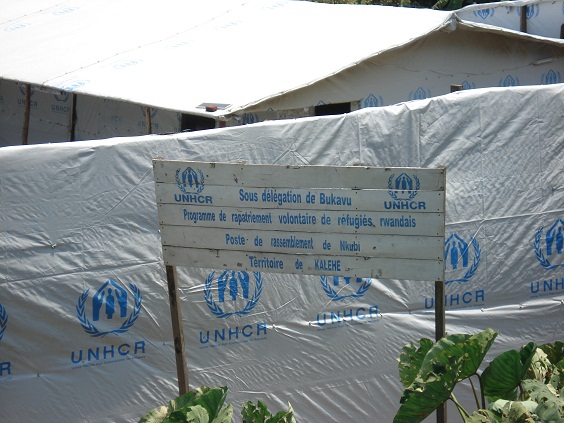
Because of the large number of displaced people the UNHCR is very much present in Nyabibwe. The photo shows a repatriation camp. Refugees from Rwanda (especially Hutu) who decide that they want to return home go here. They then stay several nights in this camp until the UNHCR picks them up by truck and brings them to Rwanda.


It is always nice to see how the presence of UN organizations spills over in other domains. Here a primary school in Nyabibwe is using a UNHCR plastic cover as ceiling cover.


I know childish but fun. Of these three shops in Nyabibwe only one is called "The Light" (the shop in the middle). It was also only this shop where the light did not work. :)

Back in Bukavu 7/7. Kanenge -> Bukavu.

After spending a night in Nyabibwe our team split up. Eustache and Desire left for Bukavu, me and Freddy took a motorbike at 630am and left for Minova. Once in Minova we took a public minibus that brought us to Goma. Reason to be in Goma? A meeting regarding Voix des Kivus.


Luckily we left Kanenge the day before our Goma trip. Kanenge is surrounded on three sides by mountains, and on the fourth side by Lake Kivu. So to get to Nyabibwe we had to climb 3 hours up the mountain.


We did have amazing views!


After a good, several-hour meeting regarding Voix des Kivus, it was time to go back to Bukavu. I had tried small speedboats from Goma, and also bigger boats during the day, but I had never tried the big boats that cross Lake Kivu at night. Curiousity of course forced me to try. In brief: fantastic! The person I met in Goma paid for the boattrip and we had comfortable seats (see picture), and even a bed. For the first time in 2 weeks I had a bed for myself (although not the room) and there were no rats running around. Ha! How I slept! The boat left at 17h00 and arrived the next day at 7h00 in Bukavu.


At 7h00 boats come in from the Idjwi (an enormous island in Lake Kivu) with sand to be used for construction in Bukavu.


Our boat - the "Akonkwa 2" - leaves again for Goma.

Monday, February 6, 2012

How to build a house.

Once in a new village many displaced stay in a host family. When it's clear - after several weeks or even months - that the security situation does not improve at home, they often build their own houses. You want to know how? There we go:

1. Find long, thick tree branches;
2. With your machete make holes in the ground - often in the form of a circle or a rectangle;
3. Put the tree branches inside the holes and fill the holes;
4. Find long but thinner tree branches, and banana skin (not the leaf);
5. Create the wall-frame by connecting horizontally the thinner branches to the vertical thicker branches by making use of the banana skin;
6. In a similar way create the frame of the roof;
7. Now fill up the walls. Create something cement-y by mixing sand plus water plus clay plus small rocks;
8. Find straw (or banana leafs) to cover the roof-frame.

And done!

Building a house like this can take as little as several days. The picture below is one of these houses - built by a displaced family from Bunyakiri on a piece of land the village chief gave them for rent. As you can see, it's located on the very outskirts of the village.

Sunday, February 5, 2012

Random pics 1/6

There is too much to tell and too little time - I'm leaving tomorrow morning again for the field. So hereby 10 random remarks and three pictures, and in the next five posts another 25 pictures with brief notes. Ready?

1. It doesn't happen often that a white person stays in the village so when we arrived in Cibandja the chief of the village and the chief of the sous-village in which we would work started arguing where the muzungu with his team would sleep. In the end we slept in the house of the chief of Cibandja, but as a compromise we would eat at least one night at the other chief's house. Let's just say we ate very well as each chief tried to outdo the other.

2. The chief and his wife talk with each other at night when they are in bed (we slept in the living room which was separated from the bedroom with a sheet of plastic, so we could hear everything). Why did this caught my attention (I would do the same)? The reason is that in the Congo relations between man and women are a bit different then we are used to, and I've never seen a sign of affection between man and wife in public here. To put it bluntly, men sit in front of their hut or drink if they have money, and the women work. [Btw. The third evening the chief wasn't there. So I asked his wife: "Where is the chief?" Answer: "Oh, he is with his other wife."]

3. Fun. I'm a white guy and to a villager whatever the white guy does is interesting. Now I'm a rather particular guy because it happens once in a while that in the afternoon I just stare in front of me for 10 minutes contemplating my research. So imagine this. After those 10 minutes there is a group of maybe 20 villagers standing next to me all looking in front of them, being completely curious where the muzungu is looking at. It's a lovely sight. [It reminds me of a Donald Duck comic in which a group of people are all looking up into the sky, only to have a person leaving the group that has his neck in bandages (and therefore can't look down).]

4. All mothers all over the world are the same. Just before leaving Cibandja the wife of the chief quickly put a large amount of peanuts in our pockets. "For on the road", she said. [She, btw, was very happy we were staying in her house because it meant that the chief (who has three wifes) was spending more time in her house.]

5. When in the Congo don’t leave clothes on the floor. You think your sweater is warm and comfortable, so do animals.

6. And don’t clean your shoes by kicking it against a wall. It's very well possible you shoe goes through the wall.

7. There are bird of prey here in the Congo (not sure exactly which one). At a certain point we heard a chicken making a lot of noise, we then saw it dissappearing into the air. Caught by a bird. Awesome.

8. Do your interviews while cleaning peanuts! People feel much more comfortable.

9. How to define a household? An often used definition is "People that share the same cooking pot in the last month". However, this doesn't really work in polygamous societies. For example the head of the household has three wifes, each living in a different house. If you visit one of these wifes, the household would be that wife with her kids and the head of the household. But actually the household as a unit is more likely to be the head of the household with all his three wifes and the kids of each of these wifes. So for our work in the Congo we adjusted the definition to take this into account. Now it is "people that share the same cooking pot with the head of the household in the last month". From UNHCR and other reports I know that in the Congo hosting relationships are important - i.e. displaced people living in host families. However, in our data we find remarkably little hosting families. It took a few days in the field to find out why, but the reason is that often the displaced do not share the cooking pot with the head of the (hosting) household. Now our definition of a household also takes this into account. I love research.

10. So Neelan left a week or two ago and being a proper academic he did not only take the key to his hotelroom with him, he also left his trousers and a sweater. Neelan argues that it is "something to remember me by". I think it is to get back at me for him having to carry my luggage from Kigali to Bukavu. :)


For our game day we need accomodation. Strategy: Occupy a church for a day. Use plastic covers (we bought them) to create three isolated areas where the games can be played in private. And we're ready to go. In the picture the players are to the right.


During the afternoon we have a brief lunch. Desire and me with the important people (among others the chief) of the village.


Aahh!

Random pics 2/6

There is too much to tell and too little time - I'm leaving tomorrow morning again for the field. So hereby a lot of random pictures with brief notes.


And the start of another game day. Introducing the team, and explaining to the players what my disseration is about (of course not in such a way that it will influence their behaviour during the games).


Eustache at work.


Desire at work.


And Freddy at work. A super team!


Very interesting. Around 2pm we take some time off to have lunch. Earlier that morning we gave money to the wife of the chief and then she and two or three more women prepare food (often foufou and sambaza - small fish from Lake Kivu) for around twenty to thirty people. As you might know, for our games we try to understand clustering: do some people cooperate more with some than with others - for example, natives versus displaced, one ethnic group versus another, etc. When it comes to eating there clearly is clustering taking place: the group on the far-right are all natives, the four on the left and front-right are displaced people.

Random pics 3/6

There is too much to tell and too little time - I'm leaving tomorrow morning again for the field. So hereby a lot of random pictures with brief notes.


Eustache doing an interview.


Freddy doing an interview. Ali: This picture is for you. Do you see the kitten on the right?!


And collecting more data. No worries, most interviews are done in private - I just liked the colors in this picture.


The Luzira river marking the boundary of the village. It's nice, but not the Congo river.


Soccerfield. Only problem is that if you hit the ball too hard you have to walk twenty minutes down the mountain (and more up) to pick up the ball.

Random pics 4/6

There is too much to tell and too little time - I'm leaving tomorrow morning again for the field. So hereby a lot of random pictures with brief notes.


Much of my research is about displacement and thus I spent a lot of time in villages that are especially affected by displacement (read: in-migration). This picture tells a lot. Many displaced people first stay for a month or two with a host family in the receiving village. However, when it becomes clear that the security situation at home is unlikely to improve the displaced want to build their own homes. So either the chief assigns a piece of land for the displaced to build their house (exactly how to build one of these houses is an upcoming post), or the host family gives a small piece of land where the displaced can build their house. The host family owns the building on the left and right, but in the space between the displaced family was allowed to build their house.


A common sight. Most motorbike-drivers only have a little petrol in their bikes because patrol is expensive ($2 a litre here, and quickly a multiple of that in more remote areas of Congo). And as a result they often run out of patrol. This was my driver trying to use his very last bit of petrol to get the motor going. I decided to walk.


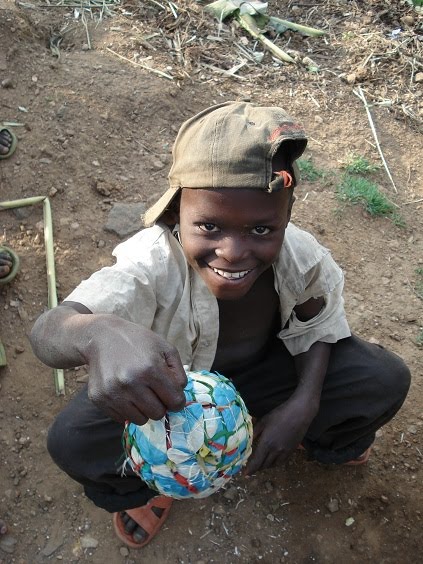
Wanna play ball?


So the idea was that I would teach them how to count from 1 to 10 in English. However they taught me how to count from 1 to 10 in Swahili. I am studying Swahili at the moment and thought that I knew how to do that. Not really, because my books are Tanzanian Swahili. The number "9" is "tisa" in Tanzanian Swahili but "kenda" here in Congo (which has a Bantu origin).


Pygmees are discriminated against in the Congo. We worked in a village that was close to a Pygmee village (a village of displaced Pygmees actually) and the guys, when seeing this, were joking that "this is to keep Pygmees from running away". It actually is for porks.

Random pics 5/6

There is too much to tell and too little time - I'm leaving tomorrow morning again for the field. So hereby a lot of random pictures with brief notes.


Waking up at 6am to go to work is really not that bad when the views are like this.


A good night of rain often transforms a village in a muddy mess; we are prepared.


Comment sava. I am not sure you want to send your children to this school.


At these moments I wish that I had a proper camera and knew how to use it.


In Congo there is something that is called "salongo". This is obligatory public work: villagers working together on constructing a road, etc. This often takes place on saturday morning, and is organized by the chef of the village or one of the chiefs some levels higher. For my disseration I'm very interested in why people cooperate, who cooperates and for what. So, next to surveys and all that, last week I joined the villagers in Luzira for salongo. They were digging holes and collecting stones in the mountains to create places for utility poles - the village wants electricity. This is a picture of the chief of Luzira: with his whistle he lets people know that salongo starts and where it will take place (this was around 7am).

Random pics 6/6

There is too much to tell and too little time - I'm leaving tomorrow morning again for the field. So hereby a lot of random pictures with brief notes.


We stayed at the house of the chief of Cibandja for six days. There were too few utensils and pots, so hands and plates it was. For our team of four we give $15 per evening to the chief's wife, who then prepares food for the evening: often a subset of foufou, beans, fish (from Lake Kivu), sambaza (small fish from Lake Kivu), bananas and rice. During the day we - once in a while - buy Kasigsi (local banana liquor).


A workday starts around 630am (sun comes up at 6am). Before starting the village mapping we discuss the best way to visit all the households. Also an aide of the chief and a displaced person is allocated to each of my team members. The aide of the chief is necessary because it indicates the chief's approval of our presence. The displaced person is necessary to make sure that the (native) aide of the chief does not 'by accident' forget to pass by displaced households - lists are seen here as distribution (NGOs that distribute in these areas often first make a list) and we want to avoid capture by the local leaders in any way possible.


Story. My first night in Cibandja. House of the chief where we slept on the dirt floor. No problem. We had 2 mattresses with us. Place some straw and a plastic sheet below it and you sleep like a king. Not that first night. It started raining hard, which I normally enjoy to fall asleep. Here however it means that animals go inside: including rats. I had animals run over me before while asleep (often chickens), but this night was different. A rat fall from a wood beam (to keep the house and roof together) two meters down right on top of me. While I was sleeping. I was wide awake that night listening to the noise of the rats. Lovely. Even my bottle of whisky didn't help.


And another picture for all the women out there that read this blog. Aahh!


This is very common. Villagers work hard to get a dirt road flat so that cars can reach the village. A few good nights of rain and you can start all over again.

Saturday, February 4, 2012

I'm sorry.

Dear parents of Luzira,

Via this post I would like to sincerely apologize. Last week, being very naive, I showed four children how, by placing a leaf between two fingers, a whistle can be created. I should have known better. The next day that idea had spread. I apologize for all the children that do now keep you awake at night.


Check the guy with his arms folded. Brilliant.


Again, I'm sorry.

Friday, February 3, 2012

Yesterday afternoon.

I am back in Bukavu after two weeks in Buloho, Bugalika and Luzira (small villages in Sud Kivu, all inside the locality Cibandja). It was fantastic, and there is - again - so much to tell.

Let me start with our afternoon yesterday. We are here with a team of four (Eustache, Desire, Freddy and me), and I push the guys hard. Each morning we wake up when the sun rises (6am) to start work at 630am, and we continue until 5-6pm. Normally we eat around 9pm. This doesn't mean that between 6 and 9pm the guys have a few hours off. No. We check the collected data, and I bother them with tens of questions (there is still so much for me to learn about the Congo).

In the villages we stay over with the chief, and we have dinner with him in the evening. However, this still often means work. Either the chief invites people ("There is a white guy staying in my house") or we do - for example, a few days ago we invited the president of the displaced-people committee of the Luzira entity for dinner. The guys know what I'm interested in, so they now often ask more and better questions then I do.

Yesterday, however, was different. We finished work early (around 3pm) and after two weeks of hard work we had the feeling of deserving an afternoon off. So we walked to Lake Kivu, stole a piroque (one of those boats cut out of a tree) and had several hours of great fun in the water. Then on our way back we got ourselves a case of Primus beer, had a lady literally taking her living room outside of her house so that we could enjoye a beer with the chief. Next to Lake Kivu, in the sun. Fantastic!


Team in Lake Kivu.


Muzungu hanging on the bow.