Tuesday, April 19, 2011

Living in History: Kibombo and Kindu’s Train Station. 1/2

After a five-hour wait at Kindu’s airport and a two-hour flight with UNHAS, I just arrived back in Goma - capital of North Kivu. However, there is one post regarding Maniema that I still want to share.

Both Arabs and Belgians were present in Maniema. During the nineteenth century this was an important area for Arabs for ivory, gold and slaves which were sent overland to Zanzibar. Also Belgians were here until independence
fifty years ago. Arab and Belgian constructions are still very much present. In Kibombo, with a little imagination, you see a Belgian colonial family walking through the street. It seems as if time has stand still ever since independence. The Congolese have not maintained the buildings since the Belgians left. People camp inside them. And what is newly build are wooden sheds or half-build adobe houses. Even after more than fifty years the colonial constructions by far outbeat the newly build constructions in both grandeur and quality. It is a really strange (and frustrating) feeling when walking through either Kibombo or Kindu. Why were people able to build houses, roads, trainstations, ports, etc. a million times better fifty years ago then they do now? Why don't people get their act together now?

Fig 1. Made from the motorbike. Arab castle?

Fig 2. City center Kibombo.

Fig 3. More city center Kibombo.

Fig 4. Ruin.

While it doesn't answer the questions raised above directly, I think there are two important reasons why Congolese have a tendency not to maintain nor renovate buildings. First, the colonial buildings are often for government employees. The government is responsible for their upkeep. Moreover, government employees often haven't been paid in many months. And if they get paid it is close to nothing. Second, even if they have money to do maintenance, there is no system of property rights or enforcement of them. As a result, if you would invest in your house and make it nice, a more powerful person would take it from you. As an indication of the lack of property rights, see the picture below that I shot in Bukavu. This is quite a common sight in Bukavu and other cities. People write on the building « Cette parcelle n’est pas a vendre », or "This is not for sale". All because there are no clear ownership rights in the Congo.

Fig 5. « Cette parcelle n’est pas a vendre »

Living in History: Kibombo and Kindu’s Train Station. 2/2

Also Kindu has beautiful old Belgian buildings. See for example this picture I shot about half a year ago when in Kindu. The city also has a train station. And yes, the trains still operate. For $50 you have a first-class ticket to Lubumbashi. I checked the price last week at the station; I did not check the 'first-class'. For more info about Congos's railroad system please see this. The only problem is that the train arrives and leaves rather irregularly: maybe once or twice a month a train arrives at the station. In addition, it's very likely you get stuck for a few weeks during the trip because the trains have a tendency to break down.

Fig 6. Kindu's train station. If you look carefully in the back you see
cranes. The Congo river is there and it used to be a port. Now there
are piroques and carcasses of Belgian-time boats.

Fig 7. More train station.

Fig 8. And more train station.

Fig 9. Belgian-constructed houses. These are currently occupied by
people working for the national railroad.

Monkeys in Maniema.

Large parts of Maniema are covered in rainforest. As a result, most villagers do not live from agriculture but from the hunt. With rifles from the Belgian period they hunt especially monkeys which they then eat or sell to the few people that pass by. The latter is important because although these villages are isolated and often days walking from 'bigger cities' they are aware of the existence of, for example, soap and hospitals.

Fig 1. Live from the hunt. Picture: enumerators.

Fig 2. Wanna buy? They recently shot two.

The monkey we bought (in the picture below on our motorbike) costed 7,000 Congolese Francs (around $8). Although, I am quite sure that the villagers increased the price because I am white.

Fig 3. For $8 you have one for evening dinner.

For the ladies that are reading this post. Hereby two more pictures: one of a baby chimpanzee and one of a baby monkey. The difference between a monkey and an ape is that a monkey often has a tale. And a chimpanzee; well they look just different. Each of them could be bought for 1,500 Congolese Francs (around $2). I'm quite sure US Customs will not allow me in though.

Fig 4. Baby chimpanzee?

Fig 5. And a baby monkey. Each $2.

Monday, April 18, 2011

The field in Maniema. Incredible enumerators!

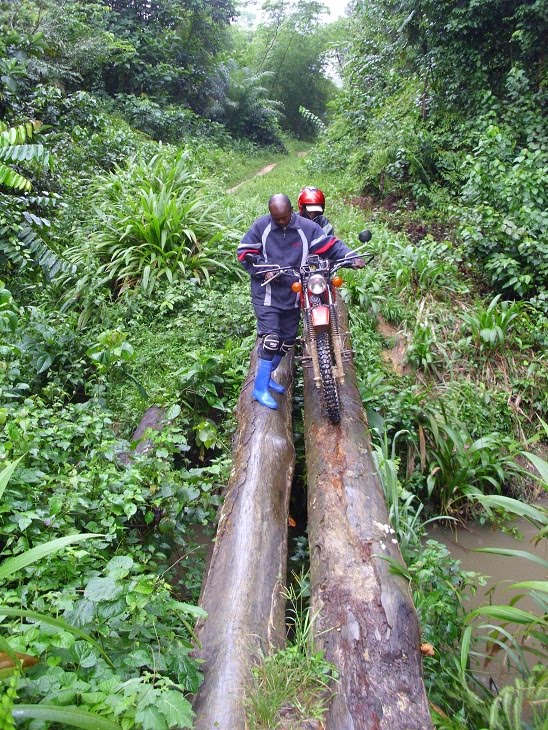
It’s Sunday evening. I’m writing this post by candle light, while drinking a very cheap whiskey from a plastic bottle, being eaten alive by mosquitoes, sweating a lot from the heat and having pain in my butt from spending two full days on a motorbike driving a bad quality road. Last Wednesday I arrived by MONUSCO plane in Maniema. After several days at Care International’s HQ in Kindu, this weekend I went out into the field to visit part of the enumerator teams in Kibombo. The latter is the capital city of the territory (an administrative unit below the province) with the same name. Kibombo city is located around 170 kilometers from Kindu. The road to get there though is horrible. Bridges are missing, there are big holes spanning meters and the whole road, many parts of the road are flooded during the rainy season (which it is 9 out of the 12 months), etc. Often one has to walk and push the bike to make progress. As a result, I was planning to post the three pictures below and write something how cool I am and how much it was like being Indiana Jones, etc.

Fig 1.

Fig 2.

Fig 3.

But whom am I kidding. From the pictures above, for example, it is clear I am little more than a muzungu tourist. First, I am wearing the wrong shoes. You need those plastic boots. Not only because you get often stuck in water, they also protect better against biting snakes. Second, I am wearing a shirt. Nobody does that – and definitely not with sleeves up given the sun that burns heavily for most of the day. Third, there is a full 25 liter jerry can on the back of the bike. With petrol prices at over $7 per liter, few of our enumerators have a full 25 liter can on their bike. Fourth, in the evening you sleep with your bike (picture 3). But notice that the place where I slept actually had proper walls. Although molt is literally drooping down, the enumerators sleep most of the time on the floor in villagers’ half-finished adobe houses. It was good luck that the teams were in Kibombo when I had time to go into the field. Kibombo is only 170 kilometers away. Most places where the enumerator teams work are over 400 kilometers away. After arriving in Kibombo I told the teams that the road was horrible. Their reaction: they laughed at me! The road Kindu-Kibombo is by far the best road in Maniema! Also, for me these difficult conditions are like an adventure holiday; Indiana Jones-y. I know that in some days I would be back in Kindu and could have a cold coke again – something you won’t find in Kibombo let alone in other villages. These guys, on the other hand, will be in the field for almost a year! It is their reality every day.

However, despite all this, the enumerators keep on going and doing excellent work. They are really very impressive! As an indication what these guys are going through I have posted the following 4 posts for them called “Maniema: bridges and water”. We gave the teams digital cameras and writing pads to document their experiences during the evaluation. Below is a sample of the many pictures they have made about the conditions on the road – specifically focusing on bridges and water because they are the main obstacles faced on the road. I post these pictures without additional comments because I think they speak quite well for themselves.

Maniema: bridges and water. 1/4

Fig 1.

Fig 2.

Fig 3.

Fig 4.

Fig 5.

Maniema: bridges and water. 2/4

Fig 6.

Fig 7.

Fig 8.

Fig 9.

Fig 10.

Maniema: bridges and water. 3/4

Fig 11.

Fig 12.

Fig 13.

Fig 14.

Fig 15.

Maniema: bridges and water. 4/4

Fig 16.

Fig 17.

Fig 18.

Fig 19.

Fig 20.

Tuesday, April 12, 2011

MONUSCO helicopter flight.

The evaluation works in four different provinces in Eastern Congo. Going from one province to another is only possible via the air. The provinces are 100s of kilometers away from each other: for example Bukavu (our HQ in Sud Kivu) is more than 1,800 kilometers away from Lubumbashi (our HQ in Haut Katanga). Also, even if you wouldn't mind the distance, the roads would not exist and it would be too dangerous because of the presence of so many different rebel groups. Thus, when in the Congo, I fly around a lot. However, I had never been in a helicopter. This changed yesterday when I flew from Bukavu to Goma! Really cool.


Fig. Peter being badass. :)

Fig. Beautiful views, and passing mountains and going over fields
so close that you want to reach out your hands and pick flowers.


Fig. We flew a Russian-designed MI 171A (more here). Because it is
strictily prohibited to take pictures at the airport, I took this picture
from the internet. Just imagine it being white with "UN" written on it.

Monday, April 11, 2011

Dining in Eastern Congo. A Guide to Bukavu’s Restaurants.

General remarks:
  • Overall, restaurant staff is bad. It is not uncommon that twenty minutes after ordering the waiter asks “What was it that you want?” and then twenty minutes after that “We don’t have that.” Tip: after placing an order, make sure the waiter repeats your order.
  • Local Bukavu food is characterized by meat (especially goat), fish, fried bananas and foufou (balls of grounded and cooked manioc root). Tip: do not order foufou.
  • Beers are always available – especially Primus, Amstel and Mutzig that are brewed by Bralima – Bukavu’s Heineken-owned brewing company. And by default they are 0.7 liters.
  • The list below is not exhaustive. Although I hangout a lot with non-expats, I am sure restaurants are missing. Suggestions welcome!
  • The keywords below each restaurant in the list go from 1 (bad/ low/ few) to 10 (great/ high/ many).
List of restaurants (alphabetically):
  1. Bellevederre
    Here you will find a large tiled, white floor with tables randomly spread out. For more privacy you can place a Japanese-style movable wall around your seating place. You won’t find expats here. I like to meet the enumerator teams here. In Bellevederre we have had both meetings, and evenings of drinking and dancing. Service is bad. Make sure you keep all your bottles on the table so that you can count them afterwards and verify the cheque – they have a tendency to add nonexistent bottles.
    Staff: 3, Speed of delivery: 3, Internet: 0, Price: 7, Food: 5, Ambiance: Expat level: 0, Directions: Close to place Mulamba.

  2. Coco Lodge
    This restaurant is very much an expat place. It has both a restaurant and several bedrooms. The owner is a Swiss expat and friendly. Do make sure to eat the pizza here because they make them themselves and taste great (my preference is the “pizza jambon”). Also, on a lucky day you have live music when the owner performs with a Swiss friend of his – although I haven’t seen them doing it in the last year. I’ve had good experiences recently with the speed of delivery but it used to be horrendously slow; making the special section on the menu called “slow food” seem like a bad joke. There is internet but the connection is spotty.All in all, this is a very nice place with good food.
    Staff: 6, Speed of delivery: 6, Internet: 4, Price: 7, Food: 9, Ambiance: 9, Expat level: 9, Directions: Just ask for Coco Lodge.

  3. Chez Victoria
    This is a restaurant, but also has three bedrooms. And since about 6 months it has a cocktail bar and dance section that makes Chez Victoria the place to be on a Friday or Saturday evening from 11pm onwards when it will be swarming with young expats. Tip: try the escalope cordon blue.
    Staff: 6, Speed of delivery: 7, Internet: 2, Price: 7, Food: 7, Ambiance: 8, Expat level: 8, Directions: Just ask for Chez Victoria.


  4. Dallas
    This is more a discotheque then a place to eat, but there is a restaurant. Needless to say, it’s dark and the music is loud. This is not a place that I highly recommend for dinner, but do go here after 10pm when Congo beats are pumping out of the speakers and mainly locals will be dancing.
    Staff: 6, Speed of delivery: 6, Internet: 0, Price: 6, Food: 6, Ambiance: 6, Expat level: 1, Directions: Close to feu rouge.

  5. Delicious
    A restaurant in Bukavu's city center with local food. The service is slow, not professional and the main things on the menu is foufou, fried bananas and goat: so the perfect Congo experience. Do check it out once. The goat brochettes are actually quite good. This was the first ever restaurant in Bukavu I went to and where I eat foufou for the first time.
    Staff: 4, Speed of delivery: 4, Internet: 0, Price: 7, Food: 6, Ambiance: 6, Expat level: 1, Directions: city center.

  6. Gerda’s
    This place doesn’t exist anymore since about a year, but it was nice. It had a pool table and it was the only place in Bukavu to eat Indian food.
    Staff: 7, Speed of delivery: 7, Internet: 0, Price: 7, Food: 8, Ambiance: 8, Expat level: 8, Directions: close to the MONUSCO South Kivu headquarters.

  7. IRC houses
    This is not a joke. The IRC has several houses spread throughout the city and each house has its own cook that prepares breakfast, lunch and dinner for the IRC staff living in that house. Befriend an IRC expat and join him/her once for lunch or dinner. Do note that most of the IRC expats still each in out in the evening.

  8. Hotel La Roche
    Situated right next to Lake Kivu. Hotel La Roche is a hotel but it also has two restaurants. A large restaurant, and a smaller one that is situated on a wooden platform on top of Lake Kivu. Gorgeous environment! Go here if you have a boy or girlfriend. Btw, they also have conference facilities here.
    Staff: 4, Speed of delivery: 7, Internet: 6 (in the hotel), Price: 7, Food: 7, Ambiance: 8, Expat level: 6, Directions: Just ask for Hotel La Roche.

  9. Lute Contra la Soif
    As the name suggests (“battle against the thirst”) this is more a drinking place than a restaurant. I've had a fair share of beers here (read meetings with Congolese), but haven't tried the food yet.
    Staff: 4, Speed of delivery: ?, Internet: 0, Price: 7, Food: ?, Ambiance: 8, Expat level: 0, Directions: on the main road, close to Nyawera market.

  10. Mama Kinja’s
    The place where expats go if they want to do local. They have small rooms here that provide privacy. The food is Congolese and very variable in quality: from being great, to people being sick the next day.
    Staff: 4, Speed of delivery: 7, Internet: 0, Price: 7, Food: 5, Ambiance: 6, Expat level: 4, Directions: Right at Place Mulamba.

  11. Meridien
    A restaurant located above a grocery shop and reachable by a wooden stairs. The food is good and the place has a cozy atmopshere. Do not be surprised if you hear 70s and 80s music. If you don’t go for the food, at least visit Meridien to look at the menu. Some of the more legendary dishes: Concert de chèvre $10, Soupe Obama $5, Ordinateur de chèvre $7, et Riz financière (unfortunately no longer on the menu).
    Staff: 7, Speed of delivery: 7, Internet: 0, Price: 7, Food: 8, Ambiance: 7, Expat level: 4, Directions: Next to Bellevedere.

    Fig: "COMPUTER FROM GOAT". Brilliant!

  12. Negrita
    Tucked away in Bukavu's city center, also upstairs, but this is a nice restaurant with good food. Delivery is slow but also here the atmosphere is good. Notable experience: Raul and me were here with some more folks for dinner when at a certain point the staff turned on a porn movie on the restaurant’s big screen.
    Staff: 7, Speed of delivery: 7, Internet: 0, Price: 7, Food: 7, Ambiance: 7, Expat level: 7, Directions: City Center

  13. l’Orchid
    This is the absolute expat place. L’Orchid is both a restaurant and a hotel. It’s situation next to Lake Kivu and not only overlooks the lake but also its own beautiful garden – Bukavu used to have many. This is the place where you can eat mussels, fresh salmon, go for gourmet, etc. This is the place where you will run into guys like George Clooney, top UN and government people visiting, but also NGO folks and expat employees from mining companies. The owner is a friendly Belgium that has lived his whole live in the Congo. If he is willing to make time for you, talk with him. Too many notable experiences here. Raul and me spent lots of time here because there was good internet connection and we could thus work. Also, once I thought that a sweater was lost after I couldn't find it for several days. When I asked the l'Orchid's reception for it, they asked me "is it this one, this one, or this one?" I had lost three sweaters!
    Staff: 7, Speed of delivery: 7, Internet: 10, Price: 4, Food: 9, Ambiance: 9, Expat level: 10, Directions: Just ask for L’Orchid.
There are two more places that I know of but I don't know their names:
  1. There is a restaurant about 20 minutes drive out of Bukavu (towards Kalehe centre) right next to Lake Kivu. I haven't been there yet because IRC doesn't allow us to leave the city in the evening. I heard it is great though.
  2. There is a restaurant that I have been only once, but that had a balcony with a great view over Lake Kivu. It's on La Botte: coming from Feu Rouge take a right when you're at the Ministry of Mining.

Comment!
  • Most of the places above I have visisted tens of times. However, this still gives a very small sample. If you want to comment please do! Also, I am sure lots of places are still missing. Please let me know about others!

Friday, April 8, 2011

Wanna Jerrycan?

Fig 1. And this is not even that uncommon!

Jerrycan fun facts:

Did you know that the jerrycan was reverse engineered during World War II from the Germans. The name reveals its German origins: "jerry" was a disparaging wartime name for Germany and Germans.

The Germans called it the Wehrmachtskanister. Ha!

The jerrycans color often indicates its content. NATO's color coding: red for gasoline (leaded), green for gasoline (unleaded), yellow for diesel, blue for kerosine, and tan or light blue for water.

Question:

So where are the above (diesel?) jerrycans coming from? If they were NGO-provided they are probably more likely to be light blue colored no? Also in villages I have seen a few blue ones, but the vast majority were yellow.

Thursday, April 7, 2011

Back in the Congo,

After arriving yesterday evening, today I had my first day back in the Congo. Why am here this time?

There are three main reasons. First and most important is the evaluation of TUUNGANE. Raul and me left the country more than three months ago, so it was time for one of us to go back to make sure the quality is high and stays high. Second, TUUNGANE 2 is about to start and our Columbia University team is leading the evaluation again. As a result we are now building the research design. Third, after 1.5 years, Voix des Kivus is coming to an end – at least on the grant that we received from USAID. In upcoming days we’ll launch a final evaluation, and of course there are still a million of small things that have to be rounded up.

Random things:

  • I’m back for only three weeks so my schedule is completely overloaded. And because I want to visit all four evaluation sites (only reachable by plane), I have a very tight (and completely unrealistic) flight schedule. To illustrate this, my first flight (this Friday from Bukavu to Kindu with a World Food Program’s UNHAS plane) was just cancelled. Of course.
  • About a month ago IRC’s TUUNGANE team moved to another bigger office. They now have a complete house just for themselves. Inside the evaluation team now has its own office. Lovely! Next time I’m taking Columbia University’s “Go Lions!” flags along from to decorate the walls.
  • I wasn’t much in the mood to go back to the DRC. Due to other trips – Netherlands Ireland, San Francisco, Germany – I spent less than two months in New York City. After being gone from home for nine months, this was too short! However, once I was in the buss heading to the Congolese border with people shooting at each other and Congolese music booming out of the speakers, I got a smile on my face again. I’m back!
  • So I gained weight over the last three months – bit too much work, bad eating habits, etc. You know it. The fun thing in the Congo is that it is a compliment to make this very clear to you. So today the cleaning lady said “You gained weight”, the professor we work with here (he himself has quite the belly) said “You start looking like a professor”, and one of the drivers said “you look like a person from there (meaning people are fat in the United States)”. This time I will not spend much time in the field. This used to be my panacea: fat-up in NYC and then go into the field and live off foufou. Unfortunately, this time will mainly be eating in big cities in those ex-pat places: so, more bad food. Also, those 0.7 liter Primus bottles do not help.
  • Question: How do you know you’re back in Africa? Answer: If you ask the driver of the buss going from Kigali to the Congo border how much longer it still is, and he replies “twenty more minutes” for two hours!

Tuesday, April 5, 2011

MONUSCO plane crash.

A MONUSCO plane on route from Kisangani to Kinshasa crashed near the Airport of Kinshasa (here). A total of 32 people are dead. People that were trying to build the Congo, and do good!

First MONUSCO plane to crash.

These planes are used by UN peacekeepers and staff of humanitarian agencies (and once in a while a PhD student from Columbia University), to get around the country.
They are often used because Congolese airline companies are unsafe - the IRC and CARE International, for example, doesn't allow its staff to use them. And there are at the moment only two main other providers: WFP's UNHAS and the European Union's ECHO. One of my first thoughts when reading about the crash was "Those Russian Antonovs!"; but this was actually a Dutch Fokker 100.

After leaving my folks' home yesterday afternoon, I just arrived in Kigali, Rwanda and could finally check email and cellphone. I haven't heard yet from anyone in my circle to have been in the plane - I keep my fingers crossed!

Am now about to start the last part of the trip: a 6 hours busride to the Congo border (where hopefully a 4x4 is waiting for me).

Sunday, April 3, 2011

Threshold Models of Collective Behavior (Granovetter. 1978)

The previous post made me think of a great paper on threshold models that I read some years ago. In very brief, a person's decision whether to riot or not (for example in Egypt) depends on what everyone else is doing. Some will start even if there is no one else, other need a critical number - a theshold. This threshold is assumed to be distributed to some probability distribution; it is thus different for different people. Interestingly, the outcomes may diverge largely even if the initial condition of threshold may only differ very slightly. I think this is still the best summary of his argument though:


Please watch this. This is absolutely brilliant!

Reference:
Mark Granovetter. 1978. Threshold models of collective behavior. The American Journal of Sociology.

Using new technology for development – Back from Berlin

This morning I came back from a two day workshop in Berlin – organized by the Center for “Governance in Areas of Limited Statehood” of the Free University of Berlin (here). It was a gathering of twelve people flown in from around the world to discuss the use of new technologies in areas of limited statehood. Day 1: The professors introduced the theoretical framework. Day 2: Three prominent projects were presented. Voix des Kivus was one of these three. The other two were Ushahidi and Helpmap Russia:

  • Ushahidi: Patrick discussed how the operating platform was used, for example, to coordinate relief efforts after Haiti's earthquake, the uprisings in Egypt, and currently in Libya.

  • Helpmap Russia: Gregory discussed how making use of new technology made it possible for people to organize and fight Russia's wildfires - something the government was unable to do.

It was impressive. There are three main things I took out of this workshop:


  1. It's incredible how new technology empowers people, and thereby makes it more difficult for authoritarian regimes to stay in power. If information is power, then it is now in the hands of the people. With increased access, freely available programs and contact to millions of people, it is impossible to stop information flows. In Egypt, for example, when the government decided to shot down the internet, a system was quickly set up that made it possible for people to leave a voicemail on an international phone that was then made a tweet (voice-2-tweet).

  2. New technologies decrease transactions costs and reduces the threshold problem for collective action ("I only go to protest if at least x others go as well, but I don't know the latter so I don't go to the street). Currently there are applications that make it possible to have maps that indicate in real-time who is where, with how many, etc.

  3. I am optimistic about the future. All this great work is done by hundreds of idealistic volunteers around the world with software that is available freely online. It is incredible to see how social networks are used, activited quickly, and how many people stand ready to help - wherever in the world. Moreover, in times of disaster we are less and less reliable upon big, slow moving and expensive government/international agencies. E.g. after the Japan disaster people want to know about radiation levels. An application was created (in minutes) where people could measure radation and send their information to a central phonenumber. Thousands of messages are being received that are uploaded unto a real-time maps exactly what levels are where at what time throughout Japan; informing the public to an extent no government agency would have been able to pull off.


Fig1: Uniquely Getting at Causality

Saturday, March 26, 2011

Really 21 flights in a month?

This morning I arrived at Schiphol Airport. I am on transit to a conference in Berlin, and after that the Congo. This the first flight in a rather (completely) nuts flight schedule this month:

New York City -> Amsterdam -> Berlin -> Amsterdam -> Nairobi -> Kigali -> Kamembe/Bukavu -> [Goma ->] Kindu -> [Punia -> Kibombe ->] Bukavu -> [Kalemie -> Moba ->] Lubumbashi -> Kalemie [-> Moba] -> Bukavu/Kamembe -> Kigali -> Nairobi -> Amsterdam -> New York City.

In square brackets are flights where the plane lands for just for several hours, and the flights in between Kamembe/Bukavu and Bukavu/Kamembe are made within the DRC. Exactly. Let's see how many of these 21 flights I will actually be on.


Btw, the sun was shining when I picked up my visa at the DRC Mission at the UN yesterday so I went for a walk downtown. Not far from the UN an artist (I don't know who) had placed statutes in a park - very nice effect.


Figure: The UN General Assembly building in the back.


Figure: The UN General Assembly building in the back.

Wednesday, March 23, 2011

Evolutionary Games and Spatial Chaos (Nowak & May. 1992).

For my dissertation I recently have been reading a lot from the evolutionary biology literature. These guys have done much very interesting work on cooperation.

Martin Nowak and Robert May wrote an interesting paper in 1992. What they did is to play the famous Prisoners’ Dilemma spatially. Yep, indeed interesting, because my dissertation is about migration and cooperation. In brief, they put the players on a lattice; assign different starting conditions (different payoffs, different number of cooperators and defectors in society, etc.), run the computer software and see what happens from one generation to the next when the players interact with each other. What they get is chaotically changing spatial patterns!

The figures below are not Persian rugs, but illustrate the presence of cooperators and defectors in a society for one generation, and the change from one generation to the next. Blue is a cooperator that was also a cooperator the preceding generation, Red is a defector that was also a defector, Yellow is a defector that was a cooperator, and Green is a defector that was a defector.

Figures 1 and 2 are societies on a 200x200 lattice after 200 generations that started with 10% cooperators, 90% defectors. The difference in starting conditions is the advantage for defectors over cooperators.

Fig 1.


Fig 2.

Figure 3 and 4 are societies on a 99x99 lattice that started with a single defector at the center. The difference is that the snapshot of society is taken at different points in time. Nowak and May show that one gets an almost infinite sequence of different patterns. Also, because the rules of the game are symmetrical, the symmetry is maintained.


Fig 3. After 219 generations.

Fig 4. After 221 generations.

Reference:
Martin A. Nowak. Robert M. May. Evolutionary Games and Spatial Chaos. Nature. Vol. 359. 29 October 1992.

Saturday, March 12, 2011

The Eastern Congo First Letter Mystery.

I've been working for over two years on Eastern Congo now, visited the area three times (a fourth time starts in three weeks), and all-together lived there for more than a year. Throughout this time something has been bothering me:
Why do so many (place)names start with the letter "K"?
Let me illustrate this. The work that we do in the DRC, next to the Voix des Kivus project, is an evaluation of a large CDR development project (more here). The project (and the evaluation) takes place in four provinces in Eastern Congo (Sud Kivu, Haut Katanga, Maniema and Tanganyika) and are highlighted below:

Fig. 1: Map.

For the CDR project and the evaluation our implementing partners (the IRC and CARE International) together with local governments constructed a large database with information on over 8,000 so-called LLUs in these four provinces. The term "LLU" we invented and is a "Lowest Level Unit". Some villages consist out of "sousvillages", some "sousvillages" consist out of "quartiers", some "quartiers" consist out of "avenues", etc. An LLU is the lowest of these natural units present.

Let's have a look at what the data says regarding first letters of these units. Ready? Hereby a straightforward pie-chart:

Fig. 2: The first letters K + L + M is more than half of all villages.

Indeed: wooh! Each letter in the alphabet probably doesn't have a 1/26th chance of being selected, but just the three letters K + L + M take up well over 50% of all the first letters! This seems nuts. And this seems to be the case across the four different provinces (the K is number 11):

Fig. 3: And it seems kind of similar for all four provinces.

To emphasize this point, within the four provinces we work in particular territories. Here is the list:

  • Haut Katanga: Kipushi, Kasenga, Mitwaba and Kambove
  • Tanganyika: Kalemie, Kongolo and Kabalo
  • Maniema: Kailo, Kabambare, Pangi and Kibombo
  • Sud Kivu: Uvira, Walungu, Kalehe, Mwenga

You see my point, or better the lines underneath the letters K? 2/3rd of all the territories start with a "K"! This is substantially more than (a likely prior of) 1/26; 2/3 is the same as 17 one-third over 26! So, what's going? I don't know the distribution in other countries, but this doesn't seem to be very normal. Two thoughts (please suggest other ones!):

  1. The Belgian Colonialist. Shame on me that I don't know this, but did the Congolese have a written language when the Belgians arrived (or probably the Arabs is more appropriate knowing they were in the east much earlier)? And (if so) the same one? Maybe the local languages had many sounds that sound like a "k", so when the Belgians visited far-away villages and documented their names they heard and thus wrote down "k"s. Or, Another reason would be that the "K" on the typewriter got stuck back then.
  2. The Language Origin. In Swahili one of the uses for the prefix "ki" is to indicate that the stem that follows is a language (Kifaransa is for example french, Kirega is the language of the Rega tribe, etc.). I know that "ki" is not the same as a "k", and that Swahili is not the same as the local languages spoken in Eastern Congo, but could it be that the natural units started of as mainly language units?

But I don't know. And am curious. Any anthropologist an idea?