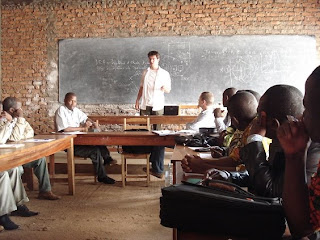
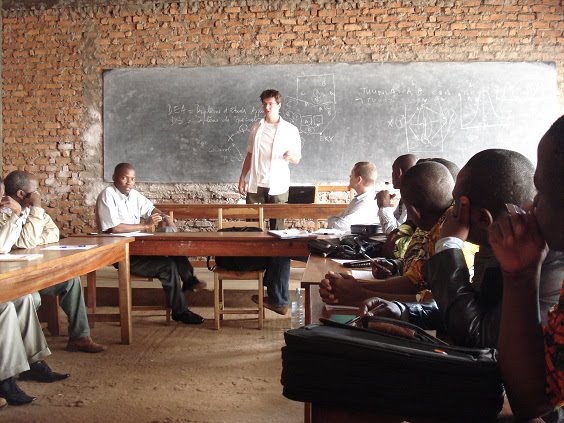
- Raul and I will split up in a week; I will be responsible for and living in the provinces Maniema and Sud Kivu; Raul has the provinces Tanganyika and Haut Katanga. The idea is that each of us will have a 'counterpart' with whom we will work closely together and train along the way for two reasons. 1. While we will leave the Congo in January, the evaluation continues for another half a year; the counterparts can take over from us. 2. It's a perfect knowledge-sharing opportunity. Raul and I will learn a lot about the Congo, and we can learn them about statistics, computer programs, etc. We want this counterpart to be a Doctoral student. So, Raul and I first presented the development project (Tuungane), which was then followed by a discussion about how the best evaluation would look like - in the meantime Raul and I checked carefully what they were saying and whether there was somebody that could be a counterpart.
- Needless to say, Raul and I also wanted to get to know Congolese academics - for us to see what they are working on and vice versa. So we had brief presentations of our research topics and after each we had several minutes of discussion. Raul and I presented our dissertation topics; Raul discussed the institution of the dowry, and I talked about migration and public good provision.
Sunday, September 12, 2010
Seminar at the Official University of Bukavu.
Sunday, September 5, 2010
It's great to be a ... PhD Candidate.
Saturday, September 4, 2010
Nerdy thoughts from the Congo.
- The other taxi drivers. Let's say that the taxi-driver knows from experience that there are more fast drivers than slow ones. As a result, the best strategy could be to become a slow driver because many potential customers are not picked up by the fast ones. So it could be that the distribution of fast and slow drivers is important.
- The mood of the driver that day. Maybe there is nothing rational to all this. Maybe after a fight with his wife in the morning, the taxi-driver is angry and thus puts the metal to the gas a bit more than otherwise. Thus, maybe a taxi-driver doesn't choose either one strategy for the rest of his/her taxi-driving career. One step further, maybe what is actually happening is that a driver has some mixed strategy where he drives fast some days (or hours) and slow the other.
- Reaction speed of the driver. If a taxi-driver is quick to react, he is less likely to miss potential customers. Consequently, these guys are maybe more willing to become fast drivers.
- Volume of the horn. Maybe what is important is the volume of the horn. If it is possible from a long distance away to notify potential customers that you are coming they have more time to walk to the road, and it is thus less likely you will miss them; i.e. you are more likely to be a fast driver.
- Any more?
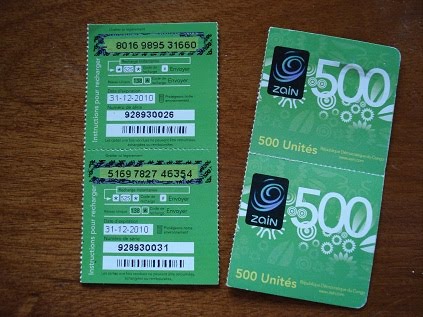
- These cards seem to be valid for a year.
- Let's say there are a total of 1 million Zain users in Congo.
[the DRC has a population of around 60 million people. Most of the country doesn't have coverage, but the big cities do. While Bukavu has only about 300,000 inhabitants, other cities are substantially bigger. The capital Kinshasa, for example, has 10 million inhabitants. So, let's run with 1 million Zain users for now.] - Every week I use about 6 of these 500 unites pieces of paper; or 30 of them if would buy the 100 unites. While I don't call much, I am a Mzungu and very rich so let's say on average people use 10 of these pieces of paper per week. That is, per year at least 520,000,000 times (1,000,000 * 10 * 52) those 13 digits numbers are used.
- It's possible that Zain doesn't introduce these unites on the market at the beginning of the year, but gradually throughout the year. Also, we have to take into account that once a person uses one of these 13 digit numbers it can't be used anymore. However, we also have to take into account that there should be many more than the 0.52 billion pieces of paper around because sellers needs reserves.
- So, let's say that around half a billion of these 13 digit numbers work and we know that there are 10 trillion (10^13 possibilities).
- You see where I am going?
- 1 out of every 2,000 tries should give you a hit. That is, on average every 2,000 times you enter a 13 digit number you earn yourself a dollar.
- Many people in the Congo have cellphones. Many people are also unemployed. Filling in a 13 digit number takes less than 10 seconds, so every hour you can try around 400 times. In other words, when working an 10 hour day you earn yourself 2 dollars.
- IDEA: What about hiring 100s of people, giving them a list with 1000s of unique 13 digit numbers on it and they can keep 100% of the profit.
- BUT: I'm sure Zain must have thought and calculated this through; it would have been relatively easy for them to put 14 numbers on the cards instead of 13. I am still curious though.
Wednesday, September 1, 2010
Blogs and websites I like.
- Africa is a Country: Blog on Africa.
- African Arguments: Blog by the RAS and SSRC on Africa.
- Alex Engwete: Very informative blog on the Congo.
- Chris Blattman: Great blog on international development.
- Congo Blog: Blog on... Congo.
- Congo Siasa: Incredible blog on Congo by Jason Stearns.
- IRIN News: UN news on development issues.
- Project Syndicate: Ideas by some of the brightest minds in the world on development.
- Radio Okapi: News on events in the Congo by MONUSCO.
- Rootless Minds: Blog by friend and colleague Raul (until January with me in the Congo).
- Relief Web: Informative website on development issues.
- Solo Kinshasa: Blog about Kinshasa - capital of the DR Congo.
- Texas in Africa: Great blog by Laura Seay on development issues with a focus on the Great Lakes.
- Wronging Rights: Brilliantly sarcastic blog on development issues by (a.o.) colleague Kate.
- Wired Science: Great blog on sciency things.
Monday, August 30, 2010
Back from Buja. Back in the velvet prison.
- Man, I'm getting older. When 'young' you see those 'older people' that have cars, houses, proper salaries, etc. The guys in Buja had this - and I am of that age now. I never really notice it; I'm a PhD student and thus still study and don't really have a salary. I also live in New York where most people rent and live in small apartments. But people of my age are getting married, start making babies, getting mortgages, etc. I never really thought of that until Buja. Scary.
- On the way to Bujumbura we drove through Uvira, a territoire of Sud Kivu in DR Congo. The car drove over 100km per hour on roads where one really should not do that. The reason was for security. I don't know how much of it is true but the driver told us that different groups (Mai-Mai, Banyamulenge from Uvira's Haut plateau, etc.) have a tendency to high-jack cars on that road. I am not sure what was more frightening the idea of being ambushed or the car being high-jacked, or the driver driving 100+ km an hour. :)
- On the way to Bujumbura we also drove through the town of Sange, where about two months ago a truck caught fire and killed over 230 people (here). Congolese friends sent horrible pictures in the days after that. The burned-out truck was still there; as a horrible monument to the disaster.
Wednesday, August 25, 2010
Crows in the Congo.
No, we're not going nuts. Raul and I work a lot at home. It's a bit unsocial but we are much more productive when we do not work at the office; at home there are no people around to shake your hand, there are no people that start talking to you, etc. However, in Bukavu there are a lot of crows; and they are noisy. They scream a lot. Moreover, we hear them walking/jumping on the roof; indeed, the tin roof-plates do not help with that. On average there are two of them in the garden and one on the roof and it's (really) annoying when you try to concentrate; something we do once in a while.
Monday, August 23, 2010
Training & Object #2.
- Us presenting the project itself (goal of the evaluation, why a behavioral measure, etc.);
- Preparing and training from hardcopies;
- Training on how to use a PDA (most of the forms will be filled out on PDAs: saving literally 100,000s of pages and decreasing data-entry mistakes);
- Training how to use the GPS devices we'll give them;
- Training on how to drive a motorbike;
- Training the supervisors on how to use the laptops we'll give them to upload the data;
- And all of this should be combined with discussions, games, etc.
Friday, August 20, 2010
An afternoon on Lake Kivu.
- My hair was cut the day before yesterday by... myself. Because we don't trust Congolese hairdressers (we have muzungu-hair), we bought ourselves a 2-dollar scissor. Result? Well, there is a reason why you don't see me on the pictures above. ;)
- I miss taking a shower. It is not that I miss the consistent flow of warm water over my body, but normally during those few minutes underneath a shower I have my best ideas. Unfortunately, these days I am too busy throwing water from the bucket over my head to think. Anybody a suggestion?
Wednesday, August 18, 2010
Object #1
Tuesday, August 17, 2010
Party and Conference (part 2).
Party
Last Friday we threw a party at IRC Golf 8; our house. Grant would leave the next day; back to New York. After working together for over a month we are really sad to see him leave. I know this sounds lame, but it's true; Raul, Grant and I formed a great team. In addition, Macartan who had been in town for over two weeks would leave the Monday after the party. Macartan in town means hard work, but also learning lots. He is a really special professor. He gives Raul and me lots of responsibilities and as a result we're motivated and work hard. We (of course) also make mistakes, which he knows and then spends lots of time (much more than if he would have done it himself) explaining how things can be done better. We learn so much that way! Next to that it is great to have breakfast, lunch, dinner and drinks with one's professor and talk about other things than work. Finally, Grant had his birthday early August, Vera (our housemate) mid-August, and Raul and me have our birthdays the end of August. Reasons enough for a party, no? So we hired a Congolese band and with well over 60 people – from the IRC, different other NGOs, MONUC, the security guards, IRC drivers, etc. – we danced until early in the morning.
Great people (fltr: Grant, Guillaume, Stephanie, Raul, me, Vera, Macartan, JB).
Conference (part 2)
Over the last few days I was able to get hold of a few more conference (August 6 & 7, see previous post) pictures:
Thursday, August 12, 2010
Conference & Fun stuff.
- IRC and Care presented their work
- The Columbia Team presented the evaluation (yes, I gave a presentation in French)
- We all went over the hypotheses
- We discussed the quality (and the feasibility) of the measures to answer these hypotheses
- The Columbia Team provided the timeline (which villages when) and together we discussed its feasibility

Monday, August 2, 2010
Why do we need a church?
Monday I took some hours off from work to go to Bukavu's Cathedral Notre Dame de la Paix (Our Lady of Peace) – the largest church in Bukavu and also the Archbishop’s seat. I was invited by a friend - Amuli - who was ordained as priest the day before and Monday he gave his first full-fledged ceremony. It was quite a happening; there were lots of people, part of the ceremony was that Amuli baptized 3 babies, there was lots of music and thus also a lot of singing and dancing. I also tried the latter. I really tried; but failed considerably. Take clapping one’s hands. This should be easy; one listens to the music and claps along. Not so for a Dutch guy: I mechanically moved my hands sideways and then calculated how much time it takes before they need to be back again in order to clap at the same time as the people that were standing next to me. Anyhow, it was a beautiful ceremony, I had a great time and am very impressed by Amuli.