Tuesday, July 20, 2010

The Joy of Fieldwork.

Fieldwork is fun for a number of reasons. First, one escapes the ivory tower of academia and sees the theories one normally reads about in books in practice (or – and this is more likely – one sees and experiences how wrong these theories (and you) were on so many points). Second, one flies to exotic places and gets to meet interesting people (do make sure you choose your dissertation topic correctly!). Third, and very important, one gets to dress in green and drive around in 4x4s and on motorbikes like a modern day Indiana Jones. But the fourth and nicest thing about fieldwork is how it combines both the intellectual and the practical. Let me give an example that recently arose.

At the moment we are piloting the evaluation of a large development project (TUUNGANE) in four Congolese villages; in two months the real evaluation will start in 560 villages. For this evaluation we want to interview 10 randomly selected people from a village-meeting of which the size is not know ex ante – people normally move in (arrive late) and out (get bored) of the meeting. So, how does one randomly select 10 people from a group of which the size is not precisely known ex ante? Needless to say, the approach should be theoretically sounds (i.e. a proper randomization) and also be easy to implement. For example, just asking “I need 10 people” and then taking the first ten people that show up, while practically easy, is not theoretically sound because those ten are unlikely to be a representative sample (when the number of village meetings go to infinity).

We came up with four different techniques.

1. Randomize the people-approach.
The people in the village-meeting take each one piece of paper from a bag or a bucket; the pieces of paper have a number on it that ranges from 1 to X, where X is the highest number of people that ever could be present (this can be higher than the actual people present). After distributing the pieces of paper, one can say out loud “number 1”, “number 2”, “number 3”, etc. until there are 10 people. While it is not necessary one can also do this a bit more sophisticated by creating a list before entering the village that has randomly selected numbers that can then be said out loud. The list could look like this:

# Lottery number
1: 120
2: 76
3: 5
4: 65
… …

Needless to say, in both cases it is in possible that a number that is read out is still in the bag; this is no problem because you then just read out the next number on the list. While this approach sounds great in theory, in practice it is more complicated to implement for three reasons. First, handing out numbers is associated with prices (like handing out lottery tickets) and people therefore rush to get more than one piece of paper. This could get chaotic quickly. A solution to this would be to line up everybody or be very orderly. Second, as we noticed during the pilot and what we should have know ex ante: not all people can read. A solution would be to have large numbers on an A4 paper and instead of shouting for example “122” hold up the A4 paper “1”, “2” and “2”. The third problem is that selecting people by making use of numbers has a connotation in Bantu tradition with witchcraft.

2. The x plus fixed interval-approach.
This is an approach we have used with previous randomizations. In brief, one randomly selects the first person and then have a fixed interval to select the other nine. In other words before entering the village one creates a list that gives for each meeting size (#people) a randomly selected number to start (Start Number) and the interval that needs to be used to get 10 people. The list would look like this:

# people Start Number Interval
… … …
121: 12, 12
122: 101, 12
… … …
130: 90, 13
… … …

It is ok that we do not precisely know the number of people present (as long as we don’t expect person 130 and 131 to be very different). In first instance we thought this (and the next) approach is theoretically wrong for the following reason:
“For example, let’s say that there are 130 people in the village-meeting of which 14 are elderly men. From experience we now know that these will stand or sit next to each other. Because the interval in this case is 13, you will always select an elder; i.e. the probability of an elder being chosen is 100%. However, if one would really have a clean random strategy there is only a 14/130 chance to select an elder.”
Upon further reflection we noticed that the above reasoning was wrong and that this (and the next) approach does theoretically make sense. The reasoning was wrong because one does not select one person, but ten times one person and thus one chooses an elderly with 10*14/130 change; i.e. larger than one.

3. Decrease the problem-approach.
Select every 10th person in the village meeting (or every 15th if the group is very large). Let’s say that you then end up with 40 people selected; now one knows the exact amount of people present and things are easy. Place 30 white and 10 red pieces of paper in a bag and let them take one. The people with a red piece of paper stay for the interviews. However, like the first approach things could get chaotic. How to make sure that only those selected 40 will come to you. A solution could be to give them a piece of paper. In addition, in first instance we thought (and we thought wrongly) that this approach was also not theoretically sound for two reasons:

“The technique has the same ‘fixed interval’-problem as approach 2. In addition, the starting number would have to be randomized. Let’s say you always start counting in the first row or the person sitting closest to you. Let’s say again that in a 130 people village-meeting there are 14 elderly in the village and they are the ones that sit on the front row. As a result, one of them will always be selected among the final 40 and will thus have an overall 1/40 change of being selected, while it should be 1/130. This also holds for when you start with people that are in the last row, in the middle, etc.; i.e. problematic if we expect people to be different on where they sit (something that we can’t assume away).”

4. Meeting size list-approach.
Because we thought 2 and 3 were not sound, we came up with approach 4. A list is created before entering the village. This list has for each size of the meeting (# people) ten randomly selected numbers (Ten Numbers) for the people that will be selected. The list could be like this:

# people Ten Numbers
… …
121: 12, 34, 56, 61, 64, 78, 95, 100, 101, 120
122: 23, 25, 34, 45, 46, 49, 67, 89, 100, 122
… …

Then one counts the number of people present. Say one count 121 people you then select person “12”, “34”, etc. Under this system it is not important if you are completely correct on the village size; it doesn’t matter if you choose row 121 or 120 in the list (i.e. count 121 people or 120 people); as long as you think person number 121 isn’t very different from person number 120.* In addition, people are allowed to move around a bit around. Even if they do it in a systematic way it is ok, because the number chosen has been done so randomly. Upon further reflection this technique is similar to approach 2, but without the fixed intervals.

* Do note that if 140 people are counted while there are actually only 130, it is possible that a number between 131 and 140 pops up; i.e. a number that does not exist in the village meeting. Solution: Continue counting at the beginning (i.e. number 12 if there are 121 people present). This gives no bias as “12” had been selected randomly.

We also wrote a little bit of code in the computer program called "R" that gives this list when one would like to randomly select 10 people:

seed = 20100715
max.size.meeting = 500
set.seed(seed)
size.of.meeting = 10:max.size.meeting
get.ten.random.people=function(j)
{sort(sample(1:j, 10, replace=F))
}
for.all.sizes = sapply(size.of.meeting, get.ten.random.people)
t(for.all.sizes)
x <- t(for.all.sizes) village.size <- 10:max.size.meeting cbind(village.size, t(for.all.sizes))
data <- cbind(village.size, t(for.all.sizes)) data<- as.data.frame(data) names(data) <- c("size", "1", "2", "3", "4", "5", "6", "7", "8", "9", "10") View(data)

Conclusion
In the end all four approaches are theoretically sounds. After piloting we think that approach 1 is easiest to implement. All in all, this was one of those examples that shows the fun of fieldwork. One has a practical problem and has to find a solution. It is intellectually challenging: think through a proper randomization technique, write some nerdy computer code, etc. However, at the same time one also has to think about the practical implications of one’s theories (something academics hardly ever do), one even meets barriers that go back to cultura, and (again) one can dress in green and drive in 4x4s and on motorcycles to check out whether your ideas work! Fieldwork. Awesome!

Monday, July 19, 2010

We're busy...

... very busy playing frisbee.

And getting it off the roof (fltr: Raul and Grant).

Saturday, July 17, 2010

Back in the Congo.

Finally my first post from the Congo. On July 8 we crossed the Rwanda - DRC border at Rusisi and have been busy since. We’re in Eastern Congo to evaluate TUUNGANE: one of the world’s largest community-based development programs. The evaluation itself is also one of the most ambitious in the world; the program has been set up as an RCT, we have an incredible behavioral measure, and it is big; very big. In upcoming weeks I will (of course) write much more on the details.

For now we are busy with (among others):

  • Piloting the behavioral measure that will be implemented in 560 villages;
  • Getting geo-locations of 7,000+ villages in Eastern Congo (40+ people are now in the field for this);
  • Cleaning the data from the 2007 baseline survey;
  • Preparing the final survey which will be conducted in 1,120 villages (expected to receive information on over 40,000 people);
  • Preparing databases and computer code for the evaluation;
  • Organizing a 4-day workshop to collect information on the 2007 baseline survey;
  • Organizing a 3-day conference with implementers and international academics to discuss the evaluation;
  • Hiring 60+ people for the evaluation;
  • Training these 60+ people;
  • Buying 16 motorbikes;
  • Preparing 60+ PDAs for data collection.

This of course next to tens of smaller things: contact with the implementers of TUUNGANE, contact with Caroline and Macartan (both are working from abroad but arrive beginning August), paperwork, socializing with locals and ex-pats, and I’m taking French classes three times a week (and after that Swahili). In other words: All awesome stuff!

Last Monday and Tuesday we were in the field. [1]

I am here with two colleagues from Columbia University forming the ultimate power team. Raul (third-year economics PhD, blog here) and Grant (incoming Political Science PhD, blog here). Grant will be here until mid-August; Raul and I will be here until January 2011.

[1] This picture is made in front of a Mai-Mai flag. Mai-Mai is a form of community-based militia group often formed to defend their local territory against other armed groups; mainly against invading Rwandan forces and Rwanda-affiliated Congolese rebel groups. These groups popped-up especially during the Second Congo War (1998-2003), but many are still around exploiting the country's instability for their own advantage to loot, rape, etc. The driver told us that this flag (which was planted next to one of the main roads in Sud Kivu's territoire Walungu) belongs to the Mai-Mai group of General Padiri; seen as the most powerful and well-organized Mai Mai groups.

Thursday, July 8, 2010

Peter finally techs up.

So not only will I cross the Rwanda-Congo border today with 3 netbooks, 7 GPS devices, 5 digital cameras, a Kindle and 2 external harddrives, I am particularly happy about the following four things.

  1. Don’t laugh, but I only found out recently that I have internet on my phone. About two weeks ago in Nairobi I was cursing (again) that I had no access to my email. Within 2 minutes a friend of mine got it working on my phone. Nice!
  2. I have installed Gmail Gears. That is, I now have 10,000+ of my emails with attachment on my computer. I can also write my emails offline and then it sends them out when there is internet. Ha!
  3. Knowing that internet is down often in the Congo, I have purchased a USB modem in which I can place a cellphone simcard and use internet. Awesome!
  4. Finally, and this is the coolest, via my phone I can send myself an email and then it will appear as a post on this blog. Knowing that in upcoming months I will be in the field often where there is definitely no internet, this rocks.

Wednesday, July 7, 2010

Perception of the (African) native.

Since recently I have a Kindle, which is a fantastic device when one reads a lot and travels. I just finished Michele Wong's "In the Footsteps of Mr. Kurz" [1] and am currently reading Marcus Roberts' "A Journal of a Tour in the Congo Free State" [2]. The latter was written at the turn of the century; the previous century!

It is a very interesting read. Roberts clearly defends Belgian involvement in the Congo (even dedicating the book to Leopold II). In addition, throughout his book he is very paternalistic to the African natives. In first instance I thought “ that must have been the Zeitgeist”, but after spending three weeks in South Africa, I am sure many people still feel strong for some of the quotes below:

"The natives however prefer all food in a high stage of decomposition and it is some time before the very smell of it ceases to make one feel ill. To see them eating kwanga fish or the flesh of elephants, monkeys, antelopes or other animals generally both rotten and raw is most disgusting and brings home the fact sharply that man here is of a very low type."

"Some traits of the native’s character were now to be demonstrated to us. His main idea always is, to do as little work as possible and he will often take the greatest trouble in his effort to accomplish this object. Each native endeavored to put his load as near the gangway as possible which was soon blocked and then he had to come back, hoist the package on his head again and carry It to its proper place. Although this performance took place every day, unless an officer was constantly on the watch, the foolish fellows in their attempts to shirk duty brought upon themselves extra work."

"Then to bed, but not to sleep, for the boys to save themselves trouble, had not fixed the mosquito net properly. In my innocence I merely ordered them to do it and had not stood by and watched. It is indeed necessary always to see that the native does as he is told, for the moment one’s back is turned, he is eating if there is anything rotten enough at hand to tempt him and if not, he quietly goes to sleep. Even the State’s servants who speak the native language and also a kind of French, really live the lives of animals, for they eat, drink, and sleep if left alone and only work when they are shown how, and watched all the time."

"In the midst of breakfast we are startled by the report that the ship is on fire, and smoke is seen to be issuing from the fore hatch, under which much of the wood used for fuel is stored. None of the Europeans, however, are more excited than the natives, who, leisurely and with due deliberation, hand up buckets of water. Nothing indeed could make a native hurry."

"This military education is certainly the best that could be given to a savage; it teaches him punctuality, regularity, obedience and collective responsibility; it shows him how to build houses and keep them clean it gives him an idea of justice for he knows he will be punished for wrong doing. The soldier therefore soon becomes an altogether different person and realizes that he is no longer an animal-man living wild in the forest, but a soldier-man and a friend of the great “Bulamatadi” who governs the country."

"They are really just like young children and are easily pleased by trifles."

Tin Tin in Congo. Had to think of this while reading the book.

Finally – and on a completely different note - the following quote is for Simon with whom I was in the Congo the first time for several months in the summer of 2010. Simon – to say it carefully –was not the biggest fan of goat:

"Above all things, remember curry powder, pickles, chutney and Worcester sauce, for even goat’s flesh can be rendered pleasant if it tastes of something else."

References

[1] Michele Wong. 2002. In the Footsteps of Mr. Kurtz: Living on the Brink of Disaster in Mobutu's Congo. New York: Harper Perennial.

[2] Marcus Roberts. A Journal of a Tour in the Congo Free State. 1905. Brussels: Lebègue.

Tuesday, July 6, 2010

Post Scriptum (after South Africa).

A final post on South Africa; this one from Nairobi Airport where there is free wifi (just like at Kigali Aiport). Schiphol, Newark, JFK, Heathrow, and all those other European and US airports: do you hear that! Free internet!

In contrast to many people Roy and I did not have a pre-organized trip in South Africa, did not fly from city to city, and did not stay over in hotels. First, this was much cheaper. Second, because this was for both me and Roy the fourth time in the country we felt comfortable not knowing where we would end up the next day. Ex post we are so happy we did this; we have slept in so many different places, met such nice and friendly South Africans* and were able to experience part of their lives.

In Durban we stayed at a nice B&B where a young couple just started managing it and did everything to make us feel at home. In Plettenberg we had one of those real backpackers places. In Capetown we slept in Kathryn’s living room and met her friends. In Bloemfontein we lived in an Afrikaner family’s house with the rest of the family. In Amanzitoti we stayed in an empty backpackers where the owner lived as well. In Uitenhagen we stayed in a beautiful B&B, and in Pretoria we stayed with Jaap and Dora where we were received as their lost sons.

All these people were so hospitable and with all of them we talked much - and often until late in the evening. It helped a lot that Roy and I speak and understand Afrikaans. There were two common themes. First, people perceive the state of South Africa to be worse since 1994: crime and corruption were the keywords. Second, the World Cup is seen as having brought black and white closer together. Now let's hope it is enough and that it will last. Anyhow, it was really special for Roy and me to have been part of that! Also, a few more days to go and the Dutch will have the Cup.

* That is, we have met and interacted mainly (and unfortunately!) with white South Africans.

Last days in South Africa (Total kilometers driven: 6,320)

Thursday
We left Amanzitoti early in the morning as we had a long drive ahead towards Uitenhagen. The latter is a small town about 20km from Port Elizabeth (PE); the city where the Dutch would play Brazil the next day. After a beautiful 1,112 kilometers we arrived around 9pm in the bed and breakfast where, because it was full, Roy and I cozily shared a bed. The next day I heard that I am a persistent snorer; sorry Roy.

Friday
Early in the morning after a healthy breakfast of baked eggs with bacon, we left for the Fanfest where – once again – before noon thousands of people were dressed in orange, drunk and singing. We walked (again) in a parade towards the stadium where we magically beat the Brazilians by 2-1. It was so amazing to have experienced this event! After the match, because we don’t know PE well, we asked a group of orange-dressed people where we could find beer and celebrating people. They said “At our place”. Half an hour later we were with lots of people at a party of a group of Dutch-supporting South Africans. Such a nice evening!

Saturday
After way too little sleep and too much beer the day before we were in the car once again: with a 1,070km to Pretoria ahead. Roy and I have lived in Pretoria for more than half a year and consider it home. We stayed at Jaap and Dora’s place; close friends of my grandmother who moved to South Africa about 40 years ago. When I studied in Pretoria they were my surrogate family. Jaap en Dora are so sweet and although we only called them the day before we were welcomed with open arms.

Sunday
Because I am heading from South Africa to the DRC, Pretoria was the last place to buy stuff. A pair of trousers and my belt passed away, and for some children of Congolese friends of mine I always like to take study books and material along, I had to do my favorite activity: shopping. Luckily Roy and I are efficient and in no time we were out of the shopping mall again and had time to spend time with Jaap and Dora; who had cooked a great dinner and had invited more of the family because ‘Peter and Roy were back in South Africa’. It was so nice and talked until late in the evening.

Monday
At 2pm from Johannesburg’s OR Tembo Airport I got on my flight to Nairobi where I am currently writing this post. Tomorrow I meet up with some friends and then at 6 pm I have a plane to Kigali where Raul and Grant (fellow PhDs) have been working for the last few days. Then on the 8th we’ll cross the border together into the Congo; definitely more adventures ahead. Roy took a plane a few hours later to the Netherlands where he will marry Faten in less than 2 weeks. They met each other in South Africa six years ago. I am so happy for them; and hope I ever get as lucky as Roy.

Orange parade to the stadium.

Brazilians clearly afraid for our Robben.

We won from Brazil!

Some Brazilians handed us the Cup. It will be on Roy's bookshelf in the years to come.

Tuesday, June 29, 2010

Into the quarter finals.

Yesterday the Dutch played the 1/8th final against Slovakia at 4pm in Durban's gorgeous Moses Mabhida stadium. Madhiba was the leader of the South African Communist Party, but he was also important in the development of the South African Congress of Trade Unions (SACTU) and the ANC; especially their armed wing Umkhonto we Sizwe. Btw, for the people who haven't read Nelson Mandela's "Long Road to Freedom", please please do! Anyhow, we dressed up in orange, drank beer, sang to bad Dutch music, and won: 2-1. The next stop is is Port Elizabeth around 1,000km south where we will play Brazil on July 2.

And we're back in Durban.

We had great seats. He! Jack van Gelder.

Robben (maker of 1-0) out, Elia in.

Huntelaar (great striker) warming up.

And what an absolutely gorgeous stadium!

Towards Durban (Total kilometers driven: 4,085).

Capetown & Bloemfontein (Friday & Saturday)

If the Dutch were second in the group they would play in Pretoria (1/8 final) and Johannsburg (1/4 final); cities where we still have lots of friends. ‘Unfortunately’ we won everything so this Monday we play Slovakia in Durban. Thus: to Bloemfontein (around 1,000 km) on Saturday and from there to Durban (around 600 km) the day after that. The preparation for the trip was rather bad. On Friday evening Kathryn threw us a party at Marcus and Laura’s place; Marcus (from Finland) works at UCT and Laura (from the UK) studies there. After a great dinner with fresh fish we drank lots of wine and were in bed only around 330am; so we had a full three hours to sleep before driving. We had such a nice time with Kathryn and friends in Capetown, though.

FLTR: Marcus, Laura, Roy, me, Kathryn, Kevin.

We drove through the beautiful winelands of the Cape and through the Karoo Desert – While listening to Mafikizolo, Johny Clegg, Papa Wemba, Freshly Ground, Daby Toure, etc. – and after 1,017 kilometer arrived around 8pm in the Afrikaner stronghold Bloemfontein. Bloemfontein is the capital of the Free State province and also South Africa's judicial capital (administrative capital is Pretoria and the legislative capital is Capetown). Free State used to be the Orange Free State: one of two independent Boer republics during the second half of the 19th century.

Because Germany played the UK in Bloemfontein on Sunday it was difficult to find accommodation. However, via via we found a place at a very nice Afrikaner family that lived in a large house with a swimming pool, bar, several hectares of land around his house, etc. He used to be a rugby player for one of the big national teams. While sitting with him, his wife, and his son and daughter at the bar we talked until late about politics, the state of the country, etc. They were proper Afrikaners and for people naïve about the country's histories, clearly racist. However it was impressive to see the effects of the World Cup in a country where there is still so much animosity between black and white, and where the whites play rugby and cricket, and where soccer is a sport for the black people. The family was telling that they got interested in soccer due to the World Cup and actually watch some games on the television. The son (around 25 years old) was telling how he went to a match of Nigeria and sat next to black people and went partying with them in the evening... and actually had a good time.

Durban & Amanzitoti (Sunday)
Because accommodation in Durban is either booked or very expensive and because it is not a nice town we booked a hostel in Amanzitoti; around 20 kilometers south of Durban. I know this area quite well as six years ago I obtained my PADI diving degree in Umkomaas – another town around 10 kilometers south of here. In front of these cities in the ocean lies the Aliwal Shoal; one of the best dive places in the world. After yet again a very comfortable ride and picking up the tickets for the next matches of the Dutch at Durban’s King Shaka international airport we arrived around 7pm in the hostel; we unfortunately had to listen on the radio how Germany beat England.

The Dutch mobile.

Towards a victory (Monday)
It’s now early Monday morning. I’ll be dressing up in orange in a bit as the Dutch have to play at 4pm against Slovakia. I woke up this morning opened my curtains and looked out on the hostel’s swimming pool in the front and the Indian ocean in the back: awesome!

Those are the views.

Random
  • There are so many speeding lights on the road and everybody consistently speeds, so much money is collected. In first instance we were cursing at them (and we still do) but we also see their benefit. First, of course, it (hopefully) makes people less willing to speed. Second, especially for developing countries it is difficult to collect taxes (see here for something I wrote on this years ago); money collected from speeding tickets could a good way to contribute to tax revenue: people choose themselves whether to speed or not, and while crude its very progressive because especially the rich drive cars. Anyhow, I’m sure Roy and I already contributed our fair share to South Africa’s the national budget.
  • Roy and I ate the best burger in the world! Place to be found: Mama’s Foodcorner in Hanover, a city only 821 kilometers outside on the N1 from Capetown to Bloemfontein on the N2. Well worth the trip.
  • Because I’m heading to the Congo on July 5th for 6 months and visit some other countries on the way my wallet is filled with Kenyan Shillings, Congolese Francs, Rwandan Francs, euros, dollars and South African rands. Yesterday after dinner the waiter ran after our car because I left shillings instead of rands. Sorry (that was already the second time I did that)!
Wallet.

  • I really dislike shopping so I randomly grabbed two jeans out of my closet when I was packing for the Congo; assuming they would survive six months there. Unfortunately one of them didn't even survive three weeks in South Africa. I wish I was trendy then holes in one's trousers is cool. Now I have to go to the shop. :(
Trousers.

Friday, June 25, 2010

Cape of Good Hope, and 2-1.

Tuesday
Early in the morning we left for the Cape of Good Hope. On our way we passed by Boulder Beach and watched penguins chill out on the beach, and take a dive into the Indian Ocean when they want to. Around noon we arrived at the Cape of Good Hope; which is not (as commonly thought) the most southern tip of Africa (the southernmost point is Cape Agulhas) nor is it the dividing point between the Atlantic and Indian Oceans. The Cape of Good Hope, however, marks the psychologically important point where by boat one begins to travel more eastward than southward. We did an hour hike and sat on a large rock hundreds of meter high and sat down. It was great!

Penguins...

on the beach.

And a submarine in the back (we were close to Simon's Town - a naval base).

Lots of baboons.

And amazing...

amazing views.

At 4pm the United States had to play Algeria; a match we wanted to see for two reasons: 1. Roy’s fiancée is Algerian, 2. Fang and Evans are in Cape Town and asked to watch the match together. I know Fang and Evans from Columbia where both just finished their PhD in economics. After the US winning 1-0 after scoring in the first minute of the extra time, we had dinner at Spur and went to bed early for the day to come.

Friday
It was going to be one of those Dutch days again. After dressing up in orange and taking public transport into town, Roy and I arrived at the Fifa Fan Fest around 11am; beer was already flowing and bad Dutch music was already playing. Because the match would only start at 830pm Roy and I sat down in a corner with a few beers and read a book. By the time it was clear Italy was kicked out of the World Cup (say around 5pm), the number of Dutch had gone up to over 18,000 people! Yet again a sea of orange. At 6pm we walked in parade to the Stadium where we won with 2-1 from Cameroon. Late in the evening all streets were filled with orange (and a little yellow, green and red from Cameroon). The atmosphere was - yet again - so amazing!

Sea of orange.

Roy, me, Fang.

Many Dutch...

clogging up the streets.

Beautiful stadium.

And towards the 2-1.

Random:
  • Completely forgot to tell this. During our drive from Durban to Plettenberg we got a speeding ticket. Around East London somebody jumped in front of our car and directed that we had to go to the left; something we didn’t as we thought the guy was nuts. That guy happened to be a police officer who then chased us with blue lights on the high way, giving us a speeding ticket (we drove 140 instead of 120). It was a very friendly cop though.
  • In addition to Fang and Evans, I also met Joost in South Africa (in Durban actually a few days ago). I know Joost from my time in Tilburg University. I saw him uploading pictures of the World Cup on Facebook, I sent him an email and a few days later we met up. It is such a small world.

Wednesday, June 23, 2010

Cape Town (Total kilometers by car: 2,348)


Monday

We woke up early and had a comfortable ride to Cape Town. The views – yet again – were incredibly beautiful. Cape Town is where the Dutch play Cameroon on Thursday, where Roy and I have been before six years ago for about 2 weeks, where Roy and I will now stay for about a week, and... Cape Town is the city where Kathryn lives. Kathryn is a good friend with whom we studied in Pretoria six years ago; she is from the United States, studies and works at the University of Cape Town (UCT) and we stay at her place for the days to come. So, after 572 kilometers we arrived around 7pm in Newlands; the area of Cape Town where Kathryn lives. We then watched the gorgeous Green Point Stadium and Table Mountain from Kathryn’s boyfriend’s roof, and finally caught up on so many things over dinner. It’s good to be back in Cape Town; the city where the Dutchman Jan van Riebeeck arrived in 1652. After almost 400 years the Dutch are back. And in the thousands!


Amazing views.

High quality roads.

And weird Dutch people.

Tuesday

We took a minibus to city center and from there had a 20 minute walk to the Waterfront. This was not advisable six years ago, but so much has changed; something I hope will outlast the World Cup. After some sightseeing, Roy and I had breakfast (with a view on either Table Mountain or the ocean depending which way one’s head is turned), I finally had internet to upload some posts with pictures, reacted to so many people who cheered “Hup Holland” after seeing my overly ugly orange shirt, went to the hairdresser (I finally do no longer have to wear a cap), and we met Neels. The latter is a big Andre Rieu-fan. Roy’s girlfriend wants to give a nice present to her parents so she found tickets for a sold-out Andre Rieu concert in Maastricht. The tickets could be picked up in… Cape Town. We had a few beers with Neels – who brought those tickets – and he invited us to a proper South African braai with him and his friends and family on Saturday. I love this country!

Yep, Dutch flags in the top left and Table Mountain in the background.

At 4pm South Africa had to play France; we watched it on the big screen at Waterfront with several thousand of South Africans. Except for those vuvuzelas it was yet another great experience with so many people in such a good mood – especially knowing the South Africans were playing very well (final score 2-1). At around 8pm Kathryn had finished work, joined us for dinner and we had some beers with her and her friends in a bar in the area Woodstock. Yet again, what a great day; with such great weather and such nice people!


The harbor on the left.

And Table Mountain on the right. Great!

Tuesday, June 22, 2010

Towards Plettenberg (total kilometers by car: 1,776)

On Sunday we left Durban early. The Dutch have to play Cameroon in Cape Town upcoming Thursday – almost 1,800km away from Durban. We're driving that distance in two parts: so up to Plettenberg Bay for that first part: 1,149km in one day. The drive was incredible! The weather was fantastic, the views (again) were amazing, and the atmosphere throughout the country was absolutely incredible. People in cars (from so many different countries) consistently wave and smile at each other, and there is so much police around and all are so willing to help (we, for example, had an escort through the city Umtata).

Escort by South African police through Umtata.

Needless to say, the trip from Durban to Plettenberg had Dutch overtones: many Dutch in Dutch-decorated cars, South African police along the way were waiving Dutch flags, and even South African tollbooth employees were dressed in orange. An absolutely incredible drive! After many (many!) hours in the car Roy and I arrived in Plettenberg around night. After two well-deserved beers and game of pool, Roy and I went knockout.

Tollbooth's in orange.

One of many...

many Dutch people on the road.

And even...

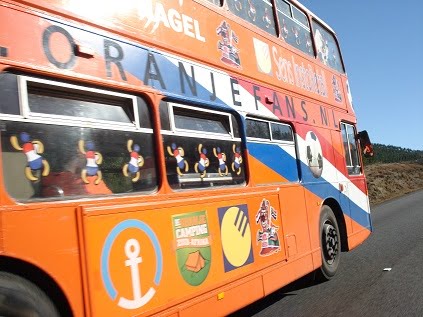
complete orange buses.

Three random things:

  • South Africa really invested a lot over the last few few years. The roads are incredible and there is so much police around.
  • Radio 2000 (the English-language sport channel) has such bad commentary. Roy and I ended up listening to RSG (Radio Sonder Grenzen): the Afrikaans-language channel.
  • I'm back in this area after six years (a long time ago I spent time in Knysna and Cape Town with my ex-girlfriend Jana).