Friday, July 17, 2009

Back in Bukavu.

Attention. Boring post ahead.

Yesterday we flew – via Moba and Kalemie – from Lubumbashi to Bukavu; back ‘home’. We left L’shi early in the morning. At around 12.30pm we arrived at Kivuma – the UN military airport – and at around 2pm, after a bumpy carride, we were back in our office at the IRC compound. We are here for only another two weeks; and still so much work is to be done. Just to give a flavor:


Because some things from the 2007 baseline survey were missing in our dataset we need to go back to the hardcopies and get that information into the computer. Today we hire and train a person to do exactly that; for 3,000 hardcopies! This job is going to take him weeks. Anyhow, we are: preparing a contract, checking exactly what we need from the hardcopies (this is a lot of work; there are two types of questionnaires and each with more than 150 questions), building a template to fill out, getting cash in via Western Union, arranging a laptop, office space, etc.


We just came back from L’shi where we – next to trained and piloted the final survey – trained the TUUNGANE boss and the M&E officer how to take GPS-coordinates - and waypoints, record tracks, etc. – by making use of GARMIN GPS devices and satellite phones. This is not too easy as we try to synchronize everything across four provinces, but there are many different projections of the world, within each projection there are different ways to take the geographical coordinates, etc. We also explained how to use specialized software (ArcGIS). We are currently writing templates and dummy-guides for the provinces.


An important thing in Haut Katanga was to clean Haut Katanga's LLU-data: yep, I will write what this is in the near future. Anyhow, the data was a mess and even together with the current and former M&E officers of Haut Katanga we couldn't clean it. Now we are making a template for all the territoire and chefferie bosses to fill out.


Today we will also train our Project Coordinator for the Phone Project; the latter is now officially know as “Voix des Kivus”. Tomorrow and the day after we will be in the field to implement the project in the first village (after that 3 more to go). This means: preparing contracts, yesterday afternoon we bought two additional mobile phones (we already bought 10 at an earlier stage), getting the specialized software to work, setting-up templates for reporting, finishing codebook, translating documents from English to French and from French to Swahili, getting car and driver (this is a non-IRC project so we have to do all the work ourselves), getting security briefings, arranging money-issues, preparing the village presentations, making marketing material (Macartan made a cool logo), etc.


Anyhow these things – and a 100 hundred smaller things – have to be done before Monday because we will be leaving for yet another week to another province; we are leaving to Kindu – the capital of Maniema province. After we come back from that: 4 more days left...


[I will upload some pictures and random notes later on today. Internet is to slow at the moment].

Tuesday, July 14, 2009

After being in the field.

Yesterday.
The last two days we were in the field. Yesterday we were in Mose; a village with a TUUNGANE project. IRC already build a bridge and will start building a "centre de sante" in about two months. Vincent and Wivini piloted the final survey; this has to be done randomly. As a result, for villages with less than 50 houses we need the following very scientific tools: crayon and a deck of cards. First, all houses are numbered. Then, divide the total amount of houses by the number of surveys one wants to conduct. From the deck of cards draw a card and then conduct the survey in the household that has the number on the card and in the households that have this number plus a multiple of the calculated number.

Thierry in action:Wiveni in action:
While Vincent and Wivini did their surveys (three each), Simon and I interviewed the villagers starting with the chief. Because most people were in the fields and only expected back at 2pm we asked the chief whether he could send somebody along with us so that we could visit the fields and have a look - we are curious PhD-students in the end. It took 45 minutes to get there and 45 minutes to get back. In the burning sun. Why are we so curious again? We then had talks with the women and then with the men.
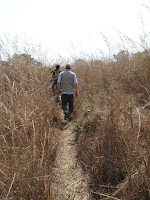
Towards to fields: Simon, Sherif (TUUNGANE boss for this chefferie), and Patrice (TUUNGANE M&E officer for Haut Katanga):
Today.
Today we went to a village that does not have a TUUNGANE project. Because we want to evaluate the impact of TUUNGANE in the correct way only having a survey before the project (2007) and after the project (2011) in the TUUNGANE villages is not enough. Maybe there are things - different than TUUNGANE - that took place in these villages between 2007 and 2011; e.g. economy went up. To separate between these general effects and the TUUNGANE effect one also needs to have surveys in so-called control villages; i.e. villages that also existed in the 4 years that TUUNGANE was in place, but did not have a TUUNGANE project. The village of today was such a control village. Because it had more than 50 houses - and doing the surveys randomly is crucially important - we used even more scientific tools that yesterday: crayon, a deck of cards and … a stick. One goes to the center of the village draw the different directions of streets on the ground and throw a pointed stick in the air. The street the stick aims at is the street that will be numbered; same process again. Things went also smooth today. Vincent and Wivini were great. Simon and I had our interviews with the chief, the women and the men. And Patrice - the TUUNGANE M&E officer here in Haut Katanga - joined so he could see how we do it and we went over the survey with him in detail. We are training him so that he can go to Tanyanika and do it with a team there; we, unfortunately, won't be in the DRC much longer.
Number 47:

Number 44, could have been Obama's house:
Quite a few notes on last two days:
- The village today had a lot of IDPs. They were from the war in 1996. They came all the way from Bukavu and Moba.
- The villages are small. People live close to each other. The walls of the houses are thin. I do not joke if I say that I have a camping feeling when I sit on the ground and talk to villagers (picture: Dutch guy, caravan, camping, etc.).
- Life in these villagers is centered around food and water; around survival. People wake up at around 5am and go to the field and work till around 2pm. The women then start preparing food and collect water (this takes hours). In the meantime the men do nothing. Then in the evening the family can eat. It is incredible, I am already pissed off if I have to walk to the supermarket less than 10 minutes away. And I do my shopping within 15 minutes and only twice a weak.
- Here in Lubumbashi mainly copper and cobalt is mined. We see many trucks heading to Tanzania and Zambia when we are on the road.
- Children here do not scream “MONUC, MONUC”, they just wave. By the way, a white person sitting in a car has a self-imposed "waving-duty".
- Still on the Dutch guy being frustrated (I am going to get at the bottom of this). People in these villages again said: We need a school, etc. So, this time we asked why don’t you build a school yourself? There is (wo)menpower, there is wood, etc. First answer: "We don’t know how to build it". We said that we didn't belief that, because they can build houses. They then gave another answer: "We don’t have the money to pay the teachers". But, all the men are just sitting around doing nothing in the afternoon! I am still frustrated.
- One of the big problems here is that the soil is not fertile. All villagers complained about this. After quite a bit of asking we got to know that - already for decades - the villagers cultivate THE SAME fields. I learned many years ago that that doesn’t work. Each year - of several fields - one has to let one field lay fallow; i.e. should not be cultivated. If a field is constantly cultivated the soil gets devastated!
- All NGOs constantly ask questions like "What is wrong in your villages?" "What do you lack?" Etc. Unfortunately, also we do. But we think this must give a bad feeling to the villagers, maybe make them start thinking about stuff they miss that they never thought off before, etc. So, we always try to end on a positive note and therefore end our interviews with the question "What are you proud off in the village?" Interestingly, or unfortunately, this seems also the most difficult question to answer. The last village said “we have nothing to be proud of.” :(
- The villages we visited are about a 2 hour car drive away from Lubumbashi. While signal was bad several villagers had a cellphone. We asked them where they charged it, and consistently - and in both villages - they said Lubumbashi. Note: these people do NOT have a 4x4 to get there.
- Funny - or actually sad - during the survey some people said that TUUNGANE wasn’t managed well. The reason: because they didn’t receive part of the money themself.
Four final random things:
- We found our blog on another website (www.congonewschannel.net). Our blog is between post from Reuters, Reliefweb, Bloomberg, CNN, Wall Street Journal and Allafrica so it should be ok. However, it is also between posts from the Episcopalchurch, Brooklynrail, and ... Foxnews.
- There are two big brewing companies in Lubumbashi at the moment. Brasimba is here since about 80 years. Then about a year ago Bralima joined and started a marketing war. At the moment the colors of these two companies are literally at each corner of the street.
- I wanted to write this down since the trip to Buyakiri, but I constantly forgot. Because the FARDC (the government army) has little money and because the Belgians left their warehouses full with army stuff when they left in the 1960s, currently many FARDC soldiers walk around with Belgian flags their jackets.
- And a final picture for all the ladies. Ahh. How sweet (and tasty on a fire with some bbq sause):

Sunday, July 12, 2009

Message from the cleanest guy in L’shi.

After 40 days of cold, early-morning showers, I undertook action. Yesterday morning I mobilized all the water-taps in the house, collected all the pans, turned on the stove, gathered all the buckets I could find and even put the small water boiler – that we use for tea – to work. After half an hour of intensive work and walking tens of times to the bathtub and back with pans and buckets, I had… a lukewarm bath with the water standing at only 17 centimeter high. I was also reminded that I don’t like baths; too boring as I can’t sit still for more than a minute.

This morning, therefore, I undertook a different approach. There we go: Boil water in the water boiler and put it - together with cold water - into a big bucket until the latter is full with nicely warm water. Place the bucket in the bathtub and stand in the bucket (nicely warm for your feed). Then with a cake-mold pour water over your body. If one does the latter slowly, little water is wasted as it returns, via your body, into the bucket. Of course, there is a trade-off because more warm water going over your body at any particular time is nicer. Of course, after shaving, washing, etc. pouring water over ones body gets boring. The nice thing of this approach is that at the end the bucket is still relatively full, and one can throw all the water over oneself in one go. Absolutely brilliant!

Some final random notes:
- Several days ago, Simon and I watched the movie "American Gangster"; a great movie. Large chunks of the moview take place in Harlem - my neighborhood in New York. The church, for example, where Denzel Washington gets arrested, is the big white church right at my street corner on 120th and Lenox. Really nice to be far away from home and then to see your neighborhood.
- The sound that goats make, makes Simon happy.
- Did you know that the Bible comprises 24 books for Jews, 66 for Protestants, 73 for Catholics, and 78 for most Orthodox Christians.
- In Bukavu it is not possible to just go for a walk, and certainly not without first notifying the radio room. Yesterday, Simon and I took advantage of the fact that the security situation is substantially better in Lubumbashi. We went for a long walk. Finally interacting with locals. I spent some time in the church (a ceremony was taking place and the singing was amazing):

There is a large copper mine nearby (Lubumbashi is known for the mining; especially copper):


We passed by a stadium, several schools, tried to avoid goats and chickens that were running around in garbage, etc. It was fantastic. I really missed just walking around and interacting at the fly with locals; something I really enjoyed when I was in South Africa. This morning, for example, we bought the eggs for our breakfast at a shop (read: 4 pieces of wood kind of tied together) in our street. Constantly living in an ex-pat bubble as we do in Bukavu is not very nice. Finally, the view on our neighborhood (we live somewhere among those houses in the back of the picture):

Saturday, July 11, 2009

How to get a Dutch guy frustrated. Part 2.

Some days ago we went out for dinner with Mark; the very friendly IRC TUUNGANE boss here. I told him about my frustration with the seeming lack of contribution by Congolese people to public projects. [See the July 6 post “How to get a Dutch guy frustrated”]. Mark said that he was also frustrated about this when he arrived in the Democratic Republic of Congo. He said, however, that he heard about two reasons that could possibly explain it (and that calmed him down in the months after that):

1. There is war, rebel groups, etc. in the Democratic Republic Congo. Consequently, it is likely that if you build e.g. a school it will be destroyed. As a result, people simply do not think long term.
2. From 1965 to 1997 Mobutu Sese Seko was in power. This guys sucked (and the West kept him in power); taking as much as possible from the country for himself. He and his government employees – who were also known as “gros legumes” – are the example cases of kleptocracy. If one builds e.g. a school, it was expropriated by the state.

So, is peace and a non-expropriating state the answer? And if this is now so ingrained in Congolese society how long will it take to get it out?

One additional thing on point 2 – I heard this from somebody in Bukavu and checked it only just now – there is the understanding that Mobutu had an article (article 15) added to the Zairian constitution when he was in power that instructed government agents to “debrouillez-vous”.* That is, “fend for yourself”. Incredible! This also makes me look very different now at the famous words in Kennedy’s 1961 Inaugural Address “Ask not what your country can do for you, but what you can do for your country.” ;)

* Actually, such an article was never really written down in the Zairian constitution. However, Crawford Young and Thomas Turner - two famous Africanists - did find a provincial document that did literally instruct the authorities to “debrouillez-vous”. This was the province of South Kasai.

Friday, July 10, 2009

I should be working.

I know it is still in the afternoon and I should be working. Trust me, I have (and will this evening). At 8am we were at the office. Thierry and Wivine were waiting when we arrived. Thierry and Wivine are two statistics student at the University of Lubumbashi. Today we trained them for piloting the final survey. Upcoming Monday and Tuesday the four of us will be in the field. All in all, things went very well. We finished around 4pm. Funny thing: Simon and I took them for lunch – a good way to have an informal talk and get to know each other a bit. We asked the driver to bring us to a place nearby. We ended up at the KFC. Well, that is: the Katanga Fried Chicken. :).

Anyhow, in the meantime we also worked on the LLU data for Haut Katanga – one day I will explain what that is – together with the M&E (monitoring and evaluation) officer. Bottomline: this data is in an absolutely horrible shape; I don’t even want to use the word ‘shape’. We are here – among others – to clean this data, but it is a mess. I therefore need a break now; so hereby a post with again some completely random things:

We have at least five people here in Haut Katanga working for us. Simon and I share a house together; indeed, how horrible. We have a cleaning lady. We also have a security guard (probably several). In addition, the IRC assigned three drivers to us – standby to drive us around: 7am-3pm it is Fredy, 3pm-23pm it is Ben, and 23pm-7am it is Vincent.

The day before yesterday we went to the supermarket. Yes, a real supermarket. Being Dutch I rushed to the cheese corner to see whether they sold cheese. They had even 4 different types! To my big suprise, one of them was Gouda Komijn. This is fantastic for me, but the fact that it is easier to buy Dutch cheese in Lubumbashi than Congolese-made Goma cheese is really bad.

To all the people out there with warm showers: we envy you! We are at around 40 days with cold showers and still counting.

This morning we had a chat with the driver when we passed by a big building that was called “June 30th”. The driver explained that June 30th is the Congolose day of independence. I thought of the other days of independence that I know off: July 4 (US), July 1 (Canada), July 14 (France), and September 16 (Mexico). Interestingly, all took place in the summer. Why the summer? Is it because people have holiday, they are out on the street, it it is warm, etc. and therefore people are more likely to rebel? Wikipedia (http://en.wikipedia.org/wiki/Independence_Day) has a long list with 149 days of independence. If you look at the months you get the following:


There seems to be happening something in the summer, but it is not very convincing. Maybe I am a bit sloppy: summer above the equator does not take place at the same time as the summer below the equator, one probably has to control for several other things (e.g. what caused the fight for independence, type of independence, type of colonizer, is the neighboring country fighting for independence, etc.), etc.

Thursday, July 9, 2009

From Bukavu to Lubumbashi.

Woke up at 5am yesterday. Reason: at 630am an IRC car picked us up for the airport (and I still had some emails to send before that). We were heading to Lubumbashi; capital of Haut Katanga.

Leaving Bukavu.
We flew from Bukavu’s airport; called Kivuma Airport. The airport is about 1.5 hours from Bukavu by 4x4 and difficult to reach. Why? We think it is for security reasons. Kivuma airport is an UN military airport; the UN has airlift, the FDLR has not. Anyhow, because it is military airport we were instructed that it was strictly prohibited from making any pictures. Therefore, please find here some pictures:


The airport did not give us a comfortable feeling: there were mostly plane wrecks and old Russian helicopters and planes around. Luckily we had been able to arrange two seats in a European Commission plane. At around 830am a Bombardier Dash 8 Series 100 with a European Union flag landed. Then after about a 1.5 hour flight we arrived in Kalemie – the capital of the province Tanyanika. The city – and the airport – is situated right next to Lake Tanyanika. Also here was a MONUC base; together with more helicopter wrecks and several UN Antonov 24RVplanes. The terminal was not in a too good shape. Simon said that the terminal is even worse than the ones at Charles de Gaulle - he shouldn't push it of course. Check out the terminal:
Us being cool (check out the EU flag in the back):

Kalemie to Moba.
After an hour we left for Moba; a flight of 30 minutes. The latter is by far the coolest airport I have ever been. That is, it is the coolest runway I have ever landed on. That is, it is the first time I have actually landed with a plane on a dirt road. By the way, did anybody see the movie Lord of War? The ones who did; remember that episode when Nicolage Cage is forced by Interpol to land his plane on a dirt road; we did the same thing; and we weren’t even forced. Anyhow, the view was absolutely stunning. The dirt road, mountain ranges on three sides around us, and then the flag of the European Union.
That's a terminal:
Arriving Lubumbashi.
Another flight of around 1.5 hours brought us to Lubumbashi. At arrival, an IRC car was literally standing next to the plane to pick us up. At Lubumbashi Airport cars are allowed to drive on the runway. Compared to Bukavu, Lubumbashi is extremely developed. The roads are paved! Even more incredible: there are not many holes in it! And, to top it off, we saw a working traffic light! Yes, really! We heard later that Lubumbashi is only one of two cities in the Congo with a working traffic light; the other is Kinshasa – the country’s capital. Also, mom, the security situation is completely different here. It is safe; no fighting going on around here.

Some completely random notes:
- Yes, it is me saying this: Goma cheese is quite nice cheese.
- Yesterday evening we went for dinner with Mark (IRC's TUUNGANE provincial director) and Claire and we saw goat testicals on the menu. Simon and I didn’t have the balls to order it.
- We went for dinner at the Hellenic club. Apparently there are many of those in the DRC. We ordered Chinese food.
- We didn’t write it the day before yesterday, but last Monday we bought the first 10 phones for the phone project. We wanted to buy 12. The shop owner first told us how amazing his store was and that he doesn't give fake phone chargers to his customers as they stop working after a month. Anyhow, we wanted to buy 12 phones. However, he couldn't find 12 related chargers. We therefore said: We buy ten now and come back next week for the other two. He replied: But I can give you fake chargers. :)

Tuesday, July 7, 2009

Message from IRIN.

http://www.irinnews.org/Report.aspx?ReportId=85170

:(

Monday, July 6, 2009

How to get a Dutch guy frustrated.

By now I have visited quite a few villages in the east of the DRC. In each of them I see the same thing. We come in and we talk with the people. In all cases (of course) we get a laundry list of things they want: a school, electricity, a community house, a water system, etc. This is not the thing that frustrates me; I can understand. If I am poor and a rich white guy arrives in my village in a car with an NGO sticker on it and wants to talk to me, I would do exactly the same. What frustrates me is the following. After a talk in which we hear how dire the situation in the village is (which it really is), the people (especially the men) go back home and sit in front of their hut and do absolutely nothing for the rest of the day; except for chatting and eating sugar cane. Build a school!! Arrange electricity!! Build a community house!! Build a water system!!

Why are no public projects undertaken??*

[People that are idealist please stop reading now].
If I ask people who know this country much better than I do and who have been here for many year what the problem of this country is (why is it so poor), I hardly ever hear things like rebel groups, war, property destruction, etc; issues that I expected to be important before arriving here. People – both locals and ex-pats – say most of the time that the problem is ... the attitude of the Congolese themselves; I hear from many people that they are lazy and they are selfish.

Firstly, is this true?
Secondly, if it is, why is this so, and if it is not, what is it then? Is it the so-called learned helplessness? Do the people in the east of the Congo think "if we don’t do it, probably a few white people from an NGO will do it"? Do they expect the government to do it (something I really doubt)? Why don't people undertake these public projects? Is it the famous free-rider problem? Is it culture? Is it because of decades of repression by the Belgians, and after that by Mobutu?

I just can’t wrap my head around this. Being from a Dutch construction-building family and with a very strong mentality of getting one's act together and work one's ass off, this is really really frustrating. For a researcher, however, it is also really interesting.
I see these poor people living in these horrible conditions. And they just sit there. Why?

* I should be a little bit careful, though. Once or twice I did see some people working on improving the "road". These are, however, just a few villagers out of many. And exceptions.

Sunday, July 5, 2009

Phone Coverage


Look! It's like T-Mobile's coverage of New York City.

Field trip to Walungu.

Yesterday Simon and I returned from being two days in the territoire Wulungu. More specifically, on Thursday to a village called Burhuba. Vincent and Usseni were going to pilot the final survey questions, we were going to talk with villages. One final test-run in the church before entering the village (left to right: Usseni and Vincent):

In Burhuba TUUNGANE is building a school:
Simon in action. Talking with the villagers:

The territoire Walungu is known for it's tea:
From Burhuba there is one mountain that absolutely rocks. It has one tree on top:
After we finished our focus groups (talking with men, women, children), we had to wait for a while for Vincent and Usseni to return. In the meantime I kicked some Congolese football-ass:
We stayed over in the church and the next day we went to the village Ikumbana. Simon working (that white guy in the middle with a laptop):

These are the balls used by the children (made out of plastic bags):


On our way back to Bukavu. After a great two days. The best team ever:

Regarding manioc, sorghum, windmills, corn and wheat.

The principal food for villagers in the east of the Congo is foufou; made from manioc or sorghum. The latter two are roots. In order to get foufou one cuts up the roots, dry them and then mill the roots into powder. The latter is extremely time-consuming (and hard work); taking about 6 hours a day.


Anyhow, people (obviously) were complaining about this. In first instance I thought “this is no problem as labor is cheap in Africa”. So many kids are being born each day. However, more kids also means additional mouths to feed (and therefore more manioc and sorghum to mill); so my reasoning doesn’t hold. Productivity per person has to increase.


I was thinking about this while a strong wind was blowing into my face. Being Dutch, I thought about… windmills! I’m serious. In these villages there are enough trees for wood, there are enough big stones around that can be used to make grinding plates, many of the men do little more during the day than sit in front of their huts so there is labor to build the windmill, and most important it is often very windy.


Of course, one has to get these men interested in building a windmill; getting them to provide effort for public goods seems to be a very big problem in the Congo (I will write on this more in future posts). Also, one has to make sure that the villagers ‘understand’ the windmill so that they can repair it when things break down. Except for these two problems which – I am quite sure – can be overcome, I couldn’t come up with any other reason why not to think about this more. So, I pitched my idea to some people that have been in the DRC for years. And, of course, I had overlooked something.


Foufou is not good for villagers; it doesn’t have any nutritional value. Foufou is like white bread; it only makes you feel “full” and that is it. Instead of building a windmill and let the villagers eat more foufou, the villagers should be growing corn and wheat. Firstly, these crops also grow in the east of the Congo. Secondly, corn and wheat, in contrast to manioc and sorghum, do have nutritional value. Finally, and important, they do not need hours to prepare. My next question, of course, was: “Why aren’t the villagers growing corn and wheat then?”


It happens to be the case that manioc and sorghum are extremely easy to grow. Manioc and sorgum is like weed and doesn’t take any time to cultivate. One goes to the field, get the roots out of the ground and you’re done. Corn or wheat, on the other hand, takes a bit more time to cultivate.


But, of course, I reacted that this is not a solid argument. If you spend 1 hour more a day cultivating corn or wheat, but spend say 4 hours less per day on preparing, you still win 3 hours! So, again, why not start growing corn or wheat?


But, remember, this is Africa. Who cultivate the crops? And, who prepare the food? Well, especially the men cultivate the crops, and especially the women prepare the food. The men – being the boss – have, as a result, no incentive to implement corn or wheat. Why would you implement corn and wheat if that means you have to work an hour more per day!?


Africa. Incredible.

Wednesday, July 1, 2009

Training, IRC and three great blogs.

Let’s see. We woke up early today. Although we already worked on this for several days, we still had some i’s to dot and some t’s to cross. That is, over the last few days Simon and I – while having contact with Macartan in New York City – wrote the new questions for the final survey.


Today we trained Ussaire and Vincent; the two M&E (monitor and evaluation) officers of the IRC in Sud Kivu. We’ll do the same with the M&E officers in Tanyanika, Maniema and Haut Katanga. We’re flying to the latter next Tuesday. We started off with lunch to break the ice. With some fried bananas and fish from Lake Albert this went perfect. Then the following hours we discussed the survey questions, let them fill out the questions, explain how to randomly select households (one uses chalk and a deck of cards. Yep, really), do interviews, etc.


Tomorrow we will wake up early again. We do a final test round of interviews at 730am and then we head into the field. We arranged an IRC car and driver, packed our bags, and picked a TUUNGANE and control village. We should be back on Friday. Btw, regarding cars (we are still boys in the end):


In total I think the IRC has about a hundred of 4x4s in the DR Congo - most of them based here in Bukavu:

They recently got a few new ones (check the guard tower in the back and the UNHCR tent to the right):


Finally some completely random notes:


- The IRC, because it is a US-based organization, has to comply with US terrorism laws. One of these laws requires that all US-based NGOs do not have contact with terrorists. Sounds ok. However, the US also wants to doublecheck this. Funnily, this means that the US wants to know of each and every TUUNGANE village who the members of the development committees are. Most of the latter see a white person about once every year. I am sure that they are in a US database somewhere. :)

- People in the east of the Congo do not like Rwandans (understatement). For the people that know the history of the Kivus (let me not start on this one, because it is a very long story) this is understandable. Moreover, many Rwandans think the US supports the Rwandans (How else can such a small country be so powerful? They argue). Many Congolese think that Rwanda wants to take over the east of the Congo (minerals, overpopulation of Rwanda, etc.). Rather unfortunately: The IRC is a US-based organization. To make things worse, the IRC-Congo office used to be under the umbrella of IRC-Rwanda office. Consequently, many Congolese therefore thought that IRC stands for Intervention of Rwanda into Congo. But to make things even better: IRC Sud Kivu has since recently a new boss... he is from the US and his wife is Rwandan.

- For the map-nerds among us. We track all our trips with GPS-devices. So we have these really cool maps saying exactly where we have been. Yesterday we found out how to put these in Google Earth. Super cool!


- Finally, three absolutely great blogs that actually each deserve a post on their own:


1. http://chrisblattman.blogspot.com/

2. http://www.congoresources.com/

3. http://texasinafrica.blogspot.com/