Wednesday, June 23, 2010

Cape Town (Total kilometers by car: 2,348)


Monday

We woke up early and had a comfortable ride to Cape Town. The views – yet again – were incredibly beautiful. Cape Town is where the Dutch play Cameroon on Thursday, where Roy and I have been before six years ago for about 2 weeks, where Roy and I will now stay for about a week, and... Cape Town is the city where Kathryn lives. Kathryn is a good friend with whom we studied in Pretoria six years ago; she is from the United States, studies and works at the University of Cape Town (UCT) and we stay at her place for the days to come. So, after 572 kilometers we arrived around 7pm in Newlands; the area of Cape Town where Kathryn lives. We then watched the gorgeous Green Point Stadium and Table Mountain from Kathryn’s boyfriend’s roof, and finally caught up on so many things over dinner. It’s good to be back in Cape Town; the city where the Dutchman Jan van Riebeeck arrived in 1652. After almost 400 years the Dutch are back. And in the thousands!


Amazing views.

High quality roads.

And weird Dutch people.

Tuesday

We took a minibus to city center and from there had a 20 minute walk to the Waterfront. This was not advisable six years ago, but so much has changed; something I hope will outlast the World Cup. After some sightseeing, Roy and I had breakfast (with a view on either Table Mountain or the ocean depending which way one’s head is turned), I finally had internet to upload some posts with pictures, reacted to so many people who cheered “Hup Holland” after seeing my overly ugly orange shirt, went to the hairdresser (I finally do no longer have to wear a cap), and we met Neels. The latter is a big Andre Rieu-fan. Roy’s girlfriend wants to give a nice present to her parents so she found tickets for a sold-out Andre Rieu concert in Maastricht. The tickets could be picked up in… Cape Town. We had a few beers with Neels – who brought those tickets – and he invited us to a proper South African braai with him and his friends and family on Saturday. I love this country!

Yep, Dutch flags in the top left and Table Mountain in the background.

At 4pm South Africa had to play France; we watched it on the big screen at Waterfront with several thousand of South Africans. Except for those vuvuzelas it was yet another great experience with so many people in such a good mood – especially knowing the South Africans were playing very well (final score 2-1). At around 8pm Kathryn had finished work, joined us for dinner and we had some beers with her and her friends in a bar in the area Woodstock. Yet again, what a great day; with such great weather and such nice people!


The harbor on the left.

And Table Mountain on the right. Great!

Tuesday, June 22, 2010

Towards Plettenberg (total kilometers by car: 1,776)

On Sunday we left Durban early. The Dutch have to play Cameroon in Cape Town upcoming Thursday – almost 1,800km away from Durban. We're driving that distance in two parts: so up to Plettenberg Bay for that first part: 1,149km in one day. The drive was incredible! The weather was fantastic, the views (again) were amazing, and the atmosphere throughout the country was absolutely incredible. People in cars (from so many different countries) consistently wave and smile at each other, and there is so much police around and all are so willing to help (we, for example, had an escort through the city Umtata).

Escort by South African police through Umtata.

Needless to say, the trip from Durban to Plettenberg had Dutch overtones: many Dutch in Dutch-decorated cars, South African police along the way were waiving Dutch flags, and even South African tollbooth employees were dressed in orange. An absolutely incredible drive! After many (many!) hours in the car Roy and I arrived in Plettenberg around night. After two well-deserved beers and game of pool, Roy and I went knockout.

Tollbooth's in orange.

One of many...

many Dutch people on the road.

And even...

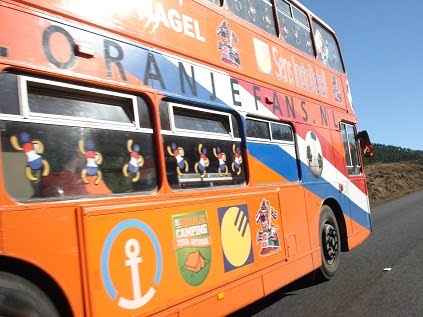
complete orange buses.

Three random things:

  • South Africa really invested a lot over the last few few years. The roads are incredible and there is so much police around.
  • Radio 2000 (the English-language sport channel) has such bad commentary. Roy and I ended up listening to RSG (Radio Sonder Grenzen): the Afrikaans-language channel.
  • I'm back in this area after six years (a long time ago I spent time in Knysna and Cape Town with my ex-girlfriend Jana).

Towards the 1-0 (Total kilometers by car: 627 km)

Friday

After a comfortable flight from Nairobi, I was back in South Africa – a country where I was an exchange student at the University of Pretoria almost six years ago. Roy – a fellow Dutchman with whom I studied during those months – was waiting for me; he had arrived 2 hours earlier directly from Amsterdam. After decorating our car with orange we were on our way to Durban where the Dutch would play Japan the next day. The road was fantastic (so much so that we expect to receive at least 3 speeding tickets), the weather was great, and the views were incredible. We arrived around 11pm in our hostel. After a few well-deserved beers in the hostel’s bar and chatting with the owners about Africa we went to bed; of course, extremely nervous for the next day. :)

Me in between the orange.

Amazing views.

Saturday

At 10am we were at the beach strip of Durban with.. at least two thousand Dutch people all dressed up in orange. The atmosphere was amazing! Bad Dutch music was playing, everybody was dancing, the beer sold in the shops around the event was finished before 11am, and Japanese that passed by were pulled into the crowd and were singing and jumping along in the sea of orange. At noon we all walked together to the beautiful stadium (singing and waving the Dutch flag), we saw the Dutch win with 1-0, and afterwards Roy and I spent our evening at a concert with African music. It was an absolutely incredible day!


The beach strip.


The beach strip with Dutch people.

Towards the stadium.

The stadium.

The anthems.

Towards another goal?
t
What a view.

African concert - awesome!

Monday, June 21, 2010

Back in Africa.

It’s Friday morning and am in the plane from Nairobi to Johannesburg. The last two days I spent in Nairobi. Reasons: 1. I have transited often via Nairobi but never left the airport, 2. Since recently a friend studies in Nairobi. Thus, time to stay a few days in Nairobi and get to know the city.

Wednesday
I arrived around 2am (Tuesday night) and Junior and Jubacae were waiting. Juni is Congolese, worked for the evaluation we undertake for the IRC in the Congo, studies computer sciences in Nairobi, and is the translator for the Voix des Kivus project. Juba is Chadian, a good friend of Junior, and also studies computer sciences. After dropping me off at the hotel they were back at 9am, having arranged a Kenian simcard and planned a busy day. After having breakfast at Juba’s place we visited a friend of them – Melvin – who lived out of the city. Sitting cramped in a small bus (picture of such a bus below) and having red dirt under my shoes again, made clear how much I’ve missed Africa.

Local transport.

After a long day in the city we were on our way back home by bus (a bigger one – picture below). Because people in Nairobi speak English we could gossip out loud in French. – and so we did, especially when two pretty girls stepped inside the bus. We jokingly said “Let’s get off at the same stop and ask them to join us for a coffee in the shopping mall”. We did. As soon as we got out the ladies turned around asked “where shall we go for coffee?”. One of them was from Burundi and spoke perfect French.

Junior and me.

After a coffee, the three of us had dinner at Juba’s place and then went to a bar to watch South Africa painfully loose from Uruguay with 3-0 and then to a popular Kenyan club where we met the two ladies again. It was a fun evening. I again did my utmost to prove that we white people can’t dance.

Thursday
After waking up early, we had a long walk through the city with Juda’s girlfriend joining us for lunch. We, among others, visited the parliament. Because Kenya is a former British colony the parliament is the same as the British Lower House from inside, and... there is a "Little Big Ben" standing right next to the parliament - just like in London.

Little Big Ben.

Me, Junior, Juda.

We again had dinner at Juba’s place. His dad is a high official for the African Union and works in Burundi. He lives with his mom and sister in Nairobi. They really made me feel at home (and his mom is a great cook). During the day we passed by the Kenyan IRC headquarters because I wanted to drop of some DRC-related material that I did not want to carry around in South Africa (netbooks, GPS devices, digital cameras, etc.). We were immediately invited by IRC’s country director to watch soccer in the evening; it was yet again a great evening. I was in bed shortly after midnight because at 5am a taxi would pick me up again for the airport.

Random things

  • While walking in Nairobi I felt as if in South Africa. The people speak English and it’s all quite developed.
  • Taking a bus in Nairobi is a great experience. On top of the above story, on Tuesday a drunk (but friendly) Kenyan tried to hook up with a South Korean sitting next to him. After she refused to give him her phonenumber he said “We will see each other again, because mountains don't meet each other, but people will."
  • Interestingly, Kenyans can see from which ethnic group their fellow country men are. Does this mean ethnic groups are not only constructed but are actually based on real differences?
  • Only the second day I noticed that we’ve been walking and driving on the left side of the road. Oeps!
  • Mom, I didn’t tell this on purpose before leaving. :). Last Sunday a bomb exploded in Uhuru park (2 minute walk from my hotel) - some grenades were thrown into a crowd of a few thousand killing several and wounding tens of people (here). The situation in Nairobi is a bit tense at the moment with an upcoming vote on a new constitution. Last Tuesday a large area of Nairobi was again blocked off because of an expected explosive device. For a little bit more information see below.

A bit of background
Since independence Kenya - despite the different ethnic groups - has remained quite stable. Things however changed for a while in 2007 when the presidential elections were rigged by the then president Mwai Kibaki - although it was clear that his opponent Raila Odinga had won. Targeted ethnic violence took place on a large scale and was directed against the Kikuyu people (the ethnic group of Kibaki). Also, some Kikuyu engaged in violence against groups supportive of Odinga (primarily Luos and Kalenjin). More information here.

Former-UNSG Kofi Annan was able to unite Kibaki and Odinga in a grand coalition government where both would share power: Kibaki as President and Odinga as Prime Minister. The new constitution - the vote takes place on August 4 - is a crucial part a reform package that was then made, aimed to heal the ethnic divisions that dominate Kenyan politics. The new constitution would limit the presidential powers and strengthen civil liberties. Both Odinga and Kibaki are supporting the document. Some, however, are afraid that the approval of a new constitution could pave the way for new alliances, threatening the current fragile coalition. Also, some senior politicians are spearheading a 'no' campaign because they are angry at the failure to devolve power to the regions and plans to cap private land holdings. And also the Christian church leaders are urging a 'no' vote because of a clause allowing abortions on medical grounds and the inclusion of Islamic courts dealing with divorce and inheritance.

Back to the Congo.

Since last Tuesday morning I am on my way to the Democratic Republic of Congo; with a detour through Kenya (a few days to meet friends) and South Africa (three weeks to support the Dutch team to the semi-finals). I will then be in the DRC for six months - coming back the end of January 2011.

So, because I am back in Africa, I will blog at Coding in the Congo in the months to come.

Saturday, June 12, 2010

Diversity.

So the Dutch parliamentary elections took place and the result is horrible (in total there are 150 seats):

Party Peter's summary Seats Change
VVD The liberals 31 +9
PVDA The labor party 30 -3
PVV The right 24 +15
CDA The christen-democrats 21 -20
SP The socialists 15 -10
GL The greens 10 +3
D66 The social-democrats 10 +7
CU The religious ones 5 -1
SGP The more strict religious ones 2 +0
PVD Yes, a party for animals 2 +0

The result is bad for two reasons:
  1. It will be difficult to create a stable government that survives to the next elections because the voters either went for very left or very right. Our queen now has to appoint an 'informateur' who will meet party leaders and try to come up with a solid government: i.e. a combination of parties that are like-minded, has a majority, and consists out of as few parties as possible.
  2. The biggest winner is the PVV. While they have some good points, they have many (many) bad ones: they want to stop (Islamic) immigration into the Netherlands all together, no money should be spend on development aid, and the role of the European Union should be diminished substantially. Why are so many Dutch people - almost 1.5 million of them - afraid of the rest of the world?
I like the following poster from Loesje:


Sunday, June 6, 2010

Purity and Exile.

I just finished "Purity and Exile" by Liisa Malkki - associate professor of anthropology at Stanford [1]. The book is based upon anthropological fieldwork done in 1985/1986 in Tanzania’s regions of Rukwa and Kigoma. Her subjects of study are the Hutu refugees that fled Burundi in 1972 when the the Tutsi-controlled Burundi army initiated mass killings of the country's majority group the Hutu; an estimated 100,000 people were killed.

After placing the massacre in historical context - discussing the long history of oppression and inequality between Hutu and Tutsi in Burundi - Malkki gets to the core of her argument: "The social and imaginative processes of the construction of nationness and identity can come to be influenced by the local, everyday circumstances of life in exile, and how spatial and social isolation of refugees can figure in these processes."

In brief, there were two groups of Hutu refugees in Tanzania. One group was settled in a carefully planned, physically isolated refugee camp in Mishamo. The other group lived in Kigoma - a city on Lake Tanganyika - outside of any camp context and dispersed in non-refugee neighborhoods. These two groups ascribed meanings to national identity and history, to notions of home and homeland, and to exile as a collectively experienced condition in very different ways. The "camp refugees" were constantly engaged in the construction and reconstruction of their (Hutu) history as a people. The "town refugees", on the other hand, had not constructued a categorically distinct, collective identity. Rather than defining themselves as “the Hutu refugees" or "Hutu", they tended to seek ways of assimilating and inhabiting multiple shifting identities derived or borrowed from the social context of the township.

An interesting read; the 352 pages were finished quickly.

[1] Liisa Helena Malkki. 1995. Purity and Exile: Violence, Memory, and National Cosmology among Hutu Refugees in Tanzania. Chicago: University of Chicago Press.

Thursday, June 3, 2010

Floribert Chebeya found death.

Floribert Chebeya - a leading human rights activist in the DRC - was found dead in Kinshasa, Amnesty said yesterday. He died of unknown causes after being summoned to meet the head of the national police force last Tuesday. Please see here for a little bit more information. Amnesty has called for an investigation into his death.

Floribert Chebeya

Sunday, May 30, 2010

Dutch elections and migration.


On June 9th there are elections in the Netherlands. We have 10 parties in parliament and they are quite different - we even have a party for animals in parliament [1] - so the different leaders battling over their party programs is great entertainment.

On May 19th Nyfer published a report arguing that non-western immigration into the Netherlands costs the Dutch government 7.2 billion euros a year. The report, commissioned by the PVV (the Dutch right-wing party) is here in Dutch. The reason is that these immigrants make more use of the welfare state and pay less tax than the average native. They are also more likely to be unemployed, criminal, etc.

I finally read the report (127 pages) while in the plane to the Netherlands. The report's scope is very limited; solely looking at the budgetary effects of non-western immigration on the Dutch government's budget. Given this the report seems solid.

Geert Wilders

Unfortunately (but expectedly), the PVV now uses it as ammunition in the Dutch election. To quote Geert Wilders - leader of the PVV - "Ten years of unchanged immigration policy means a cost of 72 billion for Dutch Society. The fact that mass-migration is also financially disastrous emphasizes the necessity of PVV's proposals such as an immigration stop for Islamic countries, a limitation on other immigrants and for upcoming 10 years not paying benefits to immigrants [own translation]."

Three things:
  1. How do we get Islamic countries to have a special treatment? That's only 1/3rd of all non-Western immigrants into the Netherlands!?
  2. In addition to the above, the PVV also wants to get out of the EU, get rid of the euro and stop all Dutch development aid. What world does he live in?
  3. I can't wait to start writing my dissertation. In Eastern Congo we find that migration is positively correlated with public goods provision. Can't wait to provide ammunition to PVV's opposing camps.
[1] The following ten parties are currently in the Dutch parliament (the ones starred are currently in the government):

Party Full name (in Dutch) Peter's summary Seats
CDA* Christen Democratisch Appèl The christen-democrats 41
PVDA* Partij van de Arbeid The labor party 33
SP Socialistische Partij The socialists 25
VVD Volkspartij voor Vrijheid en Democratie The liberals 22
PVV Partij voor de Vrijheid The right 9
GL GroenLinks The greens 7
CU* ChristenUnie The religious ones 6
D66 Democraten 66 The social-democrats 3
SGP Staatkundig Gereformeerde Partij The more strict religious ones 2
PVD Partij voor de Dieren Yes, a party for animals 2

That's science. From Dirk Jan.

A post from... the Netherlands, where I arrived last Wednesday (last week was therefore rather busy and thus no posts). To get things going again hereby a comic that goes to the heart of science.


Normally these "Dirk Jan" comics are about many different other topics: here another intellectually stimulating one, the sign reads "Men, please sit down while peeing".

Tuesday, May 18, 2010

USAID/QED conference.

It is 420am and I am at Penn Station; waiting for my train to Washington, DC. About a year ago we received a grant from USAID which made it possible to launch Voix des Kivus. I'm heading to a two-day "mid-term" conference - organized by QED - to present our project. Let's see.

Sunday, May 16, 2010

CAPERS.

CAPERS - the Comparative African Political Economy Research Seminar - is a joint NYU-Columbia Working Group for scholars of African political economy and development. It takes place once a semester, a maximum of twenty people attend, and working papers are 'presented'. That is, because people read all the papers in advance, the hour that is booked for each paper is spend completely on discussion. A total of six paper are discussed, there is lunch in between and dinner afterwards. Of those six papers 3 are from faculty and 3 are from students, each faculty paper has a student from the other university as discussant, and vice versa for a student paper.

Last Friday the 3rd CAPERS took place; this time at NYU (last time was at Columbia). As always faculty to student ratios were high (around 1 to 3), and because everybody was well-prepared and we know each other by now and thus we feel free to say what we think the discussions were great. Great to be in in a room with smart people discussing African political economy and development issues!

Thursday, May 13, 2010

MONUSCO. Where is that "O" coming from?

Since years the world’s largest UN peacekeeping force (currently around 20,000 peacekeepers) is located in the Democratic Republic of Congo; MONUC after its French acronym for Mission de l'Organisation des Nations Unies en République Démocratique du Congo.

MONUC HQ in Sud Kivu.
Picture Simon made when we were in Bukavu last summer.

Recently the Congolese government has asked for them to leave (here). Kinshasa argues that the UN is no longer necessary; most of the fighting is over and its own forces are ready to fill the gap left by MONUC's withdrawal. I am not the biggest fan of MONUC, but this is nonsense and the UN should stay: fighting is not over (especially in the east) and Congolese forces are definitely not able to fill the gap: most haven’t been paid in many months, the Congelese army is guilty of raping and killing civilians, etc. It is more likely Kinshasa wants them to leave for two other reasons:
  1. On June 30 the DRC will celebrate its 50th year of independence from Belgium; indeed, symbolically it is probably not great to the world's largest foreign force in your country;
  2. Elections are coming up - expected in July 2011 for the legislative and October 2011 for the president - and MONUC not only did most of the logistics in the last one, they also monitor.
A new UN proposal is now on the table. The United Nations will withdraw 2,000 peacekeepers by June 30 (oh so symbolically), but the remaining 20,000 leave only when security improves, France's ambassador to Congo - Pierre Jacquemot - said on Monday. He also said that MONUC may be renamed to include an "S" in the acronym as the organization is refocused on security and stabilization: "The mission of 'MONUSCO' will be focused on essential tasks: the protection of the population and the stabilization of peace." Great; another acronym to learn. Btw, where is that "O" coming from? Security is Sécurité and Stabilization is Stabilisation in French; so no "O"s there. Are we talking about COngo or maybe Observation = Observation? Pierre Jacquemot: HELP.